- RIYADH: In what can be called a historic moment for Saudi Arabia and Europe, the European Commission’s office in Riyadh will host the first meeting of European ambassadors to discuss foreign policy matters with special reference to Saudi-EU relations on July 4.
The meeting will be held for the first time at the premises of the Commission’s office as per the provisions of the Lisbon Treaty and not at the embassy of Belgium, which holds the EU’s rotating presidency from July 1 (today).
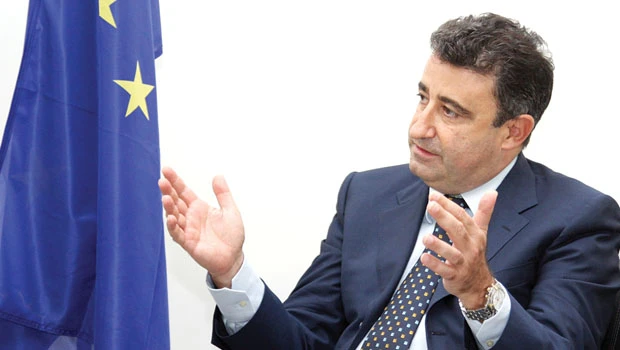
“All of the 134 EC’s delegations worldwide will have more teeth on foreign policy issues following the implementation of the treaty,” said Ambassador Luigi Narbone, chief of the EC delegation in Riyadh, on Wednesday. He pointed out that the ambassadors of all 19 member states of the European Union currently posted in Saudi Arabia would attend the meeting.
Narbone spoke on Saudi-EU relations and regional issues affecting the Middle East region, and predicted more intensive partnership between the EU and the region. He said that the EU was seeking a larger role on regional issues affecting the Middle East, including Saudi-EU issues and GCC-EU relations.
The EU has been an active player in supporting efforts to resolve the Israeli-Palestinian conflict and contributes — as a member of the Middle East Quartet — to the peace process, said the EC delegation chief.
He added that the EU and the GCC had also renewed their commitments to join hands in fighting terrorism. To this end, he referred to the call given by Custodian of the Two Holy Mosques King Abdullah to set up an international center to fight terrorism.
Referring to the GCC-EU ministerial meeting early this month, he said that the Gulf bloc and EU had also reaffirmed their commitment to fight terror financing. He said that the EU and the GCC as two major blocs had evinced keen interest in forging partnership. To this end, he pointed out that the recent EU-GCC ministerial meeting had endorsed a joint action program.
“The ministerial meeting, which was for the first time co-chaired by Catherine Ashton from the Saudi side, came out with a resolve to boost GCC-EU relations to a new high,” said Narbone.
The three-year Joint Program reflects “a shared ambition to reinforce cooperation in a number of key strategic areas of mutual interest,” he added. He pointed out that investment, trade, energy and environment, IT, education, transport, industry, telecommunications, scientific research, culture and mutual understanding are key areas of cooperation included in the joint plan.
Narbone pointed out that the EU was also cooperating with GCC countries in the field of nuclear safety. He said that the EU and the GCC have also agreed to continue their consultations on the free trade accord with a view to concluding the negotiations as soon as possible.
The EU established bilateral relations with GCC countries through a cooperation agreement signed in 1988, five years after the six-nation GCC was formed.
The objective of that first umbrella GCC-EU accord has been to contribute to strengthening stability in a region of strategic importance and to facilitate political and economic relations. It therefore aims to broaden economic and technical cooperation and also cooperation in energy, industry, trade and services, agriculture, fisheries, investment, science, technology and environment.