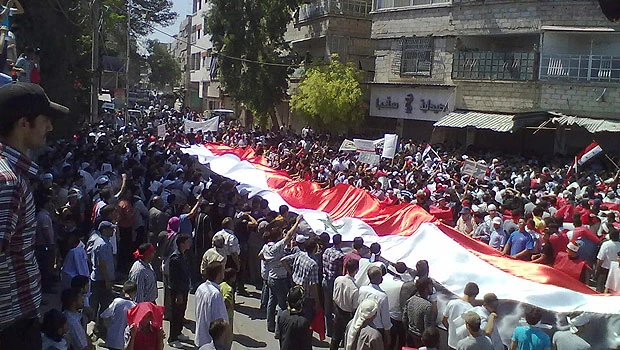
- AMMAN: Syrian tanks have deployed at the entrance to the city of Hama, activists and residents said Sunday, two days after it saw the largest protest against President Bashar Assad since an uprising began three months ago.
"Tens of people are being arrested in neighborhoods on the edges of Hama. The authorities seem to have opted for a military solution to subdue the city," Rami Abdel-Rahman, president of the Syrian Observatory for Human Rights, told Reuters.
Hama, 210 km north of Damascus, was the scene of the bloodiest episode in Syria's modern history, when troops killed up to 30,000 people in an assault in 1982 to put down a religious uprising against the iron rule of Assad's father, the late President Hafez Assad.
A resident of Hama said communication networks had been cut off in the city, a tactic that has been used by the military ahead of assaults on cities and towns elsewhere, and security forces and gunmen loyal to Assad were seen in several neighborhoods.
"They fired their rifles randomly this morning in the Mashaa district. Arrests concentrated in the areas around the football stadium and in Sabounia district," the resident, a shop owner who gave his name as Kamel, told Reuters by phone from an area outside the city, where telephones had not been cut off.
Assad sacked the governor of Hama province, Ahmad Khaled Abdulaziz, on Saturday.
The security presence had lessened in Hama since forces killed at least 60 protesters in the city a month ago, in one of the bloodiest days of the uprising against Assad. Residents said security forces and snipers had fired on crowds of demonstrators.
Neighboring Turkey has warned Assad against repeating "another Hama", in reference to the 1982 massacre.
The United States and European Union have imposed sanctions on Assad and his top officials in response to the brutal crackdown, in which at least 1,300 civilians have been killed, according to rights groups.
Switzerland said Sunday it has blocked 27 million francs ($31.8 million) worth of assets linked to the Syrian regime.
Financial sanctions and travel restrictions were imposed against 23 key players in the Syrian regime in May, including President Bashar Assad, intelligence chief Ali Mamlouk and Interior Minister Mohammad Ibrahim Al-Chaar, for their "involvement in the repression against demonstrators," the State Secretariat for Economic Affairs said in a statement.
Amid unrest in the Arab world, Switzerland has blocked some 1.217 billion francs in assets so far this year. They include 650 million francs linked to Libya's Muammar Qaddafi's regime, 410 billion francs linked to former Egyptian President Hosni Mubarak and his entourage as well as 60 million francs belonging to former Ivory Coast President Laurent Gbagbo's regime.
Turkish officials meanwhile said thousands of Syrian refugees in Turkey are choosing to return home, although it is still sheltering some 10,000 people.
Some 343 Syrians went back to their country on Saturday, taking the total number of returnees to 5,001, the country's disaster and emergency management agency said on its website.
Turkey welcomed 20 new refugees on the same day, meaning 10,227 citizens are now being provided with shelter and food, with 60 receiving hospital care, the agency said.
The number of refugees fleeing the Syrian crackdown and entering Turkey peaked at 11,739 at the end of June, when Syrian troops stormed border villages where many displaced people had massed. They are living in five camps run by the Red Cross in the southern Hatay province.