- RAMALLAH: Israeli forces on Saturday opened a road near the West Bank city of Ramallah after nine years of closure, Palestinian and Israeli sources said.
Ramallah Gov. Laila Ghannam said that the Israeli army opened road 466 near Ein Seinya, to the north of Ramallah. The Israeli army closed the road in 2002 under the pretext that Palestinian fighters used it to launch attacks against Jewish occupiers.
Ghannam said that the 10-kilometer road, which begins from the entrance of Beit El settlement to the northern entrance of Ein Seinya, connects Ramallah with cities in the West Bank.
She added that the Palestinians had used alternative roads during the last nine years to travel between the two destinations. The governor said that the Palestinian Ministry of Public Works had finished reconstructing the road last week.
A spokesman for the Israeli army said that the decision to open the road to Palestinian traffic was approved by the Israeli forces OC Central Command and the Judea and Samaria (West Bank) Division.
The spokesman added that the opening of the road is a good will gesture to Palestinians in the West Bank. Israel routinely extends goodwill gestures to bolster Palestinian President Mahmoud Abbas and moderates in the Palestinian Authority
Meanwhile, Israeli forces placed military checkpoints at all entrances of Nablus.
Palestinian witnesses said that the Israeli soldiers manning the checkpoints restricted the entry of Palestinians into the city.
Nablus Gov. Jibrin Al-Bakri said that the Israeli measures will “badly affect Nablus’ economy.” The city is the “economic capital” of Palestinian territories.
Al-Bakri said the restrictions will bar the Palestinian residents from entering the city to buy Eid Al-Fitr gifts, sweets and clothes.
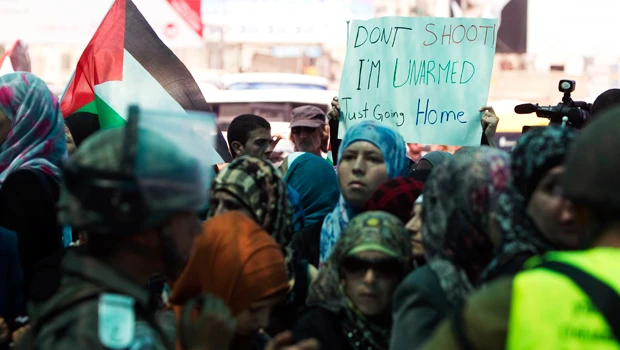
In a separate development, the Israeli Border Guard officers arrested three Israeli and one Palestinian left-wing activist during an anti-separation wall protest in the village of Al-Walajeh, to the southwest of Jerusalem.
The Israeli Army Radio said that the four activists were arrested after they entered a closed military zone.
The Israeli High court of Justice on last Tuesday has rejected requests by Palestinian villagers to reroute a section of the separation wall straddling the Jerusalem municipal border. Residents of the Walajeh village say the section, which is under construction, would cut them off from their farmlands, cemetery and a water source.
A panel of three justices, which included High Court President Dorit Beinish, explained that “the fence’s damage to the petitioners is in fair proportion to the security advantages produced by the fence.”
Israel started the construction of the eight-meter-high cement wall in the West Bank in 2002. It said that the wall is to prevent Palestinian fighters from infiltrating into Israel and carry out deadly bombing attacks.