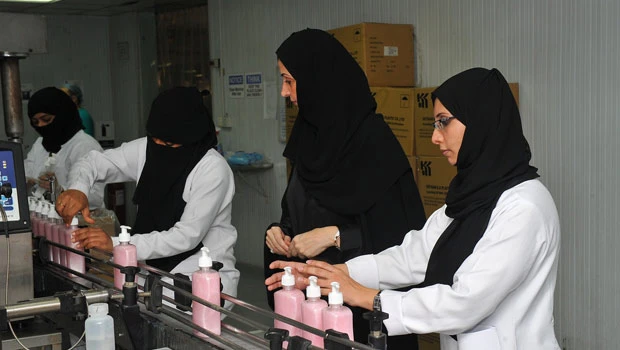
- RIYADH: Vice President of the Jeddah Chamber of Commerce and Industry’s industrial committee Ulfat Gabbani has urged more Saudi women to enter the industrial sector, which she said was the second-highest contributor to national income after petrol.
In a working paper titled “Women’s Industrial Investment ... a Promising Future,” Gabbani emphasized the importance of concentrating efforts of the public and private sectors on helping women become an integral part of the industrial sector. She presented the paper at a women's cultural gathering, which was organized by the Riyadh Chamber of Commerce’s women’s section, at the Intercontinental Hotel in Riyadh.
“I have been working in the fragrance and transformation industries for 18 years. We have established an independent women’s section, including a number of production lines with a high capacity for basic items for local markets and export. We worked to provide an adequate working environment according to Islamic teachings,” she said.
“Only two years ago I started expanding women’s roles in the workplace. It is not limited to marketing; we have appointed administrative employees, accountants, workers and technicians on production lines, and packing and wrapping specialists.”
She said the best way to train is on the job.
“It is important to focus on training type and equip the woman with a number of skills such as work culture consolidation, dealing with others, Islamic behavior, job loyalty. It is also important to give incentives in order to ensure the employee feels that she belongs in her factory and the development of the factory is one of her goals.”
Gabbani called for equality between men and women in terms of wages, salaries and bonuses. She added that there were more than 4 million Saudi women capable of entering the job market, but they only accounted for 2 percent in the industrial sector.
She recommended the development of a unified strategy to encourage women to work in the industrial sector, among other measures such as providing incentives to employers who actively employ women.