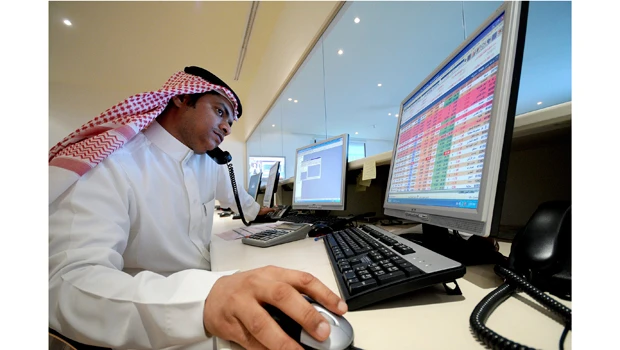
- JEDDAH: Arab bourses suffered heavy losses in the first 10 months of this year as high oil prices and regional unrest dented investor confidence in the region but analysts see the market developments as “attractive investment opportunities.”
According to the Abu Dhabi-based Arab Monetary Fund (AMF) report, Arab bourses lost $75 billion in share trading. The fast-growing Qatar was the only major gainer, while Kuwait, Saudi Arabia and Egypt were the main sufferers.
The AMF report said from around $955 billion at the start of January, the combined market capitalization of 14 official Arab stock exchanges dipped to nearly $878 billion on Oct. 30, one of its lowest levels in a year.
Saudi Arabia's Tadawul, by far the largest and busiest bourse in the Middle East, plunged by $14 billion from $340 billion to $326 billion.
Commenting on the AMF report, Jarmo T. Kotilaine, chief economist at the National Commercial Bank, said: "The performance of the Middle Eastern indices reflects the paradoxical situation where stronger economic fundamentals have not yet translated into better equity market performance, even though they are reflected in the result of many listed companies."
Going forward, he said, this should create attractive investment opportunities. But the fundamental challenge facing these markets remains: The dominance of retail investors who tend to be sensitive to negative external news. And the dominance of negative news, both internationally and regionally, has clearly been the main problem.
"The events of Arab Spring tested investor mood in the spring and, soon after a recovery set in, the deteriorating situation in the US and the euro zone led to another bout of risk aversion in response to negative headlines," Kotilaine said.
The results of Kuwait are particularly striking in view of sizable oil windfall and increased government handouts. But financial sector mood has been tested by internal political disputes, which in turn have delayed a number of government-sponsored investment projects and held back bank lending as well.
He said Bahrain is another regional bourse hard hit by its own internal disputes. But even Saudi Arabia and the UAE have lost ground in spite of a pronounced acceleration of economic growth. Qatar is the only regional bourse to have remained in the black, reflecting its exceptional growth driven by the sizable infrastructure pipeline, increased gas production, and deliberate - and to a degree successful - central bank efforts to foster bank lending to the private sector.
"The sharp clash between the regional growth spurt and uncertain international environment will likely make for a challenging market environment. As far as the GCC financial markets are concerned, this state of affairs has led to the bond and sukuk markets increasingly eclipsing and outperforming the equity markets, albeit from a lower base," Kotilaine said.
However, a Jadwa report released on Tuesday, said results from Saudi listed companies for the third quarter showed some positive performance. Net income totaled SR26 billion, up by 22.3 percent in year-on-year terms and 0.6 percent higher than in the previous quarter.
"Petrochemical earnings hit an all-time high in the third quarter and were up by 66 percent in year-on-year terms. This was largely due to higher product prices, supported by elevated production," Paul Gamble, head of research at Jadwa Investment, said.
The TASI stayed fairly stable during October. It recorded a 1.8 percent gain over the month and has traded within a range between 5,975 and 6,240 since the second half of August, he added.
The AMF report said, Kuwait's market capitalization tumbled by nearly $25 billion to $99 billion on Oct. 30, from about $124 billion at the start of this year.
Dubai's stock market lost nearly $4 billion from about $53 billion to $49 billion, while Abu Dhabi fell from nearly $67.8 billion to $65.7 billion in the same period.
Bahrain's market plunged from $20.5 billion to $16.6 billion and Oman's Muscat securities market dipped from $21.8 billion to $19 billion, the AMF report added.
It rated Qatar as the main gainer in the Gulf, with its bourse, surging from around $120.4 billion to $121.3 billion.
Outside the Gulf, Egypt was another major loser, with its market declining by nearly $14 billion from $71.4 billion to $57 billion.
The report said, Morocco, another major equity market outside the Gulf, declined by around $5.5 billion from $68.5 billion to nearly $63 billion.
Jordan and Lebanon also dropped from around $30.8 billion and $18.2 billion to $26.4 billion and $16.6 billion respectively.
Syria, which is now at the center of political turbulence in the Middle East, recorded a sharp fall in its market from $3.1 billion to $1.8 billion.
The Palestinian bourse remained unchanged at around $2.7 billion, according to the report.
Tunisia saw its bourse rise from $10.3 billion to $10.8 billion.