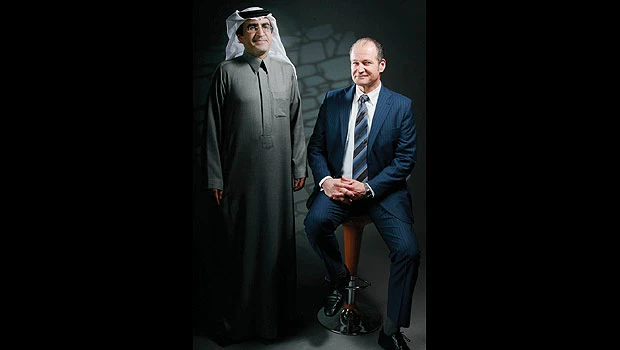
- RIYADH: Dr.
- Patrick Huser, CEO of Zurich Chefinvest, told Arab News European leaders have not yet found an effective way to deal with the economic turbulence in their countries and that the problem of economic recession may continue for some time.
He said in the current climate of recession further nationalization of banks in the euro zone should be expected and stressed the need for a sustainable solution based on a shift in attitude, scale of values and transparency in all matters for dealing with the challenge.
Huser made his comment during his meeting with Dr. Azzam Aldakhil, SRMG’s CEO, at the group headquarters in Riyadh last week.
Chefinvest Ltd. is a Zurich-based finance boutique based on the traditional strengths of Switzerland — its culture, expertise and virtues. It acts according to the principle of developing sustainable integrated solutions for their clients.
The guest was accompanied by Aldakhil during his tour of SRMG facilities, including the new built high-tech studio for both photographing and video. “We want to position our company as content provider rather than publishing only,” Aldakhil told his visitor.
Talking about his relations with the people here, Huser said: “I have built up and maintained relationships with wealthy families and their enterprises in the Middle East for many year and I have great respect as well as appreciation of the Arabic culture. Furthermore, I am born in Kuwait and it is, therefore, always very special for me to have the pleasure to visit the region.” Huser said their goal is to create added value through customized services, so as to meet the clients’ needs in a cost-effective and transparent manner.
The clientele of Chefinvest Ltd. comprises high net worth individuals and their enterprises in Switzerland, Europe and the Middle East who require either all their services “or just individual building blocks. This is how the ‘multi-family’ character of our support operation comes about, and where our long- standing experience in delivering practical solutions is applied.” Referring to its range of services, Huser said they encompass national and international wealth management, tax and legal advice, finance-oriented family office services, and support for real estate transactions.
Additionally, the company mediates in business transactions of its clients and their enterprises in Switzerland, Europe and the Middle East to support their expansion or divestment plans to strengthen multicultural as well as multi regional ties for promoting development.
Referring the current scenario, he said: “We continue to expect moderate economic growth of 2.2 percent for the US in 2012 and ongoing stagnation in the EU due to the austerity policies. In contrast, due to the weakening of dynamics in the economic performance of the emerging countries, growth in the global gross domestic product seems to be tailing off at 3 percent. The negative real interest rates dominating the established markets are leading to a questionable transfer of assets from creditors to debtors, resulting in false investment incentives,” he observed.
Huser explained that as well as struggling with its huge debt burden and overwhelming budget deficits, the EU also needs to deal with the problem of mounting current account deficit between the southern and northern Euro countries. This added up to more than 200 million euros in 2011 alone and is a clear sign of the lack of competitiveness of the southern European countries.
For these reasons, the austerity policy in the southern EU countries is set to further aggravate the debt crisis in the short term. The solutions that the EU has come up with to date — if they are actually implemented — will, therefore, not yet hit the mark due to the lack of any growth factor and/or competitiveness in the southern European countries. Clear and feasible solvency rules for states and associated average debt levels for other EU countries, therefore, seem unavoidable if investor confidence is to be regained, he said.
Huser said a recapitalization of the banks is also on the cards, which poses a large challenge for the future. It is expected that it will be difficult for the banks to finance the necessary equity increases on the financial markets in the current economic climate. Many of the financial institutions are, therefore, trying to meet the new equity capital requirements through the sale of financial assets with the knock-on effect of increasing pressure on asset prices.