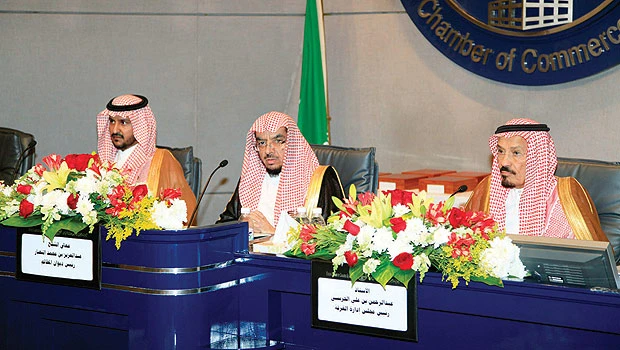
- Prince Bandar bin Salman, adviser to Custodian of the Two Holy Mosques King Abdullah and head of the Saudi Arbitration Team, said the settlement of disputes comes through amicable or non-amicable means.
Prince Bandar, addressing a symposium on the settlement of disputes through non-judicial methods at the Riyadh Chamber of Commerce and Industry (RCCI) on Monday, said the settlement of disputes through amicable means is handled mainly by judiciary bodies and supported by other methods such as arbitration and reconciliation.
He said the Kingdom had adopted the New York Convention regarding applying foreign laws as long as its provisions do not contravene the Kingdom’s Shariah system.
“We have nothing to fear if we apply any (foreign) system that does not contravene Shariah law,” he said.
Prince Bandar explained the difference between arbitration and reconciliation, saying that they have exerted enormous efforts at international conventions backing the introduction of Shariah-literate arbitrators. “Now we have such arbitrators inside and outside the Kingdom,” he said.
Head of the Court of Grievances Sheikh Abdulaziz Al-Nassar said the Kingdom is prepared to host international arbitration functions.
He said development of business, local and international investments, and growing trade transactions have necessitated the adoption of arbitration and reconciliation principles in settling disputes.
He said disputes that are settled by arbitration and reconciliation are better than those settled by pure judicial means.
Al-Nassar said commercial arbitration has been attracting considerable attention in commercial and trade circles, where arbitration has become the favored means for parties involved due its efficiency. Moreover, it has become normal to see that business contracts contain a provision on arbitration, particularly when the contracts involve non-Saudis, he said.
He said the Court of Grievances has been practicing its regulatory role after a royal decree ordered that an arbitration body should be set up and arbitrators trained.
Chairman of RCCI Abdulrahman Al-Jeraisi stressed on the importance of the symposium for various stakeholders including lawyers, judiciaries, firms, and individuals.
He appreciated the role played by Prince Bandar in spreading the culture of arbitration in local and international forums.
He said the RCCI has settled many commercial disputes amicably without needing to resort to the courts. The RCCI handled 3,264 disputes within the last five years over claims worth SR436 million, he said.
Mohamed Al-Marzougi presented a work paper at the symposium on the role of legislative bodies in supporting alternative methods for the settlement of disputes, in which he traced the development of arbitration in the Kingdom.
Former spokesman of the Court of Grievances and judge Dr. Ahmed Al-Sagie also presented a similar paper dealing with arbitration and reconciliation.