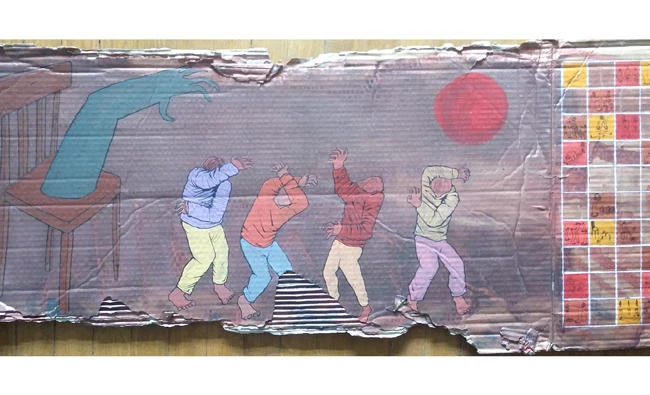
Artist Ali Abdel Mohsen has been shaking up the Egyptian art scene ever since his first solo exhibition “A Voice from the Clouds” in 2010. His latest body of work is also making waves.
Gallerist Stefania Angarano, who has been promoting young Egyptian artists for the last 27 years, was immediately drawn to Mohsen’s creativity and hosted his last three exhibitions at her Mashrabia Gallery in Cairo.
“What really fascinated me since the beginning about Ali is his ability to give shape to a dystopian reality world, but nevertheless (make it) extremely convincing and credible,” Angarano told Arab News.
“All the elements of his work contribute to giving shape to a negative order… I believe that Ali is not afraid of using violent images and expressing the utmost limit of his pessimism with no chance of redemption.”
The artist’s use of discarded cardboard boxes are striking, as using such materials could have been viewed as an easy way out over the apparent failure to use canvases or other traditional surfaces.
“Cardboard boxes are absolutely not the easy way out, they’re a massive pain to work with,” Mohsen told Arab News.
“You can’t prop them up on anything without them folding in on themselves, which is annoying,” he said. “I only get a good, full look at the pieces when they’re finally hanging up in the gallery… It’s actually easier to find canvases and almost any type of drawing paper than it is to find a refrigerator-sized piece of cardboard that’s still usable or a piece with the right proportions for the combination of scenes you want to put on it.
“Paper and canvas seem too clean, almost. The edges are too straight, they’re too bright to look at, to even work with, and it doesn’t match what I want it to feel like, which is like something that’s been torn out of a larger thing, like a rotted tooth or an infected limb. Like a scream that’s been cut off.”
Both an artist and a journalist, Mohsen, who was born in 1984, currently lives in Philadelphia and says that he cannot remember the first time he felt the desire to paint.
“I don’t recall it ever being a conscious decision. (It was) boredom, most probably. It seemed like a good way to kill time,” he said. He added that in his youth he did dream of becoming a film director, which could account for his storyboard style art.
His creative process
Mohsen collects cardboard boxes from his friends and relatives and also often hunts for them in the street. Even the folds of these discarded pieces of cardboard can be used to tell a story, he explains, as they give the artist the opportunity to express the various angles of the story in a way that is not too disruptive — the painting consists of a series of different scenes presented on one piece of cardboard.
“Then there’s the whole feel behind it, the idea of this cardboard being the regurgitated mess of a million other things, pushed into the shape of a box, gets a logo printed on it and used to carry something that probably causes some type of cancer and then tossed out on the street,” Mohsen said. “Now it’s pulled apart and stained and sticky. That’s something. And you see it sitting there in the corner of your room, worn out, like a visual version of a low growl or a sigh of defeat and I respond to that.”
The artist tends to use a Uniball pen, which he says is most convenient as it holds up well against the cardboard and the grainy orange paint — the color of fire that brings a spark of life to the scenes steeped in despair.
Mohsen admits that he does not like to be too comfortable when he works and tries to draw according to his mood. He sets aside certain segments of his work for a time when he feels nervous, sad or oversensitive. He will even eat certain kinds of foods, listen to music he either likes or dislikes and will leave the television on certain channels depending on the kind of feelings he needs to express when he paints. Frustration, in particular, fuels his creativity, triggering a surge of energy, which can at times be overwhelming, he said.
Gallerist Angarani praises Mohsen’s work, saying he doesn’t resort to any of the tricks used nowadays in contemporary art, such as gigantism or the unbridled use of technology, but rather relies on the power of drawing.
A large portion of his works are untitled but his body of work, “Slow War,” stands out.
Mohsen’s grisly scenes could easily invoke in viewers’ minds Edvard Munch’s iconic painting “The Scream.” Both painters are expressing impending chaos and calamity. Munch depicts in one painting a moment of extreme anxiety whereas Abdel Mohsen’s entire body of artwork has become a touchstone for our troubled time.
His paintings, steeped in fear, angst and alienation, leach out a negative emotional reaction to just about anything.
Having reached the point of no return, it seems prudent to wonder what the artist will offer next. Having just finished a small series of ink drawings in black and white on paper, this could mark a new beginning.
It is definitely something to look forward to.
• [email protected]
Shaking up Egypt’s art scene with struggle and despair