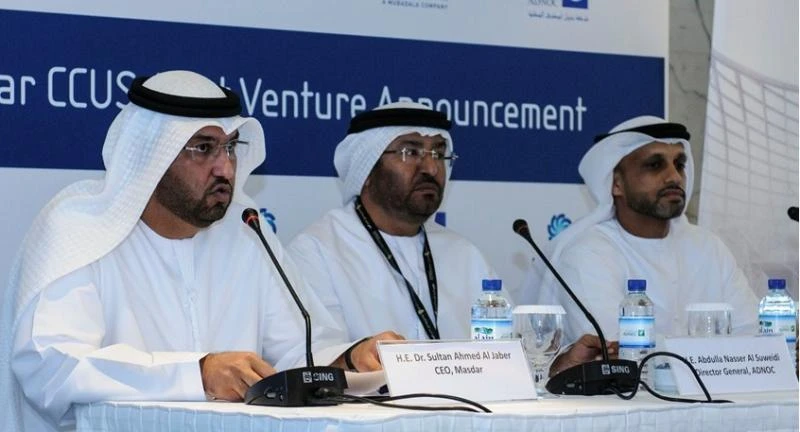
Abu Dhabi National Oil Company (ADNOC) and Masdar have signed a joint venture agreement to set up the Middle East’s first company focused on exploring and developing commercial-scale projects for carbon capture, usage and storage (CCUS).
ADNOC and Masdar jointly awarded a AED450 million engineering, procurement and construction (EPC) contract to Dodsal Group to build a carbon dioxide (CO2) compression facility and a 50 km pipeline. The joint venture is 51 percent owned by ADNOC and 49 percent by Masdar.
The joint venture agreement was signed at the Abu Dhabi International Petroleum Exhibition and Conference (ADIPEC) in the presence of Sheikh Hazza bin Zayed Al-Nahyan, national security adviser, and vice chairman of Abu Dhabi Executive Council.
Located in Abu Dhabi, the joint venture’s first CCUS project consists of three core components. First, CO2 will be captured onsite at Emirates Steel, the UAE’s largest steelmaker’s facility. Second, the CO2 will be compressed and transported along the 50 km pipeline to oilfields operated by ADNOC. Third, ADNOC will inject the CO2 into oil fields to enhance oil recovery, while storing the injected CO2 underground. The project will sequester up to 800,000 tons of CO2 annually. Completion is set for 2016.
“The implementation of this technology is a demonstration of Masdar and ADNOC’s commitment to de-carbonizing the UAE’s growing economy,” said Sultan Ahmed Al-Jaber, CEO of Masdar, Abu Dhabi’s renewable energy company.
“We are proud to be pioneering the use of CCUS technology in the region, a critical strategy to reduce global carbon emissions,” added Al-Jaber.
The UAE has traditionally used hydrocarbon gases in some of the Abu Dhabi fields to enhance oil production. However, with the nation’s rise in its energy demand, this CCUS project will allow the UAE to preserve its natural gas for domestic electricity generation.
“The UAE is a responsible hydrocarbon producer,” said Abdullah Nasser Al-Suwaidi, director general of ADNOC. “We believe CCUS has tremendous potential to both reduce our carbon footprint and enhance our oil and gas production. We are committed to finding and adopting real-world solutions that have economic and environmental returns.”
The joint venture is the first phase of an industrial-scale CCUS network planned as part of Abu Dhabi’s commitment to de-carbonize its economy and create a low-carbon power generation industry.
“With energy demands surging to unprecedented levels, along with greenhouse gas emissions, the Middle East must adopt clean technologies, renewable energy and carbon mitigation solutions,” added Al-Jaber. “Through collaboration between ADNOC and Masdar, the UAE is developing a blueprint for how to incubate and establish a low-carbon, new-energy industry in the region.”
ADNOC, Masdar to set up new joint venture