Saudi Basic Industries Corporation (SABIC) has posted a 2.5 percent rise in its third-quarter net profit ending Sept.30.
SABIC’s net income grew to SR6.47 billion ($1.73 billion) from SR6.31 billion during the corresponding period last year.
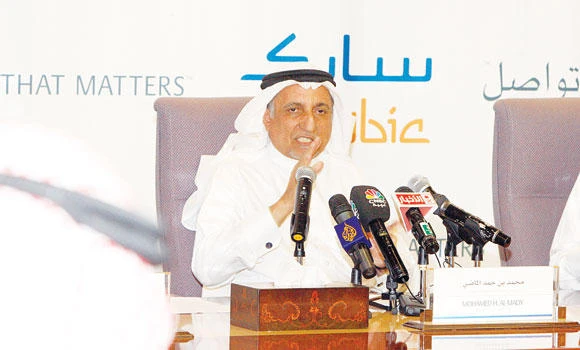
CEO Mohamed Al-Mady said the outlook for next year was improving.
“About the future outlook, I think 2014 will be similar to 2013 or slightly better,” he told a news conference.
The increase in SABIC’s earnings is attributable to rise in the quantities sold, favorable prices for some of its products and lower financial charges despite other lower incomes.
“The other reasons cited for enhanced income included higher sales volumes and decline in financial charges,” said Mohammed Al-Mady, SABIC vice chairman and CEO.
The financial performance of SABIC, especially petrochemicals, metals and fertilizers, is closely tied to the world economy because its products are used extensively in construction, car manufacturing and other major consumer goods.
The profits are directly linked to the rise in oil prices, he said, adding that the future outlook in 2014 will be similar to 2013 or slightly better.
As the global economy improves, Al-Mady predicted a growth in the petrochemicals demand in SABIC’s main markets such as the US, China and Europe.
The company’s sales in the third quarter rose by 9 percent to SR48.8 billion ($13 billion) over the same period in 2012, with sales from the first 9 months of this year unchanged from last year at SR140 billion.
“SABIC plans a new Eurobond issue later this year, as the company seeks to take advantage of low interest rates to refinance its total debts of around SR80 billion,” said Mutlaq Al-Morished, SABIC’s executive vice president for Corporate Finance.
SABIC has reduced its total debts by around SR15 billion over the past nine months and plans to take on some of the debts now held by its subsidiaries, he said.
SABIC, which employs 40,000 people around the world, relies heavily on natural gas as a raw material for its chemical business, and is facing increased competition from the US where a shale gas boom has made new supplies available.
Last month, SABIC printed a $1 billion five-year bond, its first since 2010, attracting commitments from investors worth $5.25 billion.
Enlightening on its research and development activities, he stated that it has currently 15 technology and innovation centers in the world and two more will be set up soon in China and India. In China, he said, it will have 300 researchers attached to the facility.
Earlier in a statement, Al-Mady said: “Europe faces a new reality. The European chemical industry and various governments need to focus on more resource and cost efficient manufacturing, targeting incentives for innovation at the development stage and instituting a robust regulatory framework based on good science with clear goals. Governments must proactively support this transition — it cannot be done by industry alone.”
Regarding SABIC’s operations in Europe, he said the company will continue to play an active role in the region, striving to maintain its in-market manufacturing presence, providing technology from a growing innovative portfolio, and utilizing the optimal value chain to develop solutions to both Europe’s shifting demographic profile and exportable goods and technologies.
SABIC’s manufacturing capabilities in the continent will target and invest in more resources and cost efficiency, which will in turn improve the company’s environmental footprint, he said.
On innovation, Al-Mady said SABIC would develop technology from its multiple research facilities around the world.
“Technology and innovation are central to our future success in Europe as well as the rest of the globe,” he said.
For SABIC and other global companies to effectively contribute toward Europe’s economic growth, Al-Mady urged proactive and coordinated support from the region’s various governments.
He called for “a robust regulatory scheme for more resource and cost-efficient manufacturing.”
He said historically the European industry’s strength has been its ability to confront difficult challenges and create viable alternatives to achieve greater success.
“In my opinion, this industry has the will and the necessary tools to meet the challenge,” he added.
EPCA is a Brussels based international non-profit association that serves a global network for the chemical business community consisting of producers of petrochemicals, their suppliers, customers and service providers.
SABIC upbeat on demand as Q3 profit rises 2.5%