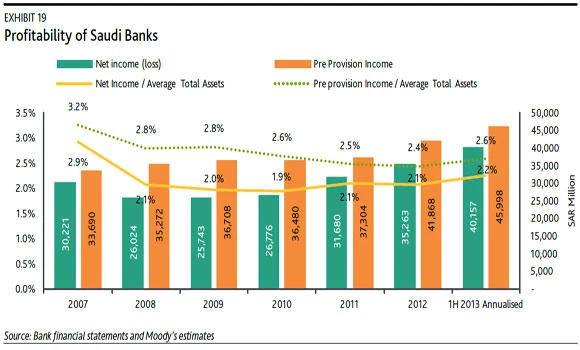
Moody's Investors Service expects the Saudi banking system to continue to benefit from expansionary fiscal policy. It anticipates that the nonoil sector, where most bank lending is extended, will continue to expand, growing by almost 6 percent in 2013 and just over 5 percent in 2014.
Basing its expectation over the 12-18 month period, Moody's says the outlook for the Saudi Arabian banking system remains stable. “The outlook, which has been stable since September 2009, reflects the benign operating environment,” Moody's said in its “Banking System Outlook: Saudi Arabia” report released on Tuesday.
“Banks will continue to do well during the rest of the year as they will continue to report better than expected results, mostly on the back of lower than expected provisions. Most banks will continue to report flat or marginally higher net interest margins. This bodes well for the sector as we are seeing the bottom of NIMs contraction,” John Sfakianakis, chief investment strategist at Masic, said.
However, he added: “With loan growth higher than deposit growth, we may see short-term pressures on cost of funding, which may impact next quarter's net profits. Saudi banks continue to perform strongly compared to their regional peers with solid balance sheet support and a strong economy.”
Domestic banks remain on solid footing and their performance reflects the strong stance of the Saudi economy, Fahad Alturki, head of research at Jadwa Investment, said.
He said many of the bank indicators were now back to the pre-crisis level.
“There is ample liquidity in the system and credit to the private sector has accelerated averaging 15.7 percent year-on-year during the first eight months of 2012, compared with 13 percent in 2012, driven by strong corporate credit growth and soaring consumer lending,” he added.
“The low funding cost, preferred operational environment, government spending and private sector performance have all contributed to near record high bank profits last year. For this year, these same factors will push bank profits even higher which we expect to exceed its 2006 record high of SR34.7 billion,” Alturki said.
Moody's expects problem loan formation to decline, which, in addition to continued loan growth, will lead to an improvement in the problem loans-to-gross loans ratio to around 2 percent over the next 12 months. Although Moody’s expects the improving trend to continue, asset quality will remain exposed to event risks, owing to persistently high, albeit declining, single-party exposures in Saudi banks’ loan books and some vulnerabilities in the corporate sector such as the low transparency of family-owned businesses and the intermingling of investment activities with operating activities.
Jarmo T. Kotilaine, a regional analyst, said: “The Saudi banking sector is performing strongly. It is a mature sector with a history of prudent management and the benign macroeconomic backdrop has fueled strong loan growth in recent years. While the rate of increase may moderate, the basic outlook for the sector remains favorable.”
In the GCC context as well, Kotilaine said, the Saudi banking sector is performing very well.
“While loan growth may be below the Qatari market, which has had its own specific dynamics, the Saudi market has been largely spared the sectoral dislocations faced by countries such as the UAE and Kuwait.”
“Also the regulatory environment has been fairly consistent with less of a need of the kind of regulatory tightening some other regional jurisdictions have experienced after the onset of the global crisis.”
Moody's also expects that Saudi banks’ high profitability will continue to drive robust internal capital-generation and substantial loss-absorption capacity.
Saudi banks gain from expansionary policies