The energy industry in the Middle East is an increasingly vibrant center of innovation, thanks to burgeoning cooperation between governments and businesses throughout the region. Technological advances are unlocking new oil and gas resources in the UAE and beyond. This is not only helping to supply the world’s growing energy needs. It is also generating oil and gas revenues that can bring economic, social and environmental benefits to countries across the Middle East.
This week, as Shell participates in the 16th edition of ADIPEC energy conference in the UAE, we are struck by the sense of purpose and optimism in the region regarding its role in the global energy market.
Global demand for energy is set to increase as the world’s population grows and living standards rise, especially in emerging economies. Over the next seven years, the world could generate new energy demand equivalent to China’s entire energy system.
Governments in the Middle East are rightly taking a long-term view. They see how future oil and gas revenues can bring real economic and other advantages.
Importantly, they also recognize the role that innovation in the energy sector can, and must play. It is a fascinating area of progress.
As the CEO of Shell, I lead an international energy company that partners with governments and their national oil companies for mutual benefit. Our relationships and local knowledge, formed over many decades in the Middle East, remain essential, while our technology, expertise and large-scale project delivery capabilities add real value.
For this reason, we spend more than any other international oil and gas company on research and development — more than $1 billion annually over the last five years, on average. Today, we have more than 14,000 granted patents and pending patent applications. Because our activities span the entire industry, from extracting oil and gas to delivering fuels and petrochemicals, we can bring technologies together to maximise their impact.
The latest innovations can help countries derive more value from oil and gas fields over time, and increase export revenues. But they can also help to strengthen knowledge-based economies and provide sustainable energy policies.
In the Middle East, new technology is already making a tangible impact every day and this will continue. The practice of Well, Reservoir and Facility Management (WRFM), for example, is helping countries make the most of oil fields. By integrating surveillance, production and predictive technologies, it can unlock trapped resources, help avoid leaving oil and gas behind unnecessarily, and optimise the lifecycle of a field over decades.
At the Fahud oil field in northern Oman there has been a remarkable turnaround thanks to these techniques. Fahud is operated by Petroleum Development Oman, a joint venture that is majority owned by the Omani government with Shell having a 34% stake.
Despite being one of PDO’s oldest fields, the team applied the latest Shell technology, business processes and continuous improvement principles from across the world. The rate of production decline reduced from 8 percent to close to zero for the last three years. One tactic was a successful strategy to re-open and better manage several wells that had been closed, leading to 3,500 barrels a day of additional production.
Enhanced oil recovery (EOR) also has real potential, especially in mature fields. Many people are surprised to learn that the oil and gas industry typically recovers about 35 percent of oil from reservoirs, with the rest remaining trapped in rock. Methods to inject gas, heat or chemicals to encourage flow can increase returns. Studies indicate that just a 1 percent increase in the global efficiency of hydrocarbon recovery would raise conventional oil reserves by up to 88 billion barrels, which is equivalent to three years of annual production at today’s level.
The Middle East provides much scope for such technology. The ongoing EOR work by Shell with PDO in Oman is seen as a global best-practice reference, and we broke new ground there, developing three new injection technologies.
In December last year, PDO commissioned the Middle East’s first solar EOR pilot project. It uses sunlight to produce steam that is pumped into the Amal West field. The system was built by GlassPoint, a leading solar EOR company in which Shell has invested via its venture capital fund.
And it is not just in extracting, but also in using energy where technology can bring big rewards to governments and their people. Our Pearl gas-to-liquids plant in Qatar is the largest in the world. It turns natural gas into a whole range of liquid products such as cleaner-burning fuels and lubricant base oils – including the capacity to produce enough diesel fuel to fill more than 160,000 cars a day and enough base oil for 225 million car lubricant fills per year. Its size brings economies of scale, and helps the country maximise value from its resources, and diversify its export revenues.
Another area of progress is liquefied natural gas (LNG). The ability to cool gas to a liquid and then transport it in ships to far flung destinations, can increase export opportunities for countries with natural gas resources.
But LNG can also help countries meet rising domestic energy demand with imports, either temporarily or in the longer-term. Dubai, for example, is already taking advantage of LNG imports.
It is now possible to build LNG import facilities in the same two-year timeframe that it takes to build a gas-fired power station. In this way natural gas, the cleanest-burning fossil fuel, which is an ideal partner for renewable sources, can help to create long-term, sustainable energy plans.
Working with cutting-edge technology in oil and gas also brings broader economic advantages with the right partnerships. For example, it can benefit future generations of scientists, engineers and senior managers.
In the UAE we have implemented one of the world’s most highly regarded management training programmes with our partner, Abu Dhabi’s ADCO.
In another programme with ADCO, we recently celebrated the graduation of the first group of Emirati drilling engineers to receive certification in the Shell Round 1 and Round 2 programs. These are globally accredited qualifications enabling them to work on Shell onshore or offshore oil platforms anywhere in the world.
However, such training is not just about progress, but also ensuring the highest possible safety standards. For a company like ours, and the countries where we operate, safety goes hand in hand with innovation.
The selection of Shell by Abu Dhabi’s ADNOC in May to help develop the UAE’s Bab sour gas reservoirs illustrates all these points. Sour gas is a valuable source of energy but contains hydrogen sulphide, which must be carefully removed.
Only a select number of energy companies have this capability. Shell has more than 50 years’ experience in sour gas treatment, and has developed more than 1,200 processing plants for contaminated gas across the world.
The reservoirs will be developed by a joint venture over 30 years, with Shell having a 40 percent stake. Continuous sour gas research work by Shell means that future technology, as well as existing equipment, will drive improvements and efficiency gains.
Together, a shared commitment to technology and long-term thinking are paving the way for ever more effective partnerships between energy companies and governments. This is good for both sides, and will also help power economies across the world.
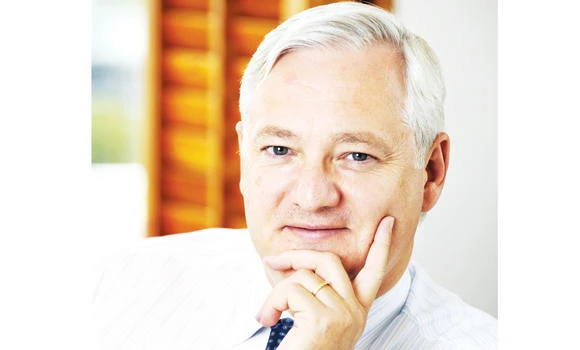
- Peter Voser is CEO of Royal Dutch Shell
‘The latest technology is vital in making the most of resources’