The UAE is investing heavily in its natural gas supplies as the country prepares to utilize gas as a primary source of power generation, says a top energy official.
Matar Al-Niyadi, undersecretary of energy, stated that the UAE is a leader in energy diversification and that its robust and diverse energy policy will ensure the country remains attractive for foreign investment and continues to support future economic development.
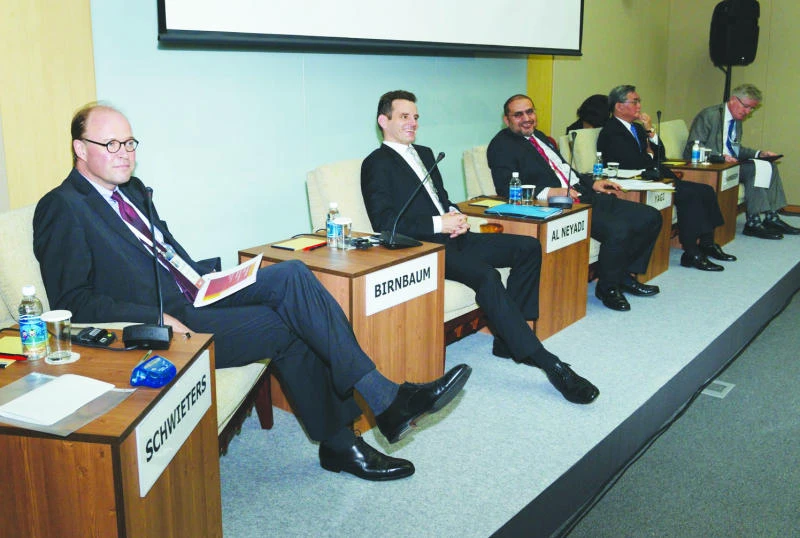
He made the remarks during a high level panel held at the World Energy Congress (WEC) in Daegu, South Korea, said a statement received here.
Alongside a panel entitled ‘Transition of a country in a decade,’ Al-Niyadi said the UAE’s innovative energy policy rests on four pillars — diversification, conservation and efficiency, security of supply and managing talent in the industry.
This approach is geared toward mitigating risk to energy security, future economic prosperity and climate change.
The broader panel discussion addressed the world’s growing need to develop robust strategies to address rapid rises in global energy demands and the need for established hydrocarbon exporters to lead the transition.
The panel included Leonhard Birnbaum, vice chair of Europe WEC and member of the executive board, E.ON, Germany; Makoto Yagi, president, Kansai Power Company, Japan; and Gudni Johannesson, chair of Icelandic National Member Committee.
Highlighting the UAE’s regional leadership role in the adoption of clean energy, Al-Niyadi said: “Diversifying our energy mix is the first pillar of our energy policy. To meet immediate demands, we are using more natural gas to generate electricity because of its clean and efficient burning properties.
“In December 2009, we awarded a $20 billion contract to the Korea Electric Power Corporation to construct four nuclear reactors. To be completed by 2020, this will cover about 25 percent of the UAE demand for electricity,” said the official.
The undersecretary highlighted the important role of renewables and said: “The UAE was the first country in the Middle East to announce renewable energy targets, which will see 2.5 GW of new renewable energy capacity by 2030. We expect these targets to be met with solar and waste-to-energy, and as a major first step Masdar commissioned Shams 1 in March this year — the largest concentrated solar power plant in the world.”
On the UAE’s conservation and efficiency policies, Al-Niyadi said: “Enhancing energy efficiency and our conservation efforts to cut domestic demand and prevent wasteful practices are critical. In the UAE, we have the region’s first mandatory green building codes, leading to cuts in energy and water consumption by more than 33 percent in new buildings.”
He added: “More appliances will soon fall under regulation. We are also running a large number of pilot schemes in order to develop additional policies in the next few years, including monitoring of water and energy consumption through wireless smart meters, testing of consumption and time-of-day based electricity pricing to offer lower rates for less electricity usage and the establishment of state-funded energy service companies.”
On energy security, Al-Niyadi said the UAE is investing heavily in its natural gas supplies as the country prepares to utilize gas as a primary source of power generation. “We are spending $25 billion within the next five years on exploring new gas fields using the latest technology to develop non-associated gas at onshore old oilfields,” said Al-Niyadi.
Al-Hosn, a joint venture between ADNOC and Occidental, is set to develop the Shah sour gas field which is expected to add 500 million cubic feet of gas per day to the domestic supply by 2014, he said. “Simultaneously, we are sealing long-term arrangements with Qatar to import gas via the Dolphin Energy pipeline, which helps the UAE to meet around 30 percent of its local demand for natural gas. And we are working toward constructing a second LNG terminal on the eastern coast of the UAE with a nine million ton capacity per year,” he added.
Al-Niyadi went on to illustrate the importance of investment in human capital development as the country looks to reaffirm its global energy leadership.
Institutes such as the Petroleum Institute and the Masdar Institute are both leading research facilities dedicated to ensuring that the UAE remains at the forefront of innovation within the energy industry.
“It is crucial to develop a pool of highly-skilled people in the energy industry who are equipped not just to manage the existing infrastructure, but also to transform it to the new generation of smarter energy technologies that will likely continue to emerge in the near and long-term future,” he said.
The UAE has announced its intention to bid for the 2019 World Energy Congress when the process begins in January 2014.
The WEC is held every three years; hosting the Congress in Abu Dhabi would mark the first time in the event’s 90-year history that it has been held in a member country of the Organization of the Petroleum Exporting Countries (OPEC).
UAE leading the way in energy transition