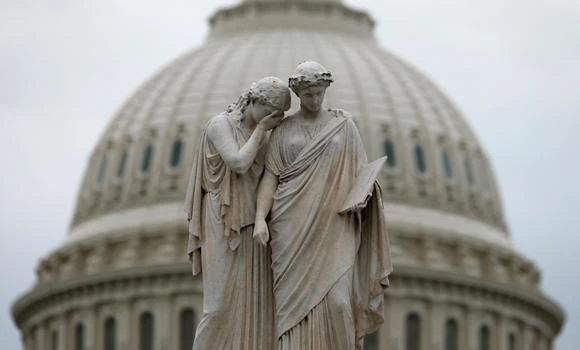
LONDON: Democratic leader Harry Reid says Senate leaders have reached a bipartisan deal to avoid default and end the government shutdown, now in its 16th day.
Reid made the announcement at the start of the Senate session on Wednesday.
The deal would reopen the government through Jan. 15 and increase the nation's borrowing authority through Feb. 7.
Reid thanked Republican leader Mitch McConnell for working out an agreement.
The lower House of Representatives is expected to agree to the Senate plan and there are even suggestions that it may vote first — an arrangement that would speed its way through Congress to President Barack Obama’s desk.
“Hopes for a resolution have seen a sharp reaction in the market,” said Kathleen Brooks, research director at Forex.com.
Europe’s markets recovered from sizeable losses earlier. The FTSE 100 index of leading British shares closed up 0.3 percent at 6,571.59, while Germany’s DAX rose 0.5 percent to 8,846.00. The CAC-40 in France recovered but still ended 0.3 percent lower at 4,243.72.
In the US, the Dow Jones industrial average was up 1.2 percent at 15,347 while the broader S&P 500 index rose 1.3 percent to 1,719.
Though the US debt standoff has been the primary point of interest in financial markets for the past few weeks, investors have taken much of the political posturing in stride. The idea that US lawmakers would allow the country to default seemed too fanciful for many.
Without a deal to raise the debt ceiling, the US government would lose its ability to borrow and be required to meet its obligations by relying on cash reserves and incoming tax receipts. The US could be unable to repay holders of Treasury bills that mature in coming days or meet interest payments on longer-dated Treasurys — putting it in default on its debt.
Even though a deal appears appears to be imminent, analysts said the long-term damage to the US’s economic reputation and the dollar’s status as the world’s reserve currency could be hefty. Fitch warned it could strip the US of its triple-A rating even if a deal is reached in time.
Simon Derrick, a senior analyst at Bank of New York Mellon, said the US’s credibility is “long shot” and that the whole episode has “undermined faith” in the country. As such, foreign exchange reserve managers around the world, notably in China, will be looking at how to diversify their portfolios from an over-reliance on the dollar.
The dollar has held up relatively well over the past few weeks, partly because there is no clear alternative to the currency’s reserve status at present. Hopes of a deal helped shore up the currency Wednesday, with the euro 0.3 percent lower at $1.3488.
Oil prices have also gotten a boost, with the benchmark New York rate up 54 cents at $101.75 a barrel.
Earlier in Asia, before the outlines of a deal were apparent, trading was far more cautious. Japan’s Nikkei 225 rose 0.2 percent to close at 14,467.14 while Hong Kong’s Hang Seng dropped 0.5 percent to 23,228.33. China’s Shanghai Composite fell 1.8 percent to 2,193.07. Australia’s S&P/ASX 200 added 0.1 percent to 5,262.91.
US Senate leader announces bipartisan budget deal