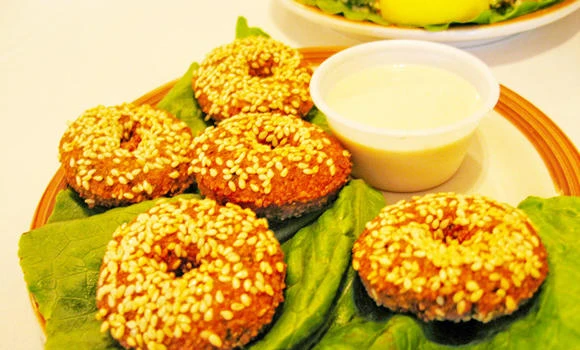
Riyadh has grown tremendously in the last two decades. New suburbs have attracted residents because of their variety of shops, restaurants, cafes and malls. Besides the ubiquitous fast food brands and other well-known chains of restaurants, there are wonderful food outlets known only to the lucky neighbors. Driving through these new suburbs, you will always find a street-side shop selling hot, crunchy falafel. These deep-fried balls of ground beans are among the tastiest fast foods in the Middle East.
Driving through Riyadh’s new Al-Nozha neighborhood, I recently found the Damascene House of Falafel. For a few riyals, you can enjoy a bag full of falafel also known as ta’amia. And if you are hungry, you will hardly resist the urge to taste these deliciously warm and crumbly bean rissoles even before reaching home! They taste even better when dipped in a tahina cream sauce, a paste of sesame seeds flavored with garlic, lemon juice and finely chopped parsley.
These fried bean croquettes are made with one of the world’s oldest foods, the broad bean. It grew tens of thousands of years ago in southeastern Afghanistan, Central Asia and the Himalayan foothills. As early as the seventh millennium BC, a thousand years before any plants were domesticated in the Middle East, the inhabitants of the “Cave of the Spirit” in northeast Thailand were growing two kinds of broad beans, which were already considerable improvements on the wild species.
The wild broad bean has a very efficient reproductive system. When it is ripe, the pod opens, rolls itself into a spiral and ejects its small seeds onto the ground. Some pods, however, do not open, and it is these abnormal pods which our ancestors chose to pick in order to shell their seeds, later at home. The seeds collected this way were sown to make it easier to gather beans from around the home campsite. The plants they produced were the ancestors of cultivated broad beans, which do not burst their pods. The early cultivated broad bean, already remarkable among seeds for its size, improved even further, and quite fast. Its size and the nutritional value of the starch it contains soon made it one of the first foods to be stored.
The Greeks, who used broad beans as ballot papers in their election procedures, liked to eat them green in their pods. Romans used to make cakes from dried beans with garlic, onions, chickpeas, spring onions parsley, coriander, cumin and baking powder. These were quite similar to today’s falafel.
The dried chickpeas and broad beans (fresh or frozen green broad beans are also used) are soaked overnight, then drained and washed. The next step is to grind the chickpeas and beans to a paste and add the remaining ingredients. The mixture is then left to stand for at least half an hour before it is deep-fried.
The Egyptian Ta’amia is similar in shape to the falafel found in the countries of the Fertile Crescent, Syria, Lebanon and Jordan but the paste does not contain chickpeas.
While waiting for the falafels, our attention is inevitably drawn to the way the hands manipulate at lightning speed a shiny brass tool that shapes each mound of pureed beans into identical bean croquettes. The mixture is spooned into the top of the tool, smoothed over, and then pushed out to deep-fry in a large black wok.
If you have more time to spare, you can wait for a falafel sandwich: fresh Arabic bread stuffed with freshly fried falafel broken into pieces with tomatoes, mint, parsley, and sometimes radish. Customers who like spicy food will never fail to ask for some chili pepper.
Falafels or ta’amia are part of the traditional Arab mezza (an assortment of appetizers) but they can also be eaten on their own. One of Egypt’s national dishes and a popular street food though out the Middle East, these scrumptious bean croquettes are eaten at all times, breakfast, lunch or dinner.
Email: [email protected]