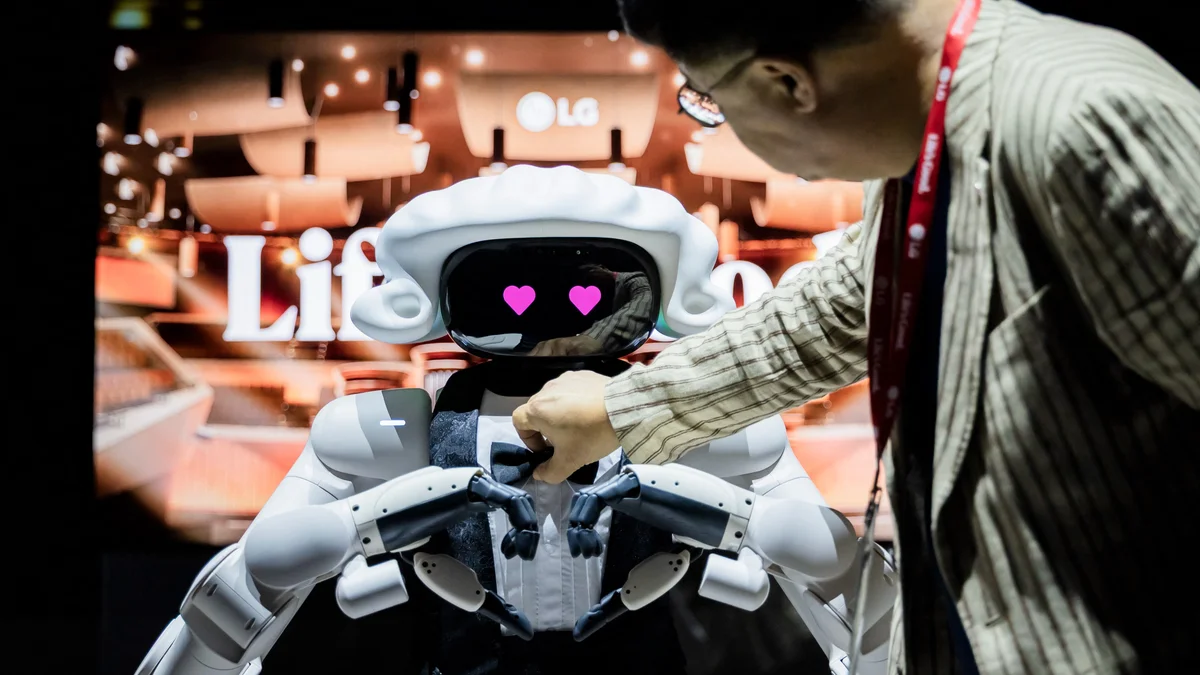
There is a sentence circulating quietly, almost like a whisper of resistance in an age of acceleration: “I want AI to do my laundry and dishes so I can create art and write — not for AI to do my art and writing so I can do the laundry and dishes.”
It is attributed to the writer and gaming enthusiast Joanna Maaejeweka, but it could belong to anyone who senses that something subtle, yet profound, is being inverted in our technological age.
This inversion is not merely practical — it is philosophical.
For centuries, humanity has defined progress as the gradual liberation of time. From the first mechanical loom to the modern washing machine, technology promised to relieve us of repetitive, physically demanding tasks so that we could ascend toward higher forms of expression: art, thought, contemplation, and meaning. In this narrative, machines serve the body so that the soul may be free.
Yet today, we are witnessing a paradox. Artificial intelligence, the most advanced tool humanity has ever created, is increasingly positioned not to liberate human creativity, but to replace it. Meanwhile, humans are still entangled in the mundane: answering emails, managing logistics, and yes, still washing dishes.
The question is not whether AI can create. It clearly can. The question is whether it should — at least in the domains that define our humanity.
As Aristotle once wrote: “The aim of art is to represent not the outward appearance of things, but their inward significance.” Can a machine, trained on vast datasets and patterns, truly access that inward significance? Or does it merely simulate it with increasing sophistication? The distinction matters because art is not just output — it is an act of being.
In this sense, the rise of AI-generated creativity risks introducing what might be called a “displacement of meaning.” If machines produce our poetry, compose our music, and write our stories, what becomes of the human need to express, to struggle, and to transform experience into narrative? Creativity is not simply a product; it is a process through which individuals understand themselves and their place in the world.
Friedrich Nietzsche warned that “he who has a why to live can bear almost any how.” Creativity has long been one of those “whys.” It gives shape to suffering, direction to joy, and coherence to memory. To outsource it entirely would not just be efficient — it would be existentially costly.
This is why the seemingly mundane quote about laundry and dishes resonates so deeply. It is not about chores; it is about priorities. It is about reclaiming a hierarchy in which technology serves human flourishing, rather than redefining it.
There is, however, a counterargument worth considering. Some argue that AI-generated art democratizes creativity, allowing those without technical skills to express ideas. Others see it as an evolution, much like photography once challenged painting. These arguments are not without merit. Technology has always reshaped artistic expression, and resistance alone is rarely a viable path.
But there is a difference between augmentation and substitution.
When the camera was invented, it did not eliminate the painter’s need to see — it changed how seeing could be expressed. When digital tools emerged, they expanded the palette, but the artist remained at the center. The current trajectory of AI, however, risks removing the artist from the equation altogether, reducing creativity to a prompt and a result.
In doing so, we risk creating a world where humans become curators of machine-generated meaning rather than creators of their own.
Hannah Arendt, reflecting on the nature of human activity, distinguished between labor, work, and action. Labor sustains life, work creates the world, and action gives it meaning. If AI takes over “work” in the creative sense, and humans remain confined to labor, the balance Arendt described begins to collapse. We may find ourselves technologically advanced, yet existentially diminished.
This is not an argument against AI. It is an argument for its proper place.
AI should excel at what humans find draining: repetitive tasks, complex calculations, and logistical coordination. It should optimize systems, enhance decision-making, and yes, perhaps even help us clean our homes more efficiently. In doing so, it can fulfill its highest promise: to give us back time.
Time, however, is only valuable if it is used well.
The real challenge, therefore, is not technological but ethical. It is about designing systems, policies, and cultural norms that prioritize human dignity and creativity. It is about asking not just, “What can AI do?” but, “What should humans remain responsible for?”
In the end, the future of AI will not be decided solely by engineers or algorithms, but by choices — individual and collective — about what we value. Do we want a world where machines write our stories while we attend to chores? Or one where machines handle the chores so we can write our stories?
The distinction may seem trivial, but it carries within it a vision of humanity.
And that, in the end, is the true measure of technology: not what it can do, but what it allows us to become.
• Rafael Hernandez de Santiago, viscount of Espes, is a Spanish national residing in Saudi Arabia.