
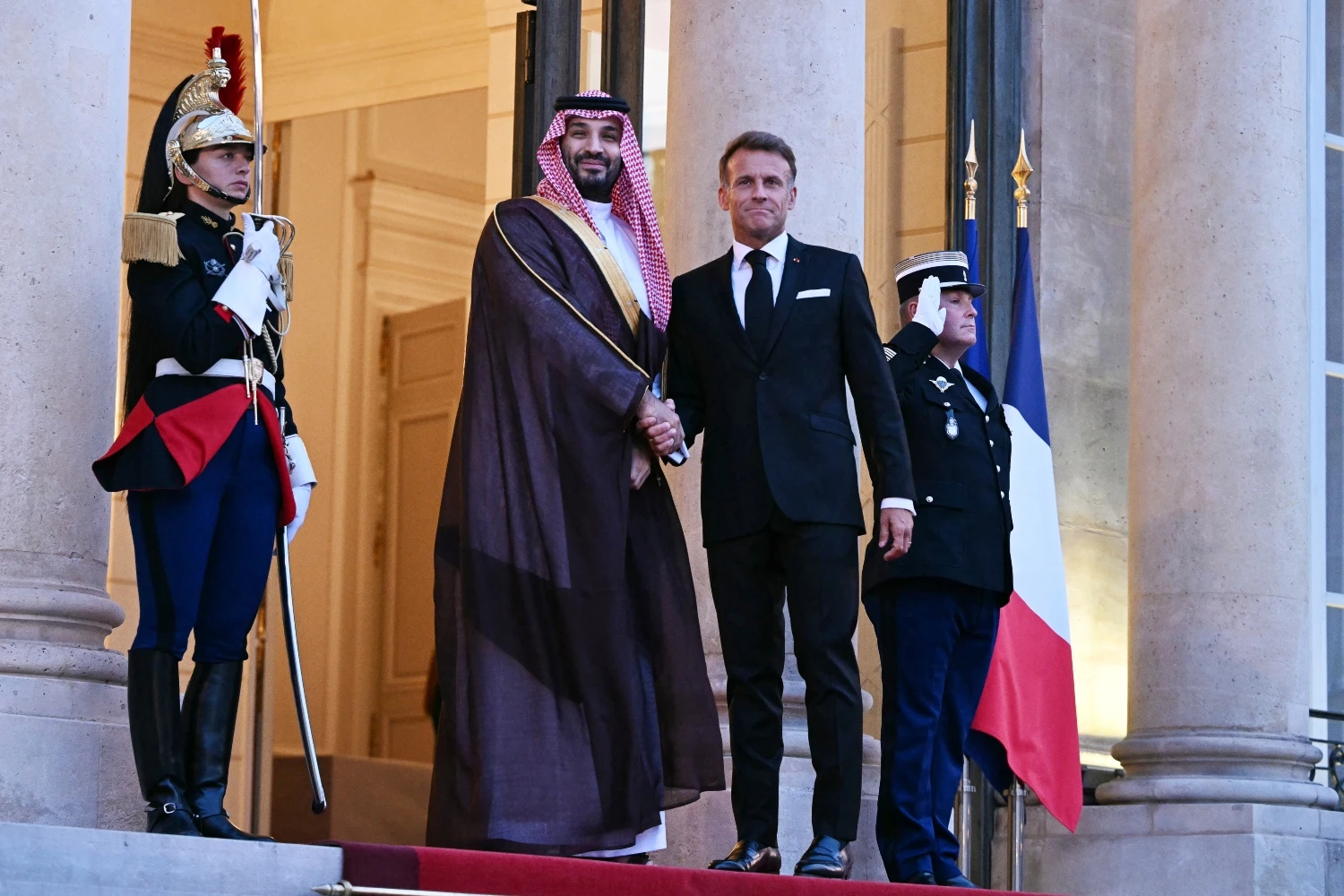

Saudi Crown Prince Mohammed bin Salman and French President Emmanuel Macron last week chaired the first meeting of the Franco-Saudi Strategic Partnership Council, signing 21 agreements across energy, industry, financial services, transport, artificial intelligence, culture, health and tourism. That was followed by this week’s inaugural Global Investment Summit, which brought European investors together in a Saudi-organized effort to deepen capital flows into the Gulf.
One gathering channeled Saudi capital and procurement toward France, the other was designed to channel European capital toward the Gulf. This points to a changing balance in the relationship, as Europe is no longer simply seeking Gulf investment. Gulf states are increasingly shaping where European capital and strategic partnerships go.
The most visible deal from the crown prince’s visit was a $7 billion entertainment complex outside Paris, with three theme parks developed under Saudi Arabia’s Qiddiya project. It is expected to create about 22,000 jobs in France.
The Global Investment Summit pointed in the opposite direction. Organized by Saudi group B&S Investments, it hoped to bring almost $29 billion in European capital into the Gulf, with a target of $50 billion by 2030. As such, the summit was not intended to be a simple gathering. It marked the beginning of a five-year series of meetings that will also take in Spain, the UK and Switzerland before ending in Riyadh in 2030. In other words, Saudi Arabia is building a sustained channel between European investors and Gulf markets and doing so on its own terms.
Saudi Arabia is building a sustained channel between European investors and Gulf markets and doing so on its own terms
Zaid M. Belbagi
The financial agreements signed by France and Saudi Arabia last month also point to a more practical phase in the relationship. The two sides have tied capital to projects with clear timelines. A $5 billion framework with Bpifrance, for example, is linked to the Riyadh Metro, the Sharaan Resort, and infrastructure for Expo 2030 and the 2034 FIFA World Cup. It also includes additional financing for Saudi Energy, alongside a $580 million contract with Alstom.
The change is as much about how the partnership is managed as the size of the deals themselves. Riyadh and Paris are moving away from the usual cycle of summits and declarations toward more structured bilateral discussions, with projects expected to move from agreement to implementation within 12 to 24 months. For Saudi Arabia, the attraction is speed and delivery. For France, it is a more direct route into the investment and procurement cycle created by the Kingdom’s transformation program.
Beyond delivery and structure, a third major shift lies in the industries involved. In fact, France is selling advanced engineering, digital tools and AI to power Saudi Arabia’s Vision 2030, while Gulf capital directly supports French jobs.
The latest agreements reflect this modern approach. Aramco secured $3.7 billion in supply deals with industrial firms SLB and Vallourec, while its digital branch partnered with Dassault Systemes on AI. Meanwhile, mining group Ma’aden teamed up with France’s Orano and a new long-term AI framework was struck between Saudi group Humain and French tech standout Mistral AI. Even the cultural partnership over the historic site of AlUla has now been extended to 2035. This creates a deep economic interdependence, one that goes far beyond traditional arms deals by embedding each nation directly into the other’s industrial future.
Europe offers Riyadh the closest large pool of investable capital at a time when the Gulf is trying to diversify both its economy and its external partnerships. France is therefore important, but it is only one part of a much wider network.
These two moves show a Kingdom expanding its options across security, investment and trade at the same time
Zaid M. Belbagi
The timing of the Paris visit was also telling. It was the crown prince’s first foreign trip since the defense agreement was signed with Turkiye and Pakistan in Makkah. These two moves show a Kingdom expanding its options across security, investment and trade at the same time.
But that does not amount to a shift away from Washington. It reflects something more pragmatic: Riyadh is increasingly comfortable in dealing with several major powers at once and has little reason to place all its strategic interests in the hands of any one of them.
The expanding Gulf-European partnership emphasizes capital and industrial capability. For the foreseeable future, European nations will complement, not replace, the established security architecture historically led by Washington. Besides, the summit’s multibillion-dollar investment pipeline represents an ambitious road map and its true impact will be measured by how seamlessly these frameworks convert into real commitments over the next two years.
The French push does not stop in the Gulf. Paris has been widening its engagement across the region, including in Syria. In July, Macron became the first Western European leader to visit Damascus since the fall of the Assad regime. He was accompanied by the CEOs of TotalEnergies and CMA CGM, signaling that France was looking beyond diplomacy and preparing its companies for the economic opportunities that could follow. The delegation discussed infrastructure, logistics and banking, giving French firms an early position in a market where much of the reconstruction work has yet to be allocated.
For the Gulf, this creates another opening. A stronger European presence gives Riyadh and its neighbors another partner to work with alongside Washington, Beijing and Ankara, while giving Gulf investors more options for placing capital beyond the region. The question, then, is less whether Europe and the Gulf are becoming more closely connected and more whether the growing volume of investment and commercial ties will eventually translate into political influence.
For now, Riyadh appears comfortable with the arrangement. It can work with Washington on security, Beijing on trade and technology, and Ankara and others on regional issues, while drawing European capital and expertise into its own economic transformation.
Zaid M. Belbagi is a political commentator and an adviser to private clients between London and the Gulf Cooperation Council. X: @Moulay_Zaid


