
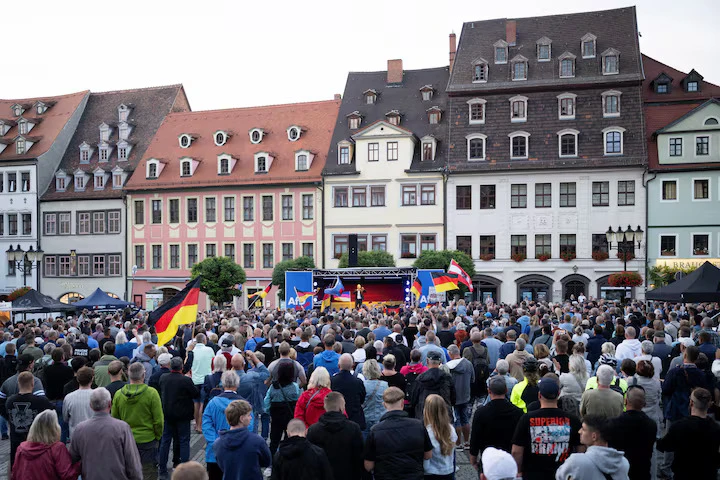

This weekend could witness the most consequential state election in Germany since the Second World War. This election could also be the EU’s most dangerous brush with the far right’s rise to power, forming a serious threat to the future of democracy, liberalism and the rule of law across the bloc.
Saxony-Anhalt may be a small eastern German state, but its upcoming election could herald the rise to power of an extremist right-wing party for the first time since 1930, when the Nazi Party of Adolf Hitler started its long march to power with 18 percent of the national vote.
Ahead of Sunday’s election, the far-right Alternative for Germany party has promised voters an economic boom through an array of policies that economists have deemed disastrous. These policies rest on deporting immigrants and reversing the renewable energy transition across the state. Voters have been promised uncosted gimmick policies, such as extensive new social benefits — including baby bonuses to encourage German couples to conceive — while being told there will be no new taxes and no new debt. Economists warn that deterring foreign workers through xenophobic rhetoric will only accelerate a skilled labor shortage in a state whose population is already diminishing and aging.
Alternative for Germany has polled at over 40 percent, harnessing widespread discontent with the federal government. It is set to be the largest party and could rule alone if the other parties do not improve their numbers come polling day. The conservative Christian Democratic Union, which has been the dominant party in the state since reunification in 1990, trails far behind, with support ranging between 23 percent and 26 percent.
Despite the Federal Office for the Protection of the Constitution’s classification of Alternative for Germany as a “confirmed right-wing extremist” organization, other parties are struggling to capture any reasonable chunk of the vote. The Left Party is polling at 13 percent and the center-left Social Democratic Party stands at between 6 percent and 7 percent.
But Germany’s predicament is not unique. Everywhere in Europe, the picture is getting gloomier. In France, parties from the right, the left and the center are grappling to find a candidate that could save the republic in the face of the continued rise of Marine Le Pen and her far-right National Rally party. She is seen as the favorite to win next year’s presidential election.
In Britain, Reform UK and now the even more extreme Restore Britain continue to breathe down the necks of the ruling Labour Party and the opposition Conservative, Liberal Democrat and Green parties. Politicians seem to be sleepwalking toward the rise of the ultra-right being a fait accompli.
In all three of these major European powers, leaders need a new political, economic and social approach if they hope to stay relevant. The far-right alternatives would bring more uncertainty and potentially chaos that could bring their democratic systems into question for good.
But all is not lost and a lot can still be done by the traditional parties to preserve democracy, liberty and the rule of law by defending their countries against the rise of groups that have a misguided ethno-nationalist, xenophobic design for society and state.
Influence from across the Atlantic, via the presidency of Donald Trump and its populist rhetoric, has weighed heavy across Europe. The US’ December 2025 National Security Strategy made no secret of its support for so-called patriotic forces across Europe in the face of the continent’s “stark prospect of civilizational erasure.”
Election interference campaigns run through an unpoliced digital realm have also helped fuel and exacerbate discontent.
In Saxony-Anhalt, Alternative for Germany’s rise in the polls has been due to its capitalization on the widespread dissatisfaction many people in the state feel regarding developments in Germany. Many jobs disappeared in the years following reunification, particularly in the lignite mining and chemical industries. The demographic challenges are also a factor, as the state had Germany’s oldest population in 2024.
Though Saxony-Anhalt’s foreign population remains comparatively small, many people oppose further immigration, as the number of people without German citizenship who live in the state has more than doubled since 2015.
At stake for Germany, like elsewhere, is whether the right-wing extremist parties will seek to reshape the constitutional order if they take power. Despite the region’s history of radical politics from the time of the Reformation, Alternative for Germany’s radical agenda for Saxony-Anhalt would be hard to implement, let alone spread to the rest of the country and ensure that other states fall in line with the far-right script. We are not there yet.
Whatever the outcome on Sunday, Alternative for Germany’s sustained lead in national polls is frightening and should send a shiver down the spine of the mainstream parties. Germany’s postwar politics has been founded on consensus, compromise and unity to suppress extreme nationalism and deny it the platform to govern or gain traction. Today, one in every four German voters currently backs a party that has tabled a plan for “mass remigration.”
The tool of noncooperation with the rising extremist party will not be enough. Just exposing such parties in Germany, France or the UK to the practical realities of governing and expecting them to fail is no longer a strategy to combat the populist promises. Mainstream parties ought to abandon their fractious politics and digest the fact that the enemies of democracy are at the gate. They must sharpen their tools to try and avert the adversities that lie ahead.
In Germany, France and the UK, public opinion is further poisoned by disinformation, aided and abetted by the Kremlin and Silicon Valley. The mainstream parties ought to tell voters that, at such times, they ought to assume responsibility and vote with their heads, not their guts. They should be persuaded that only through hope and boldness can nations overcome economic stagnation and the anxiety that accompanies it. This is a colossal ask but it is not impossible when faced with the alarming prospect of populism’s rise to power.
· Mohamed Chebaro is a British-Lebanese journalist with more than 25 years of experience covering war, terrorism, defense, current affairs, and diplomacy.


