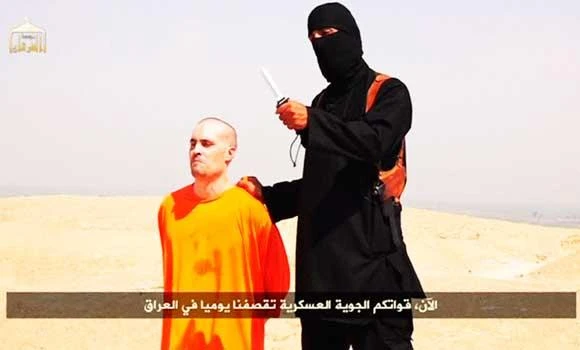
LONDON: “Jihadi John,” the masked Islamic State militant apparently responsible for beheading Western hostages, was named on Thursday as Kuwaiti-born London computer programmer Mohammed Emwazi by experts and the media.
The International Center for the Study of Radicalization at London’s King’s College, a leading resource for studying foreign militants, said it believed the identity “to be accurate and correct.”
Cage, a civil rights group that was in contact with Emwazi for two years over his alleged harassment by British security services, said the man bore “striking similarities” to the hooded militant.
Cage’s research director Asim Qureshi told a Washington Post reporter that due to the hood “there was no way he could be 100 percent certain,” the campaign group said in a statement.
The New York Times quoted a senior British security official saying that Emwazi had been identified by the government “some time ago” but the name had not been disclosed “for operational reasons.”
But London’s Metropolitan Police would not confirm a report that first appeared in the Washington Post, which identified the suspect as Emwazi, who grew up in west London after moving to Britain aged six.
“We are not going to confirm the identity of anyone at this stage,” Richard Walton, head of the police Counter Terrorism Command, said in a statement.
Contacted by AFP, the interior ministry could not immediately comment on the reports.
Emwazi, believed to be in his mid-20s, was identified to the Post by friends and others familiar with the case, with one close acquaintance telling the paper: “I have no doubt that Mohammed is Jihadi John.”
He is from a middle class family and earned a degree in computer programming before traveling to Syria around 2012, according to the report.
He is described as being quiet and polite with a taste for stylish clothes.
He apparently became radicalized after being detained by authorities following a flight to Tanzania and being accused by British intelligence officers of trying to make his way to Somalia, where they believed he had links to a man with connections to the militant group Al-Shabab.
The suspect was also angered after being barred from flying from London to Kuwait in 2010, according to e-mails sent by him to pressure group Cage.
“I had a job waiting for me and marriage to get started,” he wrote in an e-mail released by Cage.
But now “I feel like a prisoner, only not in a cage, in London,” he added.
He defined himself as “a person imprisoned and controlled by security service men, stopping me from living my new life in my birthplace and country, Kuwait,” the e-mail said.
“He desperately wanted to use the system to change his situation but the system ultimately rejected him,” Qureshi said in the Cage statement.
“This case should trigger thinking about British domestic and foreign policy.
“What risk assessments, if any, have been made about British counter-terrorism policy and the key part it plays in radicalizing individuals?” he said.
“Jihadi John,” named after Beatle John Lennon due to his British accent, is believed to be responsible for the murders of US journalists James Foley and Steven Sotloff, British aid workers David Haines and Allan Henning and American aid worker Abdul-Rahman Kassig.
He also appeared in a video with the Japanese hostages Haruna Yukawa and Kenji Goto, shortly before they were killed.
IS executioner ‘Jihadi John’ identified as UK national Emwazi