TUNIS: Militants who have joined the Islamic State group claimed Thursday the 2013 murder of two secular politicians that plunged Tunisia into crisis, warning of more killings just days before a presidential runoff election.
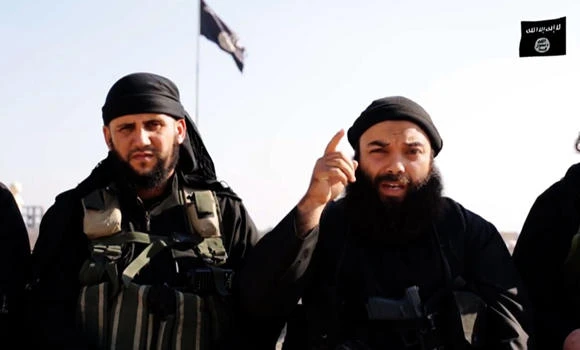
“Yes, tyrants, we’re the ones who killed Chokri Belaid and Mohamed Brahmi,” Abou Mouqatel, a dual French national wanted for their murders, said in a video released on the Internet.
It was not clear where the video was filmed, but Abou Mouqatel claimed they were in an area under the control of IS, which has seized swathes of Syria and Iraq.
“We are going to come back and kill several of you. You will not have a quiet life until Tunisia implements Islamic law,” added the militant, whose real name is Boubakr Al-Hakim.
Abou Mouqatel appeared along with three other militants, all of them dressed in combat uniform and carrying arms, with black banners waving behind them.
“Our message to the tyrants of Tunisia and to their soldiers is this — between us there will (only) be weapons.”
Interior ministry spokesman Mohamed Ali Aroui responded by saying “Tunisians are stronger than these terrorists. They mean nothing to us.”
Abou Mouqatel, born in Paris in 1983, is considered to be one of the key people organizing the flow of foreign militants to Iraq, where he himself has traveled to fight.
He was jailed in France for seven years in 2008, but given early release in 2011. The authorities in Tunis estimate that as many as 3,000 Tunisians have gone to Iraq and Syria to fight with militant groups including IS, and have expressed concern that some will return to carry out attacks at home.
Belaid was killed on Feb. 6 last year, while Brahmi was murdered on July 25, in attacks blamed by the authorities on the militant Ansar Al-Sharia group that had not previously been claimed.
The killing of Belaid triggered deadly protests and a political crisis that brought down prime minister Hamadi Jebali.
Brahmi’s murder intensified the crisis, and threatened to derail Tunisia’s post-Arab Spring transition until a compromise government was formed in January this year.
On Sunday, Tunisians vote in the second round of a presidential election, capping off four years of a sometimes chaotic transition since the 2011 of longtime ruler Zine El Abidine Ben Ali.
IS militants claim killings of Tunisian politicians