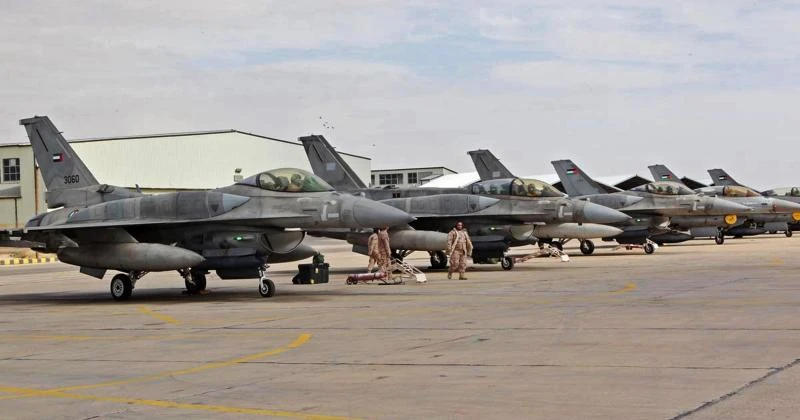
AMMAN: Jordan has launched 56 airstrikes against Islamic State group weapons depots, training centers and military barracks since militants released a video of them burning a Jordanian pilot to death, Jordan’s air force chief said Sunday.
Jordanian officials have said they would retaliate harshly for the slaying of the pilot, Lt. Maaz Al-Kasaasbeh, who set ablaze while trapped in a cage.
Since Thursday, the Jordanian air force has attacked and destroyed 56 Islamic State targets, the air force chief, Maj. Gen. Mansour Al-Jabour, told reporters. This includes training centers, military barracks, warehouses and weapons depots, he said.
“We achieved what we were looking for: Revenge for Maaz,” the general said. “And this is not the end. This is the beginning.”
The United States and several Arab allies, including Jordan, have been striking the Islamic State group in Syria since Sept. 23, while warplanes from the US and other countries have been waging an air campaign against the extremists in Iraq for even longer. The campaign aims to push back the jihadi organization after it took large parts of Iraq and Syria and declared a “caliphate.”
Al-Jabour said coalition planes have flown 5,500 sorties since the beginning of the air campaign, including 2,000 reconnaissance flights. He did not say whether this included flights over both Syria and Iraq. He said Jordan’s air force participated in 946 sorties.
The general said about 7,000 Islamic State group militants have been killed since the beginning of the coalition airstrikes, without elaborating.
Meanwhile, Syrian Kurdish forces have recaptured more than a third of the villages around Kobani from the Islamic State group since routing the militants from the town a fortnight ago, a monitor said Sunday.
“The (Kurdish) People’s Protection Units (YPG) have recaptured 128 villages out of some 350 in the past two weeks,” said Syrian Observatory for Human Rights director Rami Abdel Rahman.
The YPG recaptured Kobani on the border with Turkey from IS jihadis on Jan. 26, after four months of fierce fighting backed by Syrian rebels and US-led coalition air strikes.
“The IS withdrew from villages east and south of Kobani mostly without resistance, but fought hard to try to keep control of villages to the west,” said Abdel Rahman.
“That’s because it wants to try to protect areas under its control in Aleppo province. But the Kurds are steadily advancing,” he told AFP.
Jordan airstrikes hit 56 IS targets