- Chairman of country’s presidential council condemns attacks on Saudi Arabia
- Mohamed Al-Menfi expresses support for Palestine, Lebanon, Syria against Israeli aggression
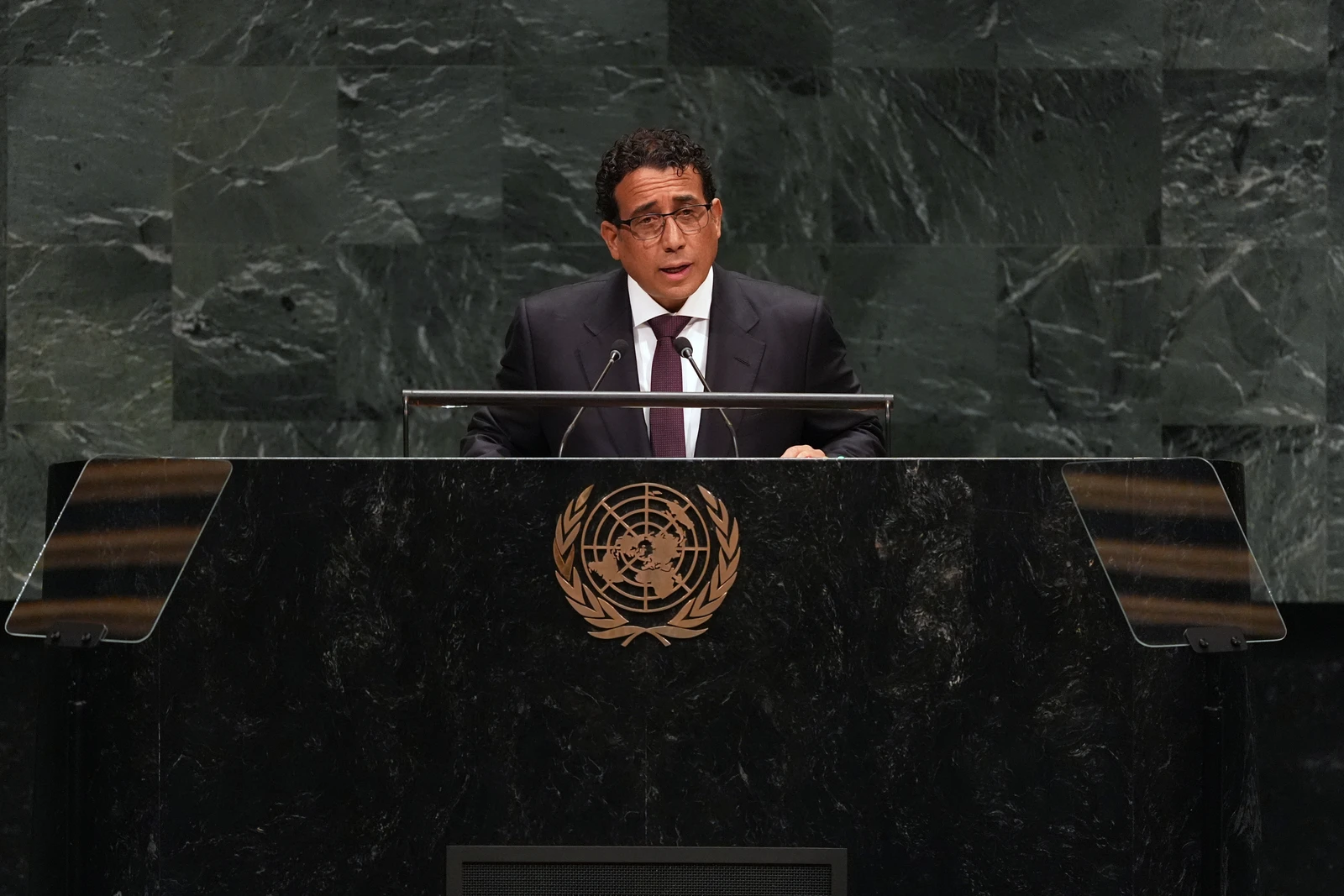
LONDON: Libya announced its intention to seek Africa’s seat on the UN Security Council for the 2028 term on Wednesday, as its leader condemned violence in the Middle East, North Africa and the Sahel region, and stated his support for Saudi Arabia following recent attacks on its soil.
Speaking at the UN General Assembly in New York, Chairman of the Presidential Council of Libya Mohamed Al-Menfi said his country’s UNSC candidacy “stems from a firm conviction that peace is built not merely on the absence of conflict, but on establishing justice and addressing the causes of injustice and instability.”
He said the move “embodies a national will for Libya to regain its natural role in the international arena and to shoulder its responsibility for the maintenance of international peace and security.”
He made the announcement as part of a wide-ranging speech that also touched upon issues surrounding regional security and African prosperity.
Al-Menfi reaffirmed Libya’s support for the rights of the Palestinian people, and condemned Israel’s escalation of hostilities against Lebanon and Syria.
“How can we build an international order in which the rule of law is an equal right, not a privilege of the most powerful, and how can we make cooperation a genuine partnership among nations rather than a carving up of spheres of influence? We in the Arab and Islamic world, and on our African continent, don’t approach the question as observers, for we live its consequences every day,” he said.
“That reality unfolds before us at every moment in Palestine, whose delegation we regret hasn’t been able to participate with us in the session.
“There, the plight of the Palestinian people continues to worsen after decades of occupation, repression and alteration of their identity, yet they remain steadfast in their adherence to their right to life and to self-determination.
“These are rights guaranteed … by international law and international humanitarian law. All of humanity yearns for international instruments and resolutions to move from texts and promises to a reality, and for the right of the Palestinian people to their state to be realized in accordance with international law.”
Criticizing Israel, Al-Menfi said: “The continued undermining of these prospects for its establishment not only squanders importunities for peace — it also drives the region toward a widening cycle of conflict, the spread of extremism, and the search for alternatives amid major expansionist projects that extend beyond occupied Palestine to Syria and Lebanon.”
Following the escalation of conflict in the Gulf due to Iran war, and amid escalating violence in Yemen, Al-Menfi also condemned the recent attacks on Saudi Arabia.
“We affirm our full solidarity with the Kingdom of Saudi Arabia in safeguarding its security, its territorial integrity, its citizens and its holy sites.
“We reject any targeting that threatens it or endangers Islamic holy sites. The security of the Kingdom and the Gulf … isn’t a national matter but a pillar of the security and stability of our region.”
Al-Menfi said the people of Sudan, “our brotherly neighbor,” are “victims of a devastating war for which they’re paying a hefty price.”
He added: “In that war, interests and interventions collide, and its effects extend beyond the borders of Sudan, endangering the security and stability of the region and the unity of its states.
“The instability in the Sahel region represents an existential threat to the unity of states. That threat stems from the nexus of terrorism, organized crime, poverty, climate change displacement and migration, and from the widening of the cycle of armed conflict in the region.
“It’s no longer acceptable for the world to regard the Sahel merely as a source of resources, an arena for international competition, or a footnote in global decision making.”
He noted Libya’s keenness to work with African partners for the prosperity of the continent, saying: “Africa, whose journey we’ve followed since the founding of the African Union, isn’t the margin of the world, it’s one of the centers of the world to come.
“Libya doesn’t lie on the edge of Africa. Libya is of Africa, of its history, of its security, and of its future.
“Decades ago, an African will emerged from the Libyan city of Sirte that contributed to the establishment of the African Union. That fact reminds us that Libya has never been merely a bridge between Africa and the Mediterranean, but a partner in shaping the African project itself.
“We therefore view the security of the Sahel region as part of Libya’s own security and stability. We view the security and stability of the states of the region, and all our African neighbors near and far … as investments in the common security of Africa and its European neighborhood.”
Libya, he noted, occupies a unique position at the crossroads of Africa, Europe and the Islamic world, making it a prime candidate for the UNSC seat and a central role in future dialogue between Africa and Europe amid increased tensions over security and migration.
“We view the Mediterranean basin not as a barrier between Africa and Europe, but as a shared space for connection. Relations among its countries should move beyond merely managing migration and crises toward making the Mediterranean a bridge for development, trade, every transition, investment and common security,” Al-Menfi said.
“Geographically and politically, Libya stands at the meeting point of these worlds. It’s Arab in its identity and language; African in its geography, destiny and belonging; Mediterranean in an intrinsic part of its culture, interests and partnerships; and Islamic in its civilizational values, which incline toward peace, security and building bridges with its neighbors.
“The multiplicity of these circles isn’t a contradiction but a source of strength, responsibility and opportunity.”
However, he noted Libya’s recent struggles, highlighting the damage caused by corruption, conflict and foreign involvement in his country.
“Sovereignty isn’t merely a flag raised, or borders drawn on maps. Nor is it slogans repeated while judicial and oversight institutions fail to exercise their roles independently and responsibly. Sovereignty means that national decision making is free,” he said.
“Sovereignty means protecting the rights and dignity of the Libyan people from violations, whoever the perpetrator, and ensuring that no one is above the law and no one escapes accountability.”
He said it is his aim to ensure that corruption in Libya is properly addressed, and he urged all parties in the country to engage with the framework of a new national committee for de-escalation and confidence building, drawing on local and national initiatives to prevent more conflict “in addition to supporting reconciliation and creating a safe environment for the political and electoral process.”
Al-Menfi concluded: “A Libya that regains its sovereignty and the unity of its institutions won’t be a gain for Libyans alone. It will be a force for stability in the Arab world, a source of strategic strength for security and development in Africa, a responsible partner in the Mediterranean, and a bridge for cooperation between North and South.”