As soon as word got out that Paul, France’s leading bakery, opened a branch on Tahliah Street, Aknaz Center, in Riyadh, customers were seen queuing up in front of the shop just before opening hours. I was lucky to miss the queue but in a matter of ten minutes, the restaurant cum coffee shop was filled with mostly women who had made an early start to enjoy a typical French breakfast.
Paul was founded in 1889 by the Holder family and has since expanded to more than 500 stores in over 22 countries.
The first Paul in the Middle East was established in Beirut where it became an instant hit. In Riyadh, a second Paul will open in Dhahran Mall in May 2013, said Rudy Haddad, Paul’s brand manager.
One of the keys to Paul’s successful expansion abroad lies in its superb branding. Paul offers what people abroad expect of France: a refined, chic atmosphere and good food.
“We provide the French ‘art de vivre’ to our customers through our inspired recipes,” said Haddad.
As soon as you enter Paul, you step into a different world. The wood stove at the entrance sets the tone. The first wood stove was installed in 1972 at the original bakery in Lille. Here it proved so popular that, as the Paul chain expanded to other French cities, it was incorporated in the shop’s architectural design.
The ambiance is cozy and relaxed, a perfect combination to enjoy the first meal of the day. Breakfast in France is a simple affair, croissants and bread with tea or coffee. If you are going to order bread, you have come to the right place.
Paul is famous for its homemade bread. A traditional seven-hour fermenting and baking process ensures the bread’s taste, texture and aroma. The breads are made with only natural ingredients. There are no artificial additives, no corn syrup, no hydrogenated fats and very little sodium. Paul’s signature bread, the baguette, is made from five ingredients only: certified organic wheat and corn flours, Atlantic sea salt, water and yeast. All the breads and pastries are made according to recipes that the Holder family developed over five generations. Moreover, the varieties of bread available in Riyadh are exactly the same traditional breads you can find in a Paul’s bakery in France.
I decided to order an almond croissant but was taken aback when the waiter informed me that they were none left! Most croissants are in fact sold out within minutes of the opening. I had to contend myself with a plain croissant but what a croissant: buttery, yet light and moist with a crispy crust!
The croissant, a symbol of French culture and tradition, has a disputed history. It has been said that several bakers in Vienna celebrated in 1683 the Turkish defeat in the Battle of Vienna by making a pastry in the shape representing the Turkish crescents they had seen on the enemy’s flags. They called this new pastry the “kipfel” which means “crescent” in German.
According to some historians, August Zang, an Austrian artillery officer, founded a Viennese bakery in Paris around 1839. This bakery served Viennese specialties including the “kipfel” and the Vienna loaf, which quickly gained popularity and inspired French bakers. After a while, the kipfel became what is known today as the croissant.
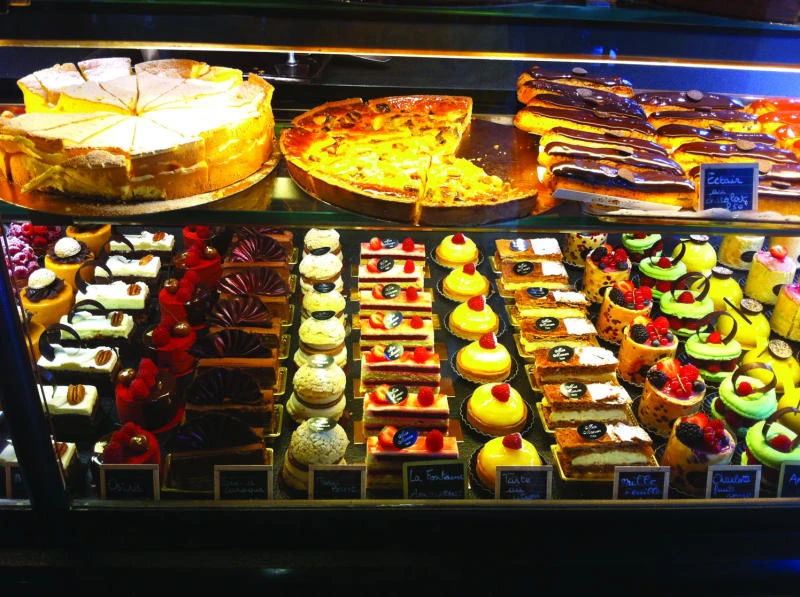
Paul offers several reasonably priced breakfast formulas, including orange juice as well as tea or coffee. You can also choose to order from the wide selection of their freshly baked traditional pastries like succès, opéra or the éclair. The latter is an oblong choux pastry, filled with a vanilla, coffee or chocolate flavored custard and topped with icing.
At one of Paul’s outlets in Paris, I once tasted a rhubarb tart. The thought of rhubarb takes me back to my childhood, when my sister and I ate freshly picked, young pink rhubarb stems, dipped in sugar.
I prefer, by far, Paul’s old-fashioned apricot tart, which tastes even better when it is served warm with some whipped cream. The raspberry charlotte and strawberry charlotte are equally tempting. This splendid pudding appeared in the culinary repertoire between 1761 and 1796, when George III married Charlotte Sophia of Mecklenburg Strelitz. And it seems that it was a certain Mrs. Rundell who was the first to publish a recipe for the charlotte in her book, “A New System of Domestic Cookery”.
Speaking of fruit desserts, I would love to see Paul include fruit crumbles. This is a delicious but light dessert of chopped fruit and a crispy crumble topping, served warm with whipped cream, ice-cream or even a vanilla cream.
For a light lunch or a snack, you can order a take-away sandwich or sit down to enjoy it. The sandwiches are made on freshly baked demi-baguettes. A crunchy French baguette is the perfect base for any sandwich, and Paul has definitely got that recipe! Sandwich fillings include tuna, tomato, lettuce and olive spread or smoked salmon tomato, lettuce and lemon spread, and the classic Caprese with mozzarella, basil and tomato and of course the delicious “Paulette” with Brie cheese and lettuce. In addition to their sandwiches, Paul also serves soups, salads, quiches and light main courses.
“We prepare food on order. Hence what’s on display at 11 a.m. is not the same as what you would find at 1 or 4 p.m. At Paul, the philosophy is very simple: use the finest quality natural ingredients and time-honored methods of production. Paul is in fact known for ‘all day freshness‘ of the food it serves,” concludes Rudy Haddad.
French delight: Paul indulges Riyadh