Israeli airstrikes have minimal impact, says Syrian monitoring group
Israeli airstrikes have minimal impact, says Syrian monitoring group
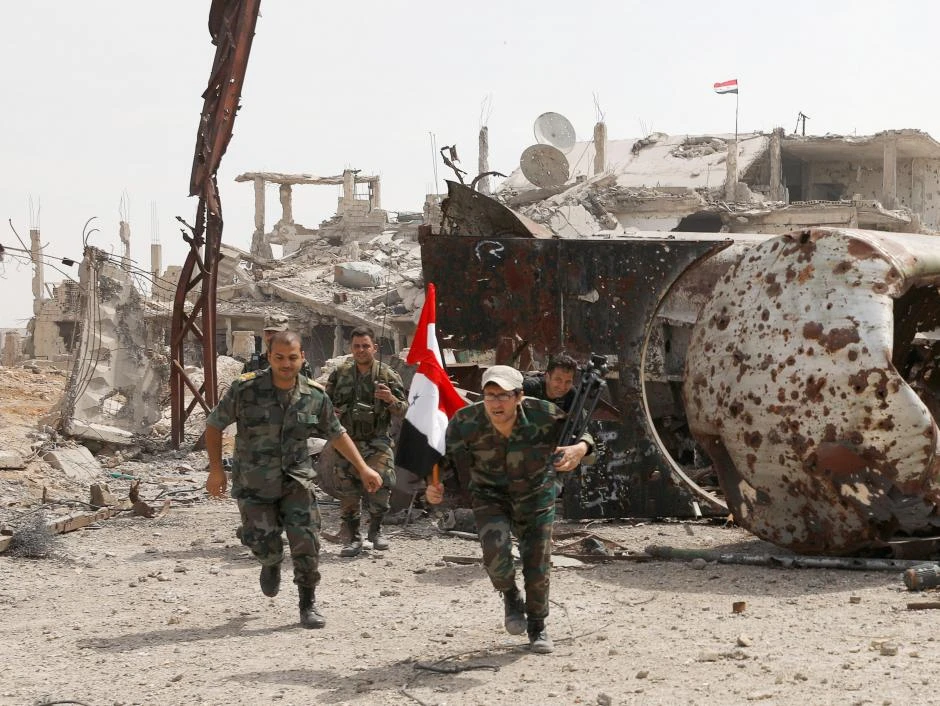
File photo showing soldiers loyal to Syria’s President Bashar Assad forces at Al-Qadam area near Damascus, Syria. (Reuters)
Updated 10 May 2018

Israeli airstrikes have minimal impact, says Syrian monitoring group
Israeli airstrikes have minimal impact, says Syrian monitoring group

LONDON: Israeli strikes on Iranian and Assad regime army bases in Syria sending a strong message that Tel Aviv will not allow militias loyal to Iran to threaten Israel’s security have been dismissed as having “minimal impact” by a Syrian monitoring group in London.

The Syrian Observatory for Human Rights,told Arab News that last night’s strike by Israel on Iranian and Syrian targets was for media consumption.

Rami Abdurrahman, the head of the SOHR, said the Israeli defense minister’s comments on the scale of the strike were “mere publicity.”

Abdurrahman, who is linked with a network of activists inside Syria, added that 40-45 percent of incoming Israeli missiles were destroyed by the Assad regime and their allies’ air defenses.

He added that all options remain open, but the world must watch to see how Russia, with its extensive presence in Syria, reacts.

“One could say that Russia succeeded in containing the situation, preventing further military escalation, but Iran has a large presence in Syria from the Iraq border at Al Bo Kamal all the way to Lebanon”.

The Syrian Observatory earlier listed more than 12 sites targeted in the Israeli raids, including several air defense sites around south western Damascus and the military air strips of Masseh, Shuerat and Khalkhaleh.

The Israelis also attacked two elite army divisions loyal to the Assad regime, the 4th Armored Division, the Republican Guard, and 60th Brigade and hit Kesweh, a high security area that houses key regime and Iranian intelligence units.


Quarter of civilian casualties in Yemen are minors: Save the Children

Quarter of civilian casualties in Yemen are minors: Save the Children
Updated 23 March 2021

Quarter of civilian casualties in Yemen are minors: Save the Children

Quarter of civilian casualties in Yemen are minors: Save the Children
  • In press conference attended by Arab News, aid group warns of ‘enormous, deep-rooted famine’
  • Saudi Arabia on Monday announced measures to ease Yemen’s humanitarian crisis

LONDON: Roughly one in four civilian casualties of the war in Yemen are children, and the situation is getting worse, Save the Children said during a press conference attended by Arab News on Monday to mark six years since the start of the conflict.


“Between 2018 and 2020, there were 2,341 confirmed child casualties,” but “the actual number is likely to be much higher,” the aid group said.


“In addition, the conflict is getting deadlier for children. In 2018, one in five civilian casualties were children, but in 2019 and 2020, that jumped to one in four.”


Yemen, the poorest country in the Middle East, was plunged into violence when the Iran-backed Houthi militia staged a violent coup against the UN-recognized government in the capital Sanaa. Since then, the humanitarian situation has progressively worsened.


“All wars that are waged in the world are wars against children, and Yemen is, sadly, a classic example of that,” said Jeremy Stoner, Save the Children’s regional director for the Middle East.


“Six years of conflict isn’t just about sporadic acts of violence that involve children, but what happens is that over six years the crises become compounded,” he added.


“We’re in a situation this year where Yemen is about to experience an enormous and deep-rooted famine that’s going to affect thousands or hundreds of thousands of children, and others, in that country. Children are going to be suffering these consequences right now, but (also) for years to come.”


Save the Children warned that a serious drop in funding for humanitarian aid, as well as problems in delivering it to those most in need, are likely to deepen Yemen’s already-serious crisis.


Due in part to the coronavirus pandemic, countries such as the UK have slashed their aid budgets and donations to Yemen have dropped massively, said Gabriella Waaijman, humanitarian director at Save the Children.


“It’s absolutely shocking to me that the UK proposed a 60 percent cut in its budget for Yemen … when six months ago the UK launched a global call to action to prevent famine,” she added.


“I don’t want to pick on the UK only. In 2018, we had about $5 billion available to Yemen — in 2020 we had $2 billion, so it’s not just the UK.”


Financial aid remains essential to ease the suffering of the Yemeni people, but the ultimate goal is peace, said Waaijman and Stoner.


Saudi Arabia, which is leading the nine-country military coalition in support of the UN-recognized government against the Houthis, on Monday said it had agreed major steps with the UN toward peace in Yemen.


Saudi Foreign Minister Prince Faisal bin Farhan on Monday announced a comprehensive ceasefire across Yemen, to be supervised by the UN.


In steps aimed at easing the humanitarian situation in the country, flights will be allowed to and from Houthi-controlled Sanaa to a number of regional and international destinations.


Restrictions on the port of Hodeidah will be eased, allowing ships and cargo — including vital humanitarian aid — to travel in and out of Yemen.


US Secretary of State Antony Blinken told Prince Faisal in a phone call that he supports efforts to “end the conflict in Yemen, starting with the need for all parties to commit to a ceasefire and facilitate the delivery of humanitarian aid.”


Prince Faisal said: “It is up to the Houthis now. The Houthis must decide whether to put their interests first or Iran’s interests first.”


Egyptian president warns of coronavirus third wave

Egyptian president warns of coronavirus third wave
Updated 22 March 2021

Egyptian president warns of coronavirus third wave

Egyptian president warns of coronavirus third wave
  • Extreme caution urged during Ramadan

CAIRO: Egyptian President Abdel Fattah El-Sisi has warned of an imminent coronavirus third wave and stressed that people should adhere to precautionary measures.

Egypt had “survived” the first and second waves and was “on the cusp” of a third, he said during a Mother’s Day speech, adding: “We hope that it will pass (without significant harm).”

Adhering to precautionary measures and exercising extreme caution was important, he said, especially during the holy month of Ramadan when people would want to gather. “We want the situation to end safely.”

A few days ago the Ministry of Health warned of an increase in COVID-19 cases during the coming weeks, coinciding with the month of fasting.

Egypt’s Minister of Health and Population Dr. Hala Zayed said that, through the lessons learned from the first wave and the hike in last April’s cases, there was the expectation that this April may also witness an increase in cases, as the peak occurred in the seventh week of each wave.

Presidential adviser for health affairs, Mohamed Awad Tageldin, also anticipated the coming period to see more COVID-19 infections.

Egypt was in a state of COVID-19 case fluctuations, he said, and the numbers were rising and decreasing by 10 percent daily. The third wave had started in other countries, he added. “But we hope that we will not reach this stage. A third wave may occur in Egypt if we do not adhere to the precautionary measures.”

Islam Anan, a professor of health economics and epidemiology, expected Egypt to witness a third wave by next month. The country was still at the end of its second wave and there was an increase in the number of casualties, he said.

Anan added that countries were divided into parts where COVID-19 spread along the emergence of new waves, as they appeared first in Europe, then Asia, the US, and finally the Middle East and Egypt, pointing out that the third wave had begun in Europe.

But Dr. Hossam Hosni, head of the scientific committee to combat coronavirus, said Egypt was currently in a stage of epidemic stability, having controlled the second wave.

“The occurrence of a third wave of the virus is related to factors including low societal awareness, climate changes, and the lack of necessary caution, which is the basis for surviving the rise of infections again. We are currently in the stage of epidemiological stability.”

An official at Egypt’s Health Ministry said an update was being made to the treatment protocol in order to contribute to high recovery rates among the sick, following the previous update in November.


UN experts demand ‘credible’ probe into murder of Hezbollah critic

Luqman Slim, 58, was shot six times, three times in the head, in his car on Feb. 4. He was found in an area of southern Lebanon said to be under Hezbollah’s control. (AP/File Photo)
Updated 22 March 2021

UN experts demand ‘credible’ probe into murder of Hezbollah critic

Luqman Slim, 58, was shot six times, three times in the head, in his car on Feb. 4. He was found in an area of southern Lebanon said to be under Hezbollah’s control. (AP/File Photo)
  • Concerns raised over effectiveness of Lebanese government’s investigation into Luqman Slim’s death
  • ‘A lack of accountability may have a profound chilling effect on freedom of expression in Lebanon’

LONDON: UN human rights experts have called on Lebanon’s government to “ensure a credible and effective investigation” into the assassination prominent intellectual and Hezbollah critic Luqman Slim.

“More than a month after Mr. Slim’s murder, the investigatory steps taken at national level have led to no meaningful result, raising concerns as to the effectiveness of the current investigation,” said the three special rapporteurs from the UN’s Human Rights Council.

“The government should urgently implement measures to guarantee the independence and the impartiality of the investigation, and ensure that those responsible are identified and held accountable.”

Slim was an outspoken critic of Iran-backed Hezbollah, and many have speculated that the group was behind his murder.

Slim, 58, was shot six times, three times in the head, in his car on Feb. 4. He was found in an area of southern Lebanon said to be under Hezbollah’s control.

Prior to his death, he said should he be killed, “everybody would know who would be behind it.”

The experts, who specialize in extrajudicial killings, judicial independence and free expression, said: “The killing of Mr. Slim appears to be linked to his civic engagement and to be emblematic of the regression of Lebanon civic space, in the context of a reported surge of arrests, intimidations, threats and violence against human rights defenders, journalists and activists.”

They added: “We are deeply concerned that the murder of Mr. Slim in the event of a lack of accountability may have a profound chilling effect on freedom of expression in Lebanon.”

The UN said Slim was reportedly probing how and why the huge supply of ammonium nitrate that exploded in Beirut’s port last year, killing over 200 people and injuring thousands, was in the country.

“Any alleged relation between the explosion and Mr. Slim’s assassination should be fully investigated,” the experts said.

At the time, US Ambassador to Lebanon Dorothy Shea condemned the killing, saying: “We are saddened to have lost a great person through such an unacceptable barbaric act that we will never forget.”

She emphasized “the need to know who committed this heinous crime,” and vowed to “continue supporting the institutions Slim had established.”


Lebanon stalemate continues after 18th Aoun-Hariri meeting collapses

The 18th meeting between Hariri (L) and Aoun (R), held at the Presidential Palace, was met before and after with pessimism by much of the Lebanese public. (AFP/File Photos)
Updated 22 March 2021

Lebanon stalemate continues after 18th Aoun-Hariri meeting collapses

The 18th meeting between Hariri (L) and Aoun (R), held at the Presidential Palace, was met before and after with pessimism by much of the Lebanese public. (AFP/File Photos)
  • Saad Hariri: President ‘had last chance to end collapse’
  • Protesters swarm Beirut streets as currency exchange rate spikes on black market

BEIRUT: A critical meeting on Monday between Lebanese President Michel Aoun and Prime Minister-designate Saad Hariri on the country’s uncertain future failed to reach an agreement.

The 18th meeting between the two men, held at the Presidential Palace, was met before and after with pessimism by much of the Lebanese public.

Hariri insists on forming a government of 18 independent specialists acting as ministers, without the capacity for a blocking third by any party, while Aoun and his Free Patriotic Movement (FPM) propose a government of 20 ministers, with the right to name 6 ministers in addition to an Armenian minister.

After Monday’s meeting, which lasted just 35 minutes, Hariri said that Aoun sent him on Sunday “a complete ministerial structure in which the portfolios were distributed among the sects and parties, along with a letter telling me that it is advisable to fill it out.

“The list includes a blocking third of his political team, whether the government consists of 18, 20 or 22 ministers.

“He asked me to suggest names for the portfolios according to the sectarian and party distribution that he had prepared.”

Hariri said that he told Aoun during the meeting that “this is unacceptable because it is not the prime minister—designate’s job to fill out lists prepared by anyone, and it is not the job of the president to form a government.

“Our constitution clearly says that the prime minister-designate forms the government and puts the names, and discusses his formation with the president of the republic.

As a result of this, Hariri said: “Accordingly, I respectfully informed him that I consider his letter as if it had not been sent. I returned it to him and informed him that I would keep a copy of it for history.”

Hariri said he previously suggested a government formation to Aoun more than 100 days ago, and told him: “I am ready for any proposals and amendments to names and portfolios. Even with his insistence on the Interior Ministry, I suggested a solution for him. Unfortunately, his answer was clear: The blocking third.”

Hariri added: “I have one goal, which is to put an end to the collapse and the suffering of the Lebanese. I asked the president to listen to the pain of the Lebanese and give the country its only and last chance for a government of specialists to implement reforms and stop the collapse without disruption or narrow partisan considerations.”

Hariri denied that he had previously provided Aoun with broad lines for his government. He distributed to the media the list of “specialized ministers” that he presented to Aoun on Dec. 9, requesting that “public opinion be the judge.”

The prime minister-designate did not respond to questions by the press, and no date has been set for a new meeting between the ​two parties.

Hariri’s suggested list included well-known academics and experts, including three women.

The Future Movement media coordinator, Abd Al-Salam Moussa, told Arab News: “Hariri thwarted the administration’s coup against the republic.”

After Hariri finished a speech at the Presidential Palace after the meeting, large swathes of protesters took to the streets of Beirut to express their anger, while electronic platforms that control the black market began to raise the dollar exchange rate again.

Earlier in the day, the exchange rate stood at 11,300 Lebanese pounds, but after Hariri’s statement, it spiked to 13,000 Lebanese pounds.

The 17th meeting between Aoun and Hariri last Thursday also complicated Monday’s meeting, making it difficult to reach a solution to Lebanon’s political crisis.

Maronite Patriarch Mar Bechara Boutros Al-Rahi, on the eve of Aoun and Hariri’s meeting, appealed to the two parties to “stop onerous conditions.”

He said: “​If some want to burden the next government with the region’s conflicts and the race to the presidency, regime change and control of power, then​ that​ will lead to chaos​, which ​will not show mercy to anyone, starting with its creators.”

Caution and public anxiety preceded the Aoun-Hariri meeting and increased after it.

Despite the reopening of restaurants and cafes on Monday, with strict health measures in place — two months after total lockdown began — the public chose to stay home.


Yemenis embrace Saudi peace initiative and urge Houthis to accept

Yemenis embrace Saudi peace initiative and urge Houthis to accept
Updated 22 March 2021

Yemenis embrace Saudi peace initiative and urge Houthis to accept

Yemenis embrace Saudi peace initiative and urge Houthis to accept
  • Analyst says there is no excuse for militias to reject it as it meets all their requirements
AL-MUKALLA: The Yemeni government, local officials and displaced people on Monday welcomed the Saudi initiative to halt the war in Yemen, and called on the Houthis to accept it and end more than six years of conflict.

Yemen’s Foreign Ministry said the Saudi plan is “compatible with” the Yemeni government’s repeated calls for peace and an end to the suffering of the Yemeni people. It blamed the Iran-backed Houthis for the failure of previous peace plans.

“The Yemeni government is fully aware that ending the suffering of Yemenis will only be done by ending the coup and the war that was sparked by the Houthi militia,” the ministry said. “(The government) is committed to all peace efforts to end the coup, restore the state and reject Iran’s destructive project in Yemen.”

The war in Yemen began in late 2014 when the Houthis stormed the capital, Sanaa. They placed President Abed Rabbo Mansour Hadi under house arrest and overthrew his government. The conflict has claimed more than 100,000 lives, destroyed state institutions and, according to the UN, created the world’s worst humanitarian crisis.

The effects of the war and Houthi oppression forced tens of thousands of Yemenis in Houthi-controlled regions to flee their homes. They are now living in displacement camps in areas under government control.

Abu Omer and his large family fled the fighting in the northern province of Al-Jouf early last year. They are now living in a camp in the central city of Marib. He said he hopes the Saudi initiative will end the war, and urged the warring factions to cease hostilities so that his family can go home.

“This is good news and all people must accept it,” he told Arab News. “I hope to return to my home when the Houthis leave our area.”

Health officials in Yemen have also called for a halt to the fighting across the country so that they can work to contain a new wave of COVID-19 infections that has started to claim dozens of lives in the past few days.

Ishraq Al-Subaee, a spokeswoman for the Aden-based National Coronavirus Committee, called on the warring factions to accept the Saudi peace initiative to help relieve the pressure on health services in Yemen.

“We (support) the peace initiative and calls for stopping the war in Yemen,” she told Arab News. “We want to confront the second wave of coronavirus that has spread quickly in the country.”

She added that the war has devastated the Yemeni economy and health service, and is responsible for creating a malnutrition crisis.

Analysts said that the Saudi initiative leaves no room for maneuver for the Houthis, who have long refused to accept any peace deal that does not include the reopening of Sanaa airport and Hodeidah seaport, among other things. Saleh Al-Baydani, a Yemeni political analyst, told Arab News that there is no excuse for rejecting the deal because it meets all of these requirements.

“The initiative shows the international community who is the party that obstructs peace efforts in Yemen,” Al-Baydani said. “The international community should exert real pressure on this militia that has held millions of Yemenis hostage.”

The Houthis have rejected or breached previous peace agreements and initiatives, said Yasser Al-Yafae, a Yemeni political analyst in the southern city of Aden. Therefore they might try to disrupt the latest plan by launching drone and missile strikes on targets inside and outside of Yemen if the international community does not intervene, he warned.

“Without real international pressure on them, the Houthis could foil this initiative like what they did with previous peace efforts,” Al-Yafae told Arab News.