


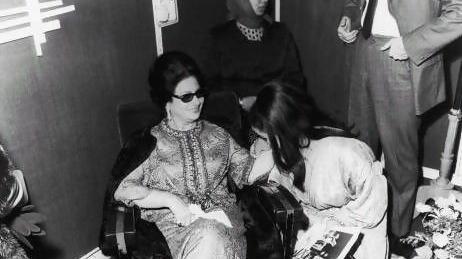
A group of musicians and singers traveled recently from the US to Saudi Arabia, for the first time, to pay tribute to two legendary singers from the Arab world. In two concerts featuring classics from 20th-century Arab music, the young ensemble, currently called the National Arab Orchestra, delighted Saudi audiences. Two female artists, by any measure towering figures of contemporary art in the Arab world, Asmahan and Umm Kulthum, were invoked through eight songs. Featuring two capable singers, Syrian Lubana Al-Quntar and Egyptian May Farouq, the concerts at the main theater of the King Abdul Aziz Center for World Culture (Ithra) in Dhahran were reportedly sold out. These events, and the enthusiasm with which they were received, are reminders of how music works in predictable, as well as unpredictable, ways, including in settings that combine seemingly disparate elements.
The small orchestra is an Arab music ensemble, founded and conducted by Michael Ibrahim, a graduate in music from the universities of Eastern Michigan and Wayne State. Since the then-student ensemble’s first concert in 2009, the number of amateur and professional musicians engaged with it has increased. Current members, who reside in different parts of the US, meet in Michigan for rehearsals prior to each performance, Ibrahim informs me. Their mission? “To preserve and integrate Arab culture by creating memorable musical experiences,” according to the ensemble’s Facebook page.
As a registered nonprofit organization in the state of Michigan, the ensemble emphasizes education in its mission. Its location, in one of the Midwestern states to have been badly hit by the decline in the automobile industry, is home to a sizeable Arab immigrant community, especially from Iraq and Syria, which regularly hosts refugee families. That this location puts the ensemble and its mission in a place of particular need and relevance would not have escaped its founding conductor Ibrahim, a 35-year-old son of Syrian migrants, whose artistic mission appears to be enhanced by a social entrepreneurial spirit. Through a number of configurations, the ensemble’s musical outreach started in the Detroit public school system and has now reached Saudi Arabia.
Arab music is traditionally performed by “takht,” a small ensemble that usually includes qanun, oud, nai, a percussion instrument (typically riqq), and (frequently) one violin. For a number of reasons, the size and variety of instruments increased dramatically in 20th century stage performances (to include electric keyboards, for instance). Still, academically inclined institutions in the Arab world have adhered more closely to takht formations, even with large ensembles. State-sponsored, national institutions, such as the opera houses of Cairo and Damascus, relied on size in establishing the National Arab Music Ensemble and the Syrian National Orchestra for Arabic Music, respectively. It is not clear why the 24-member Michigan ensemble chose a comparable name, other than perhaps to emphasize a focus on what many would consider high art in Arab music.
That emphasis was abundantly clear to the Dhahran audience. Conversations between the ensemble’s and the center’s artistic directors began in March and a program was designed, in collaboration with Al-Quntar and Farouq, to bring to the fore women in Arab music. While Kulthum’s songs were played in shorter renditions than in the diva’s original recordings, the audience experience was, in many ways, as close as it gets to what mid-20th-century nostalgia would reconstruct.
While in some ways the Dhahran concerts were not extraordinary events, they were, in fact, striking and beautiful occurrences.
Tala Jarjour
At the start of the first concert, Ibrahim addressed the audience, alerting them to a change in the order of pieces in the program. This practice is familiar to concertgoers in the world of orchestral performance. However, deviating from current European-style orchestral concert decorum, Ibrahim made a double take. Turning again to face the audience, he invited its members to participate by clapping. Alluding to the participatory nature of listening in Arab music, and to the fact that performers draw necessary feedback from seeing and hearing audience reactions, this orchestral conductor’s invitation elicited loud cheers. Throughout the concert, audience members sang along and clapped, shouted appreciation, and interjected compliments for the singers.
While in some ways the Dhahran concerts were not extraordinary events (an emerging group of Arab and non-Arab musicians giving its first overseas concerts), they were, in fact, striking and beautiful occurrences. From the misfortunes of economic depression and political disadvantage, American music enthusiasts traveled to one of the world’s wealthiest countries to showcase Arab culture. At face value, the gaps between the disparate pieces of this picture could not be wider. Yet, in Dhahran, music defied stereotypical perception. As evidenced by audience energy and reactions, music renders gaps irrelevant, as it consoles and connects.
According to Ithra developer Aramco, the aim of the center is to transport the Kingdom from the era of oil discovery to an era of knowledge discovery. The distinguished building, designed to mimic a constellation of five rocks in the desert, symbolizes linking past, present and future, and facilitates connecting heritage with achieving dreams. If “inspiring minds” is the expressed purpose of Ithra (which means enrichment), then harnessing music, along with the social and cultural powers it carries and revives, is indeed a potent strategy.
- Tala Jarjour is author of “Sense and Sadness: Syriac Chant in Aleppo” (OUP, 2018). She is currently Visiting Research Fellow at King’s College London and Associate Fellow of Pierson College at Yale.


