UN experts denounce Israeli branding of Palestinian rights groups as terrorists

UN experts denounce Israeli branding of Palestinian rights groups as terrorists
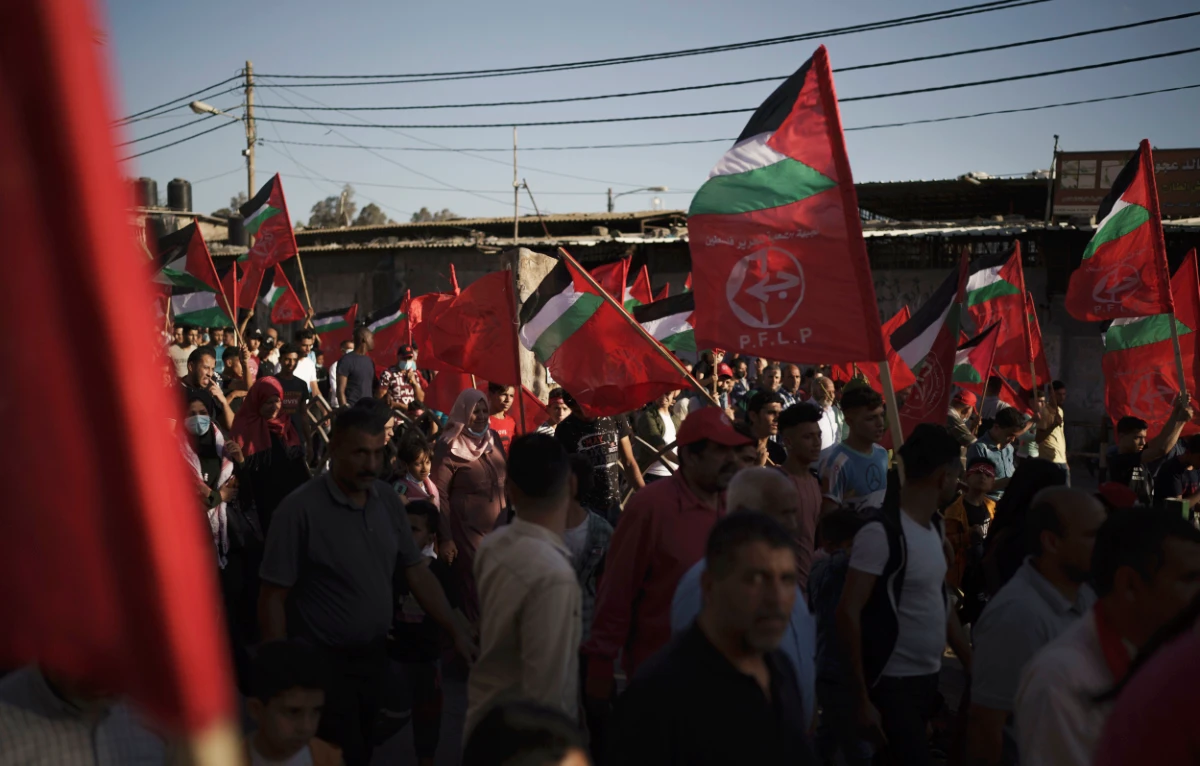
Palestinians attend a rally organized by the Popular Front for the Liberation of Palestine (PFLP), in Gaza City. (AP/File)
Short Url
Updated 26 October 2021

UN experts denounce Israeli branding of Palestinian rights groups as terrorists

UN experts denounce Israeli branding of Palestinian rights groups as terrorists
  • Group of special rapporteurs said designation of six organizations is an ‘attack on the Palestinian human rights movement and on human rights everywhere’
  • They said it is not what a democracy following accepted humanitarian standards would do; called on the international community to ‘defend the defenders’

NEW YORK: UN human rights experts on Monday “strongly and unequivocally” condemned the decision by Israeli authorities to designate six Palestinian human rights groups as terrorist organizations.
“This designation is a frontal attack on the Palestinian human rights movement and on human rights everywhere,” the special rapporteurs said.
“Silencing their voices is not what a democracy adhering to well-accepted human rights and humanitarian standards would do.” 
They called on the international community to “defend the defenders” and added: “These civil society organizations are the canaries in the human rights coalmine, alerting us to the patterns of violations, reminding the international community of its obligations to ensure accountability, and providing voices for those who have none.”
Special rapporteurs are independent experts who serve in individual capacities, and on a voluntary basis, on the UN’s Human Rights Council. They are not members of UN staff and are not paid for their work.
They include Martin Lynk, special rapporteur on the situation of human rights in the Palestinian territories occupied since 1967, and Fionnuala Ni Aolain, special rapporteur on the promotion and protection of human rights while countering terrorism.
The experts said that antiterrorism laws must not be used as a tool to undermine freedoms, and reminded Israeli authorities that the Security Council and all other UN bodies “have all been clear about the requirement to apply counter-terrorism measures in a manner which is consistent with international law and does not violate states’ international obligations.”
Such “egregious misuse” of counterterrorism measures by Israel, the experts added, undermines the security of all.
Israeli Defense Minister Benny Gantz on Friday designated as terrorist groups the Palestinian organizations Addameer, which provides legal support for prisoners and collects data on arrests and detentions; Al-Haq, which documents rights violations; Defense for Children International Palestine; the Union of Agricultural Work Committees, the Bisan Center for Research and Development, and the Union of Palestinian Women Committees.
“These organizations speak the language of universal human rights (and document abuses in Palestine),” the experts said. 
They added that the decision to designate them as terrorist organizations effectively bans their work and gives the Israeli military free rein to arrest employees, close offices and confiscate assets.
The experts expressed concern that in the case of one of the organizations, the decision might be a reprisal for cooperation with UN groups.
“The Israeli military has frequently targeted human rights defenders in recent years as its occupation has deepened, its defiance of international law has continued and its record of human rights violations has worsened,” the experts said.
“While international and Israeli human rights organizations have faced heavy criticism, legislative restrictions and even deportations, Palestinian human rights defenders have always encountered the severest constraints.”
UN spokesman Stephane Dujarric said that the UN office in Jerusalem, in addressing the issue, continues to engage with the Israeli authorities and the concerned parties.
“The secretary-general has repeatedly expressed concern about the shrinking space for civil society in many places around the world, including in Israel,” he added.
Taliban order Afghan girls’ schools shut hours after reopening

Taliban order Afghan girls’ schools shut hours after reopening
Updated 23 March 2022

Taliban order Afghan girls’ schools shut hours after reopening

Taliban order Afghan girls’ schools shut hours after reopening
  • All schools were closed because of the COVID-19 pandemic when the Taliban took over last August
  • Only boys and some younger girls were allowed to resume classes two months later

KABUL: The Taliban ordered secondary girls schools in Afghanistan to shut Wednesday just hours after they reopened, an official confirmed, sparking confusion over the policy reversal by the hard-line Islamist group.
“Yes, it’s true,” Taliban spokesman Inamullah Samangani told AFP when asked to confirm reports that girls had been ordered home.
An AFP team was filming at Zarghona High School in the capital Kabul when a teacher entered and ordered everyone to go home.
Crestfallen students, back in class for the first time since the Taliban seized power in August last year, tearfully packed up their belongings and filed out.
The international community has made the right to education for all a sticking point in negotiations over aid and recognition of the new Taliban regime.
All schools were closed because of the COVID-19 pandemic when the Taliban took over last August — but only boys and some younger girls were allowed to resume classes two months later.
The international community has made the right to education for all a sticking point in negotiations over aid and recognition of the new regime, with several nations and organizations offering to pay teachers.
The education ministry said schools would reopen Wednesday across several provinces — including the capital Kabul — but those in the southern region of Kandahar, the Taliban’s spiritual heartland, will not open until next month. No reason was given.
On Wednesday morning AFP teams saw several groups of girls enter school grounds in the capital.
At Rabia Balkhi School, also in the capital, dozens of girls had gathered at the gate waiting to be let in.
Schools in other provinces such as Herat and Panjshir were still to open.
The ministry said reopening the schools was always a government objective and the Taliban were not bowing to pressure.
“We are not reopening the schools to make the international community happy, nor are we doing it to gain recognition from the world,” said Aziz Ahmad Rayan, a ministry spokesman.
“We are doing it as part of our responsibility to provide education and other facilities to our students,” he told AFP.
The Taliban had insisted they wanted to ensure schools for girls aged 12 to 19 were segregated and would operate according to Islamic principles.
Some pupils said they couldn’t wait to get back — even if it meant covering up according to a strict Taliban dress code.
“We are behind in our studies already,” said Raihana Azizi, 17, as she prepared to attend class dressed in a black abaya, headscarf and veil over her face.
The Taliban have imposed a slew of restrictions on women, effectively banning them from many government jobs, policing what they wear and preventing them from traveling outside of their cities alone.
They have also detained several women’s rights activists.
Despite the schools reopening, barriers to girls returning to education remain, with many families suspicious of the Taliban and reluctant to allow their daughters outside.
Others see little point in girls learning at all.
“Those girls who have finished their education have ended up sitting at home and their future is uncertain,” said Heela Haya, 20, from Kandahar, who has decided to quit school.
“What will be our future?“
It is common for Afghan pupils to miss chunks of the school year as a result of poverty or conflict, and some continue lessons well into their late teens or early twenties.
Human Rights Watch also questioned what motivation the girls would have to study.
“Why would you and your family make huge sacrifices for you to study if you can never have the career you dreamed of?” asked Sahar Fetrat, an assistant researcher with the group.
The education ministry acknowledged authorities faced a shortage of teachers — with many among the tens of thousands of people who fled the country as the Taliban swept to power.
“We need thousands of teachers and to solve this problem we are trying to hire new teachers on a temporary basis,” the spokesman said.


Four dead in Israel stabbing, car-ramming, assailant shot

Four dead in Israel stabbing, car-ramming, assailant shot
Updated 23 March 2022

Four dead in Israel stabbing, car-ramming, assailant shot

Four dead in Israel stabbing, car-ramming, assailant shot
  • The assailant, who Israeli media have identified as a Bedouin man who previously tried to join Daesh, was shot dead by armed locals following the attack in the southern city of Beersheba
  • Liraz Zrihan, who was washing her car at the petrol station when the rampage began, said she saw the attacker holding a long knife, ‘like a sword,’ while looking for people to stab

BEERSHEBA, Israel: A man wielding a knife stabbed several people and ran over another in southern Israel on Tuesday, killing four, in one of the deadliest attacks in the country in recent years.
The assailant, who Israeli media have identified as a Bedouin man who previously tried to join the Daesh group, was shot dead by armed locals following the attack in the southern city of Beersheba, police said.
Prime Minister Naftali Bennett promised to crack down on “terrorists” following the bloodshed that began shortly after 4:00 p.m. (1400 GMT) and unfolded at a petrol station and on a street outside a nearby shopping center.
Liraz Zrihan, a 25-year-old who was washing her car at the petrol station when the rampage began, said she saw the attacker holding a long knife, “like a sword,” while spinning around and looking for people to stab.
According to police and the Magen David Adom emergency medical responders, the assailant stabbed one woman at the gas station, used his car to run over a man in his sixties on a bicycle, and stabbed several others outside the shopping center before he was shot.
Police have not officially identified the suspect.
But multiple Israeli media outlets reported the attacker was Mohammed Abu Al-Kiyan, a former schoolteacher in his thirties from the Bedouin community of Hura, near Beersheba, who was previously convicted over seeking ties with Daesh and preaching extremist ideology.
In 2015, Israel arrested six Bedouins, including four teachers, for allegedly supporting Daesh.
Bennett, who met with his internal security minister and police chief after the attack, praised those who shot the alleged assailant, saying they “showed resourcefulness and courage and prevented further casualties.”
“Security forces are on high alert. We will work hard against terrorists. We will pursue them as well and those who help them,” the Israeli premier tweeted.
The United Nations’ envoy for Middle East peace, Tor Wennesland, condemned the violence, which he said was “the seventh stabbing attack against Israelis this month.”
“I am increasingly alarmed by the continued violence in the Occupied Palestinian Territory and Israel that is taking place on a daily basis,” the UN envoy said in a statement.
Stabbing and car-ramming attacks are common in Israel.
But much of the recent violence has occurred in east Jerusalem, the Palestinian sector of the city annexed by Israel after the 1967 Six Day War, or in the West Bank, which Israel has occupied since the same year.
Attacks resulting in multiple Israeli fatalities have also been rare in recent years, while Israel’s south, including Beersheba, has largely been spared such violence.
The region has seen unrest involving Bedouin, who are part of Israel’s 20 percent Arab minority and who have clashed with security forces, typically over land disputes.
Mansour Abbas, the leader of Israel’s Raam party that backs Bennett’s government and was widely supported by Bedouin voters in elections last year, denounced the attack.
“The Raam party condemns the criminal attack in Beersheba and sends its condolences to the families of those killed,” said a party statement posted on his personal Facebook page.
The local council in Hura also condemned the incident as a “criminal and terrorist act.”


Community and conflict: How Turks and Syrian refugees are learning to live together

Community and conflict: How Turks and  Syrian refugees are learning to live together
Updated 22 March 2022

Community and conflict: How Turks and Syrian refugees are learning to live together

Community and conflict: How Turks and  Syrian refugees are learning to live together

ANKARA: The latest UN-backed study into Syrian refugees living in Turkey and the thoughts of the two communities was released on Monday.

Supported by the United Nations High Commissioner for Refugees, the Syrians Barometer-2020: A Framework for Achieving Social Cohesion with Syrians in Turkey was released under the leadership of Prof. M. Murat Erdogan from Ankara University.

The survey is the third of its kind conducted since 2017. Its findings are based on face-to-face interviews with 2,259 Turkish citizens in 26 cities and 1,414 Syrian households in 15 cities.

The report showed that the level of social acceptance of Syrians is high despite some ongoing concerns.

“Turkish society’s acceptance of Syrians has largely been transformed into ‘toleration’ rather than an understanding of establishing a practice of living together,” it said.

HIGHLIGHTS

New study shows Turkish acceptance of migrants is rising, but problems remain.

80% of Turks say they provided cash or other assistance to Syrians during the COVID-19 pandemic.

Concerns about jobs losses and rising crime were lower than before, and the COVID-19 pandemic had boosted solidarity and neighborly ties between the two groups, it said.

“This can be explained by the normalization trend that created a habit among Turkish society regarding the presence of Syrians, while the pandemic also shifted social priorities toward making ends meet,” Erdogan told Arab News.

About 80 percent of Turks said they provided cash or other forms of assistance to Syrians during the pandemic.

But Turkish people living in border towns with a high density of Syrian refugees were less positive, saying they considered them an ongoing source of problems.

There remains misunderstanding about how Syrians generate income, with most Turkish people claiming the refugees rely on assistance from the Turkish state. But those who are financially supported by an EU-funded assistance program account for only about 44 percent of the general Syrian population in Turkey.

While concerns remain about the deterioration of public services, loss of jobs, rise in criminality and corruption, the proportion of Turks who said they had experienced personal harm from Syrians in the past five years was 11 percent.

“When I conducted a field study in the southeastern province of Sanliurfa, Turkish residents said they were harmed by the presence of Syrians because they were speaking loudly at night and not sleeping at the right time,” Erdogan said.

“Turks are more inclined to perceive Syrians through the prism of identity concerns.”

According to the report, 55 percent of Turks are against Syrians opening their own businesses, saying it would generate unfair competition.

A total of 77 percent of Turks said they did not think Syrians had cultural similarities with the Turkish. But Syrians considered themselves socially very close to Turks, the report said.

Turkey is home to about 3.7 million Syrians under temporary protection, which represents about 5 percent of the Turkish population. Many of them said they were not settled in the country.

In the latest report, the proportion of refugees saying they did not plan to return to Syria was 77.8 percent, up from 51.8 percent in 2019 and 16.7 percent in 2017.

Similarly, 90 percent of the Turks surveyed said they thought that at least half of the Syrians would stay in Turkey.

Asked where the Syrians should live, 85 percent of Turkish respondents suggested they be housed in camps, secure zones or designated cities instead of integrating with local communities.

“Turks prefer an isolated lifestyle for Syrians in Turkey,” Erdogan said.

While Turkey’s Interior Minister Suleyman Soylu recently announced that the country had granted citizenship status to more than 193,000 Syrian refugees, 71 percent of the Turks polled said they were against giving citizenship to Syrians, while about 17 percent said Syrian children should not be given an education.

A total of 46 percent of Syrians said they had been integrated into Turkish society but would prefer the status of temporary protection rather than citizenship so as not to lose their benefits under the EU support programs. The survey also showed that at least one member of each Syrian family could speak Turkish.

More than 88 percent of the Syrians polled said they had not faced any problems regarding access to health services during the pandemic, but 64 percent said it had negatively affected their financial situation.

The study also found that there had been an increase in the proportion of Syrians moving on to a third country to 49 percent in 2020, from 34 percent in 2019 and 23 percent in 2017.

Despite the high proportion of Turks saying they had extended a helping hand to Syrians during the pandemic, 67 percent of the Syrian respondents said society’s perception of them had not changed since the health crisis.

In its recommendations, the report said that Turkey’s policies on Syrians that are based on temporariness should be revised as establishing a peaceful Syria remained an unlikely prospect in the short and medium terms.

It said also that more needed to be done to find viable employment for Syrians.

“Agriculture, animal husbandry and the industrial sector all offer opportunities to create employment,” it said.

It added that civil society should assume a greater role in aiding integration and that a financial support program needed to be developed to allow local authorities to help Syrians living within their jurisdictions.

It also said the international community should share the responsibility of providing financial support and resettlement options for Syrians.


Abu Dhabi crown prince says UAE keen on energy security, global markets balance

Sheikh Mohammed bin Zayed Al-Nahyan spoke with Azerbaijan's president, Ilham Aliyev. (Reuters/File Photo)
Updated 22 March 2022

Abu Dhabi crown prince says UAE keen on energy security, global markets balance

Sheikh Mohammed bin Zayed Al-Nahyan spoke with Azerbaijan's president, Ilham Aliyev. (Reuters/File Photo)

ABU DHABI: Abu Dhabi's Crown Prince spoke with Azerbaijan's president about the global energy market in light of the Ukraine crisis, and stressed that the UAE is keen on energy security globally and the stability and balance of energy markets, Emirates News Agency reported on Tuesday.

Sheikh Mohammed bin Zayed Al-Nahyan also discussed with Azerbaijan's president, Ilham Aliyev, bilateral relations, especially in fields of economy, trade, energy, in addition to a number of regional and international issues of common concern.

The Abu Dhabi crown prince also spoke with Japan’s prime minister Fumio Kishida on Tuesday about the Ukraine crisis and also assured him that the UAE is keen to maintain energy security and keep global markets stable.

Sheikh Mohammed's comments come a day after he visited Egypt's Red Sea resort of Sharm El-Sheikh to meet with Egypt's president Abdel Fattah El-Sisi.


Social media calls by Lebanese citizens for prosecution of central bank governor

Social media calls by Lebanese citizens for prosecution of central bank governor
Updated 22 March 2022

Social media calls by Lebanese citizens for prosecution of central bank governor

Social media calls by Lebanese citizens for prosecution of central bank governor
  • ‘Moment of Truth for Riad Salameh’ hashtag was trending on Twitter amid calls for more efforts to prosecute those responsible for country’s financial crisis
  • An activist and lawyer told Arab News that political affiliations should be set aside and Salameh held accountable purely in his capacity as head of the central bank

DUBAI: Growing numbers of people in Lebanon are taking to social media to call on the country’s judiciary to prosecute Riad Salameh, the governor of the country’s central bank, over his alleged involvement in financial irregularities and corruption.
The hashtag “Sa’at Al-Haqeeqa Riad Salameh,” which translates as “Moment of Truth for Riad Salameh,” began trending on Twitter, as hundreds of users called for him to be dismissed from his position, arrested and impeached. They demanded that he be punished for allegedly dispersing public funds and covering up for corrupt politicians involved in the misappropriation of depositors’ funds and life savings.
Salameh denies the allegations of wrongdoing. He recently told Reuters: “I ordered an audit and it was proven that public money was not the source of my wealth.”
Twitter users also urged the judiciary expand its efforts to investigate the criminal and financial activities that led to the current financial crisis in Lebanon, as a first step toward holding the politicians and others who are responsible or it to account.
One Twitter user posted a photo of Salameh dancing during a Brazilian carnival and commented with just one word: “Wanted.”
Someone else posted a message that asked the question: “What are you afraid of and who is behind you?”
Another read: “It’s a shame how you all are protecting each other and neglecting people’s basic rights. What kind of a country are you planning for?”
Many others social media users posted or retweeted photos of Salameh and asked him to provide information required for criminal investigations.
“Almost every single depositor who has lost his or her life savings and deposits wants Salameh behind bars,” said an activist and pro-bono lawyer who spoke to Arab News on condition of anonymity.
“Set political affiliations or pressures aside; Salameh is involved and should be held accountable in his capacity as central bank governor. He should be questioned and it is up to the judiciary to decide whether or not he’s corrupt or guilty.”
On Monday, Mount Lebanon’s attorney general, Judge Ghada Aoun, charged Salameh with illicit enrichment. He was charged in absentia after he failed to attend the hearing.
Judge Aoun had ordered the arrest of Salameh’s brother, Raja Salameh, on Friday in connection with the same case. Raja’s lawyer said any allegations of illicit enrichment and money laundering were unfounded, describing them as “media speculation without any evidence.”
Meanwhile, a strike in Lebanon’s banking sector that began on Monday continued on Tuesday in protest against judicial decisions issued against several leading banks. They condemned the rulings as arbitrary and noted that some lawsuits filed by groups of activists defending depositors are related to their requests to recover US dollar funds that have been withheld by the banks since 2019.
The Lebanese Banks’ Association announced that the financial institutions would be open again on Wednesday.