Egypt restricts workplace access to unvaccinated govt employees

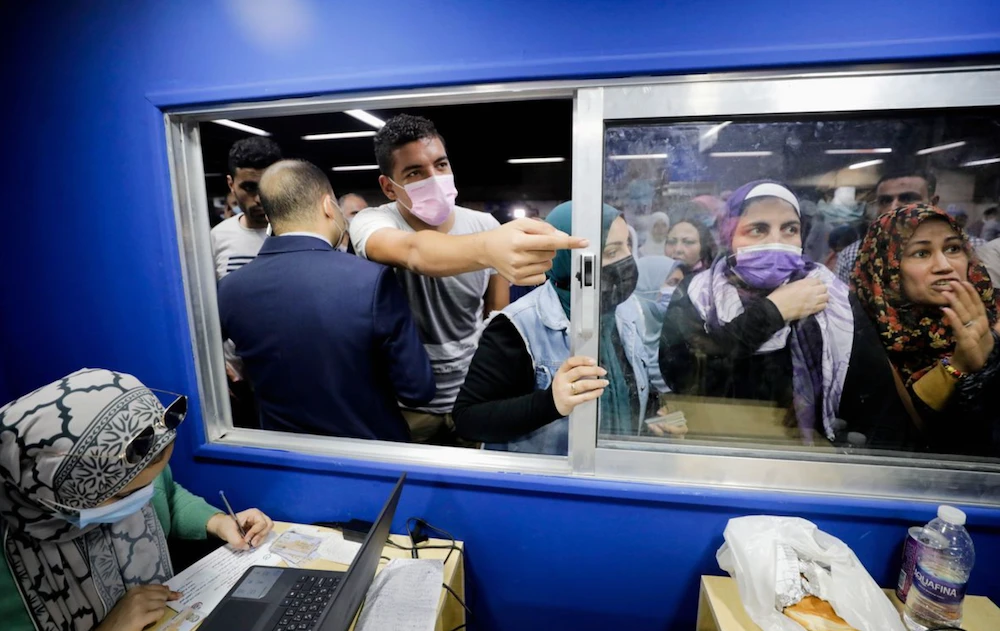
People wait to receive a dose of the coronavirus disease (COVID-19) vaccine at an immediate vaccination center operating at the Sadat underground metro station, in Cairo. (Reuters)
Short Url
Updated 15 November 2021

Egypt restricts workplace access to unvaccinated govt employees

People wait to receive a dose of the coronavirus disease (COVID-19) vaccine at an immediate vaccination center operating at the Sadat underground metro station, in Cairo. (Reuters)
  • Acting Health Minister Dr. Khaled Abdel Ghaffar announced the rolling out of vaccine centers in subway stations

CAIRO: Egypt’s government on Monday began implementing a decision not to allow workplace entry to state-sector employees who have not received a COVID-19 vaccine unless they take a weekly PCR test.

Cabinet spokesman Nader Saad said failing to do so will be considered an interruption of work and legal measures will be taken. “We’re facing a dangerous epidemic. The vaccine is the only way to survive,” he added.

Saad also confirmed that all government agencies will refrain from providing services to any citizen who has not received the first dose of a COVID-19 vaccine as of Dec. 1.

He said there are three ways to prove that a citizen or employee has been inoculated: A card from a vaccination center, the automated electronic certificate issued by the Health Ministry, and via the government app.

Saad added that university employees and students will not be allowed to enter from Monday unless they submit a certificate proving that they have obtained their first vaccine dose.

He said the problem lies with registration, not citizens’ willingness to be vaccinated. When mobile vaccination units were provided there was severe overcrowding, he added. There is no shortage of doses as close to 38 million have not yet been used, Saad said.

Acting Health Minister Dr. Khaled Abdel Ghaffar announced the rolling out of vaccine centers in subway stations, in coordination with the Transport Ministry.
France warns Iran against ‘sham’ nuclear negotiating stance

France warns Iran against ‘sham’ nuclear negotiating stance
Updated 20 November 2021

France warns Iran against ‘sham’ nuclear negotiating stance

France warns Iran against ‘sham’ nuclear negotiating stance
  • France said on Thursday a strong message should be sent to Iran over its nuclear activities and a lack of cooperation.

PARIS: France’s Foreign Minister Jean-Yves Le Drian warned Iran on Friday not to come to the next round of talks on reviving the 2015 nuclear deal with a “sham” negotiating stance, a day after Paris urged the board of the UN atomic watchdog to send Iran a tough message.
Tehran had earlier responded to Paris by saying the International Atomic Energy Agency, which verifies Tehran’s compliance with the 2015 deal with world powers limiting Tehran’s nuclear program, must be “free of any political conduct.”
The statements highlighted rising tension before the US, Iran and world powers resume indirect negotiations on reviving the deal on Nov. 29, five days after a meeting of the IAEA’s board of governors.
Western diplomats say time is running low to resurrect the pact, which then-US President Donald Trump abandoned in 2018, dismaying the other world powers involved — Britain, China, France, Germany and Russia.
Six rounds of indirect talks were held between April and June. The negotiations were interrupted after the election of a new Iranian President Ebrahim Raisi, who has said Iran will not back down in the talks.

Opinion

This section contains relevant reference points, placed in (Opinion field)

Paris warned Tehran over what US and European diplomats view as unrealistic demands, including a call for all US and EU sanctions imposed since 2017 to be dropped.
The foreign minister told Le Monde newspaper Paris wanted first to establish whether talks would resume where they ended in June.
“If this discussion is a sham, then we will have to consider the JCPoA (Joint Comprehensive Plan of Action) empty,” he said, referring to the 2015 deal.
“The United States is ready to return to the negotiations where they left off in June, so that they can be concluded quickly. We will assess from the 29th and in the following days whether this is also the Iranian will.”
France said on Thursday a strong message should be sent to Iran over its nuclear activities and a lack of cooperation.
The US envoy for Iran warned that Tehran was approaching the point of no return for reviving a nuclear deal after it boosted its stocks of enriched uranium before talks resume this month.
Robert Malley said Iran risked making it “impossible” to gain any benefit from resuming the agreement, which has been on hold since then president Donald Trump walked away in 2018.
Tehran said the IAEA must not be politicized.


After years of war, Libya’s Benghazi a chaotic urban sprawl

After years of war, Libya’s Benghazi a chaotic urban sprawl
Updated 20 November 2021

After years of war, Libya’s Benghazi a chaotic urban sprawl

After years of war, Libya’s Benghazi a chaotic urban sprawl

BENGHAZI: Over a decade of war in Libya the second city Benghazi has mushroomed to twice its size, creating an unplanned and chaotic urban sprawl.
The fighting has displaced countless families, forcing many to build new homes without permits in a jumble of unplanned neighborhoods that often lack infrastructure, from proper roads to schools or sewerage systems.
As the country tries to stabilize and rebuild, authorities are scrambling to address the legacy of years without urban planning.
“We had to leave our homes in the city center because of the war,” said one Benghazi resident, Jalal Al-Gotrani, a Health Ministry employee in the northeastern coastal city.
“When the fighting stopped, we found our houses destroyed and uninhabitable. We couldn’t afford to pay rent, so we had to build a little house in an unplanned neighborhood.”
Benghazi was the epicenter of the 2011 revolt that overthrew dictator Muammar Qaddafi, sparking years of lawless chaos in Libya.
The city was the site of the 2012 extremist attack that killed the US Ambassador Christopher Stevens, and it saw more heavy fighting between 2014 and 2017 that pulverized large districts.
Al-Gotrani, who supports a family with six children on a salary of just $130 a month, said that so far “there has been no state plan and no help to rebuild the areas that were destroyed.”
As a result, entire informal neighborhoods have sprung up in outlying areas zoned for farming, with no building permits and no master plan.
“Stop building and contact the planning department!” reads a notice on the fence of one unauthorized building site on the outskirts of Benghazi.
The state faces a surge in unregulated building that “it can’t keep up with,” said Abu Bakr Al-Ghawi, housing minister in Libya’s unity government, which took power in March.
Municipal planning chief Osama Al-Kazza warns the phenomenon is creating districts that lack roads, green spaces and schools and are unconnected to vital water and sewerage networks.
The eastern city has swelled from 32,000 hectares to 64,000 hectares since the last urban master plan in 2009, largely due to unlicensed buildings which now make up half the city, he said.
“More than 50,000 housing units are outside the public plan” — half of the city’s buildings — Al-Kazza said. “Development is running ahead of planning.”
Libya’s capital Tripoli, some 1,000 km to the west, has also seen entire districts emerge without a single building permit, for similar reasons.
A year-long battle between eastern-based Gen. Khalifa Haftar and Tripoli-based armed groups caused massive damage to the outskirts of the capital, displacing thousands and creating a housing crisis.
A year of relative peace since an October 2020 ceasefire, with UN-led efforts underway to bring a more permanent peace, has focused minds on the massive job of reconstruction.
Ghawi said the government is working with Libyan and foreign consultants to lay out a new nationwide urban development strategy, the third in the country’s history.
The last one, in 2009, was never implemented because of the war and the years of lawlessness that followed the overthrow of Qaddafi.
But a scramble to enforce planning laws without providing alternative housing has had human consequences.
In recent weeks, authorities in Tripoli have demolished a string of structures built since Qaddafi’s fall, including cafes and restaurants — but also homes.
Yet by demolishing unlicensed buildings without providing their occupants with alternatives, authorities risk making some families, already displaced by war, homeless for a second time.


Yazidi family abandons EU dream, reluctantly returns to Iraq

Yazidi family abandons EU dream, reluctantly returns to Iraq
Updated 19 November 2021

Yazidi family abandons EU dream, reluctantly returns to Iraq

Yazidi family abandons EU dream, reluctantly returns to Iraq
  • Kalo, 35, had begged for loans and spent his savings on the ill-fated journey to the Belarusian capital of Minsk
  • The family returned home, fearing they were endangering the life of Kalo’s ailing 80-year-old mother

DOHUK, Iraq: Khari Hasan Kalo peered out of the window of the repatriation flight as it touched down in northern Iraq.
It’s a place he and his family had hoped never to see again after they left for Belarus two months ago, driven by dreams of a new life in Europe.
Kalo, 35, had begged for loans and spent his savings on the ill-fated journey to the Belarusian capital of Minsk, the first stop on a journey to the West.
His wife, 30-year-old Zena, had sold her few belongings on the gamble that left the family of six stranded for days in a cold forest on the border of Belarus and Poland. In the end, they returned home, fearing they were endangering the life of Kalo’s ailing 80-year-old mother.
Yet they say they would do it all again to escape their hopeless life, spent in a camp for displaced persons for the past seven years. The Kalos are Yazidis, a religious minority that was brutalized by Daesh militants when they overran northern Iraq in 2014.
Years after their lives were torn apart, Yazidis are still unable to return home or locate hundreds of women and children who had been snatched by the extremists. The Kalos’ home lies in ruins.
“If it wasn’t for my children and my mother, I would never have returned, I would have stayed in that forest at all costs rather than return to this tent,” Kalo said Friday, speaking to AP from the Karbato camp in Dohuk province in the autonomous Iraqi Kurdish region.
His mother, looking frail, slept throughout the interview.
The Kalos, including three children ages 5, 7, and 9, had returned from Belarus a day earlier.
“It’s not even our tent; it’s his sister’s,” his wife interjected. “It’s no place to raise children, have a life.”
The region is considered the most stable part of conflict-scarred Iraq, yet Iraqi Kurds made up a large group among thousands of migrants from the Middle East who had flown to Belarus since the summer. Even in Iraq’s more prosperous north, growing unemployment and corruption is fueling migration, and the Yazidi community has endured particular hardship.
On Thursday, hundreds of Iraqis returned home from Belarus after abandoning their hopes of reaching the European Union. The repatriation came after thousands of migrants became stuck at the Poland-Belarus border amid rising tensions between the two countries.
Kalo’s family was among 430 people who flew from Minsk back to Iraq, where 390 got off at Irbil International Airport before the flight continued to Baghdad.
The West has accused Belarus President Alexander Lukashenko of using the migrants as pawns to destabilize the EU in retaliation for its sanctions imposed on his authoritarian regime following a harsh crackdown on internal dissent. Belarus denies engineering the crisis, which has seen migrants entering the country since summer, lured by easy tourist visas, and then trying to cross into Poland, Lithuania and Latvia, all EU members.
Kalo didn’t mind if a geopolitical game was being played at his expense if it got his family out of Iraq.
“So what if I was a pawn in someone’s hands if it gets me to Germany?” he said.
Since being displaced, the family had gotten increasingly desperate. Their tent burned down in an accidental fire in June that ravaged the Sharia camp, also in Dohuk. They tried to return to their original home in Sinjar but found their house uninhabitable.
He heard from friends about Kurds finding their way to Germany after Belarus eased visa requirements last spring. He begged his brother in Australia to wire him $9,000 to pay the smugglers’ asking price for his wife, three young children and mother.
He also had saved money from his time as a policeman — cash that was hard-won because he endured discrimination as a Yazidi.
“What good is a job if it’s still not enough to feed your family?” he said of his decision to quit.
The Kalos took the land route to Istanbul in September, and boarded flights to Minsk the following month. There, they headed straight to the Polish border. With two other Iraqi families, the Kalos dug under the border fence, reaching the other side in darkness.
They walked for four days in search of a GPS point where they were promised a car would meet them and take them straight to Germany.
But that never happened.
Instead, on the fourth day, Kalo’s family ran out of food as temperatures dropped in the dense and soggy forest.
Polish authorities found them and sent them back across the border. They were greeted by an encampment of hundreds of migrants. Belarusian authorities were handing out wire cutters and pushing the migrants back through the razor wire.
Polish authorities used water cannons to repel them. But this did not deter Belarusian authorities, who beat and threatened them, Kalo said. He said they shouted: “Go (to) Poland!”
Still, husband and wife fought to stay, agreeing that anything was better than their life in a tent.
But with his mother struggling to survive as conditions grew increasingly squalid, Kalo sought the pity of the Belarusian authorities. They allowed them to return to Minsk to seek medical help.
Kalo heard the Iraqi government had agreed to repatriate citizens free of charge. He turned to his wife and they considered their choices: Return to their desperate lives in Iraq, or bear the responsibility if his mother died.
Reluctantly, they put their names on the list.
But their hope is not lost, Kalo said, as his 5-year old daughter, Katarin, dug her face into his chest at the Karbato camp.
“I have two priorities now,” he said. “The first (is) to get a tent of our own. The second, to get back on my feet and leave this country. I will make it this time.”
He added: “If it was my last day on this Earth, I will spend it trying to leave.”


Time shrinking for Iran nuclear deal, US envoy warns

Time shrinking for Iran nuclear deal, US envoy warns
Updated 19 November 2021

Time shrinking for Iran nuclear deal, US envoy warns

Time shrinking for Iran nuclear deal, US envoy warns
  • Robert Malley said Iran risked making it “impossible” to gain any benefit from resuming the agreement
  • This week, the IAEA said Tehran had again increased its stockpile of highly enriched uranium

MANAMA: The US envoy for Iran warned Friday that Tehran was approaching the point of no return for reviving a nuclear deal after it boosted its stocks of enriched uranium before talks resume this month.
Robert Malley said Iran risked making it “impossible” to gain any benefit from resuming the agreement, which has been on hold since then president Donald Trump walked away in 2018.
This week, with Iran set for talks with world powers in Vienna on November 29, the International Atomic Energy Agency said Tehran had again increased its stockpile of highly enriched uranium.
“The time will come if Iran continues at this pace with the advancements they’ve made, (it) will make it impossible even if we were going to go back to the JCPOA to recapture the benefits,” Malley told the Manama Dialogue conference in Bahrain.
The Joint Comprehensive Plan of Action was the agreement struck in 2015 under which Iran agreed to clear limits on its nuclear activities in return for an easing of sanctions.
“Iran’s advances are spreading alarm across the region... that’s what’s making the clock tick faster and making all of us say that the time is short for a return to the JCPOA,” Malley said.
On Wednesday, the US and its Gulf Arab allies accused Iran of causing a nuclear crisis and destabilising the region with its ballistic missile program and support for armed militias.
Malley said the US shared a “commonality of purpose” with rivals Russia and China “because we want to avoid that crisis, all of us, the crisis that would be sparked if Iran continues on its current path.”
“And I want to be clear, because there’s no ambiguity about what they seem to be doing now, which is to drag their feet on the nuclear talks and accelerate the progress in their nuclear program.”
The US envoy said he was not encouraged by the statements from the new Iranian government of President Ebrahim Raisi, which earlier on Friday accused Washington of conducting a “propaganda campaign” against the country.
“If they stick to their public pronouncements, unfortunately we’re not headed in the right direction... but let’s wait to see what happens,” he said, pledging that President Joe Biden would honor a revived deal.
“Our intent, our clear intent in coming back into the deal is to stick with the deal because we don’t want to see a nuclear crisis,” Malley said.
Iran had reacted angrily to a US pledge to take its Gulf Arab allies’ interests into account in any revived nuclear deal with their arch rival.
“The US government, which is responsible for the current situation after withdrawing from the nuclear deal, is once again trying to provoke a crisis,” foreign ministry spokesman Saeed Khatibzadeh charged.


Lebanon PM says information minister will resign soon

Lebanon PM says information minister will resign soon
Updated 19 November 2021

Lebanon PM says information minister will resign soon

Lebanon PM says information minister will resign soon
  • Protesters storm Health Ministry in Beirut as medicine subsidies are lifted
  • President Aoun: ‘We seek better relations with the Gulf’

BEIRUT: Lebanese Prime Minister Najib Mikati announced on Friday that he will soon call a cabinet session, saying that the situation in the country is “very difficult and the people should not have to deal with more crises.”

His remarks came after protesters stormed the Ministry of Health building in Beirut on Friday morning in opposition to the lifting of subsidies on medicines, which has caused prices of vital health care treatments to skyrocket.

Arab News learned from a source close to Mikati that Information Minister George Kordahi will submit his resignation from the government during the soon-to-be-held cabinet session. Kordahi’s recent statements regarding Saudi Arabia prompted the Kingdom and other Gulf states to cut diplomatic and economic ties with Lebanon.

The Iran-backed Lebanese political group Hezbollah has insisted that Kordahi should not resign to defuse the diplomatic crisis, citing “national sovereignty.”

President Michel Aoun recently told a Lebanese military delegation that “Lebanon always seeks better relations with the Arab countries, especially the Gulf.”

He added: “We hope that what led to a problem with these countries will be quickly resolved. It is important that the interests of the Lebanese people not be harmed and that they do not pay for what is happening.”

In an interview with the Arabic-language daily Al-Akhbar, published on Friday, Aoun said he was not enthusiastic about the information minister being dismissed during the cabinet session, and would prefer that the decision be made personally by Kordahi.

Mikati visited Aoun on Friday morning and informed him of his intention to hold a cabinet session. He then headed to the General Labor Union headquarters, where he announced: “There are over 100 items on the cabinet’s agenda, (so we need to hold) a session soon to manage the state’s affairs and expedite the public budget and refer it to parliament for approval, in parallel with approving the required reforms (to reach an) agreement with the International Monetary Fund.”

Cabinet sessions were suspended less than a month after Mikati formed his government in September, as Hezbollah and the Amal Movement called for the removal of Tarek Bitar, the judge leading the probe into the August 2020 Beirut Port blast, accusing Bitar of “politicizing” the investigation.

Following the deadly clashes between supporters of Hezbollah and the Amal Movement protesting Bitar’s handling of the investigation on one side and the Lebanese Armed Forces and unidentified gunmen on the other in Tayouneh on October 14 this year, Hezbollah and the Amal Movement refused to attend cabinet sessions, with Hezbollah claiming the LAF was responsible for the clashes and calling for the arrest of LAF affiliates involved in the incident.

The successive crises have worsened Lebanon’s already disastrous economic collapse. The Lebanese pound has continued to lose value; it is currently being traded at 23,000 Lebanese pounds to the dollar.

“Lebanon has no choice but to resort to the IMF, and negotiations may last until 2022,” Mikati said. “But through the IMF, our country is giving a certain signal to the world that Lebanon can recover and must be supported.

“The world does not want Lebanon to fall and is ready to help us,” he continued. “And when I say the world, I also mean the Arab countries. But we need to do the required work first. We have hit an unprecedented inflation rate due to the years and years of subsidies, which we can no longer provide since the public treasury is unable to bear it.”

He announced that steps would be taken “at the beginning of December to secure aid for 250,000 families from the World Bank, amounting to $245 million.” Mikati said the payment process would begin at the end of 2021 or the beginning of 2022.

“There is assistance intended for 40,000 families residing in villages 700 meters above sea level, worth $165 per family,” he added. “We will also cooperate with the UN Food Program, which will allocate $600 million to the Lebanese, starting at the beginning of next year.”

Mikati also referenced the smuggling and illegal storage of subsidized medicines for chronic and cancerous diseases and noted that an investigation into the lack of subsidized baby formula in the market showed that it was “used for nutritional purposes in dairy factories.”

Mikati stressed that the government had no intention of selling any of the state’s assets at the moment. “It’s not the right time,” he said. “Our current priority is to reform all sectors and improve the electricity supply.”

Ali Darwish, an MP in Mikati’s parliamentary bloc, said Mikati had “intensified his political consultations in search of a way out of the political crisis.”

Darwish told Arab News: “Everyone was convinced of the need to hold cabinet sessions. Everyone agreed on the need to defuse crises, and that judicial issues should only be resolved within the judiciary itself. When paralysis affects the public sector and the health sector, no party, including Hezbollah, has any interest in obstructing solutions, because everyone will be affected.”