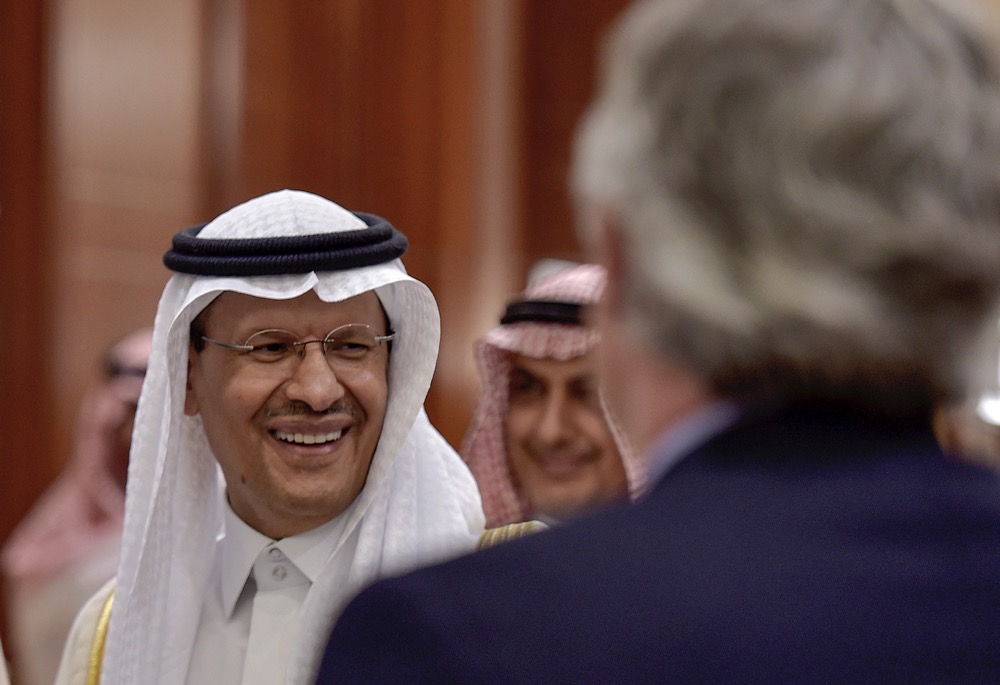
Writing about the Organization of Petroleum Exporting Countries is not an easy task. Nor is writing about an experienced prince who dedicated most of his life to serving his country and the Vienna-based organization that supplies more than 48 percent of the world’s crude oil consumption.
But I will start this series of reflections with Prince Abdulaziz bin Salman because he is the longest-serving minister with OPEC. He started his career as the Saudi deputy energy minister, serving for a long time until he was appointed the minister in September 2019. The prince spent more than 30 years working closely with the organization.
One of the milestones that helped the organization become a significant player in the world’s energy arena was Prince Abdulaziz’s efforts to bring in 10 oil-producing countries to join OPEC through the Declaration of Cooperation, also known as OPEC+.
Over the years, the prince’s calm diplomacy won the hearts of energy ministers worldwide. And through this personal connection and his diplomatic skills, he brought into OPEC countries such as Azerbaijan, Kingdom of Bahrain, Brunei Darussalam, Kazakhstan, Malaysia, Mexico, Sultanate of Oman, Republic of Sudan, and the Republic of South Sudan.
It also included one of the world’s largest oil producers after Saudi Arabia: The Russian Federation. Whether other countries like it or not, the DoC is now a significant player in the world’s energy spectrum.
Countries that opposed OPEC and its policies and called it a cartel have now realized that OPEC and its allies can help stabilize the world’s oil market. It has delivered especially in this challenging time when COVID-19, other deadly diseases and a deteriorating world economy pose challenges.
Even former US President Donald Trump, who tweeted many times against OPEC, thanked the organization and its allies for saving the energy market following the universal pandemic.
Prince Abdulaziz played an instrumental role during the early days of the pandemic, ensuring the success of OPEC+. Through its notable framework, the organization took bold and swift decisions that resulted in the largest and longest production adjustments in the industry’s history, restoring stability to a highly volatile oil market.
Through the prince, the Kingdom continues to inspire OPEC+ with its forward-looking plans to adapt to the ever-evolving dynamics brought on by the energy transition. One example is the Saudi Green Initiative initiated by Crown Prince Mohammed bin Salman. The vision will help support an inclusive and fair energy transition toward greater sustainability. OPEC+ was created in December 2016, thanks to the two cycles that led to the collapse of the world oil market: one in 2014, when there was a big surplus in world production that overshadowed demand, and then with the pandemic in 2019, which led to a worldwide lockdown that reduced oil consumption to the minimum.
Oil prices collapsed once to minus $34 per barrel, meaning sellers had to pay buyers to receive crude oil.
With his ministerial colleagues, the prince reacted quickly to save the oil market by calling for an urgent ministerial meeting. The meeting, however, failed to reach a consensus to reduce oil production as the prince desired. But later on, all members of the DoC found the prince’s call for an immediate and immense reduction to be a necessity. Without it, they realized, the market would collapse forever.
Prince Abdulaziz called for a new ministerial meeting which all members welcomed. At that meeting, a historic decision was taken, which is still working and saving the world’s energy market from collapsing. And this was all due to the prince’s vision and astute analysis of the market situation.
There is no doubt that Prince Abdulaziz played a pivotal role in securing the consensus needed to reach the agreement and implement these production adjustments.
Hassan Hafidh
History will remember the instrumental role of Saudi Arabia’s energy minister during the early days of the COVID-19 pandemic. At a meeting of OPEC+ on April 12, 2020, co-chaired by the prince and Russian Deputy Prime Minister Alexander Novak, the two leaders thrashed out a historic agreement. They brought down their crude oil production by 9.7 million barrels per day from May 1, 2020, to June 30, 2020.
For the subsequent six months, from July 1 to Dec. 31, the total adjustment agreed was 7.7 mbpd. It was followed by a 5.8 mbpd adjustment from Jan. 1, 2021, to April 30, 2022.
The baseline for calculating the adjustments was the world oil production in October 2018. The Kingdom and the Russian Federation both had the same baseline level of 11 mbpd. The organization would consider a possible extension of the agreement during a review of market conditions in December 2021. The deal has been extended since then and is still working, with some minor adjustments. This approach is a clear sign of its success.
Even Donald Trump welcomed the agreement’s outcomes, saying it was a “great deal for all” and saying on Twitter that it would “save hundreds of thousands of energy jobs in the United States.”
He even said he “would like to thank and congratulate” Russian President Vladimir Putin and the Saudi Crown Prince, to whom he had spoken.
There is no doubt that Prince Abdulaziz played a pivotal role in securing the consensus needed to reach the agreement and implement these production adjustments. Now, the DoC, under the chairmanship of the prince, meets every month and decides on the next steps. During the most recent session, he reiterated that the group was ready to act whenever needed.
The group will meet again early next month, and I am confident that the meeting will be a grand success.
• Hassan Hafidh is the former Director of PR and information at OPEC. He has worked for 10 years each in Reuters and The Wall Street Journal in Baghdad, reporting on oil and gas in Iraq and the Gulf Region.