‘A symbol of resilience’ — workers in Iraq complete reconstruction of famous Mosul minaret

‘A symbol of resilience’ — workers in Iraq complete reconstruction of famous Mosul minaret
1 / 2
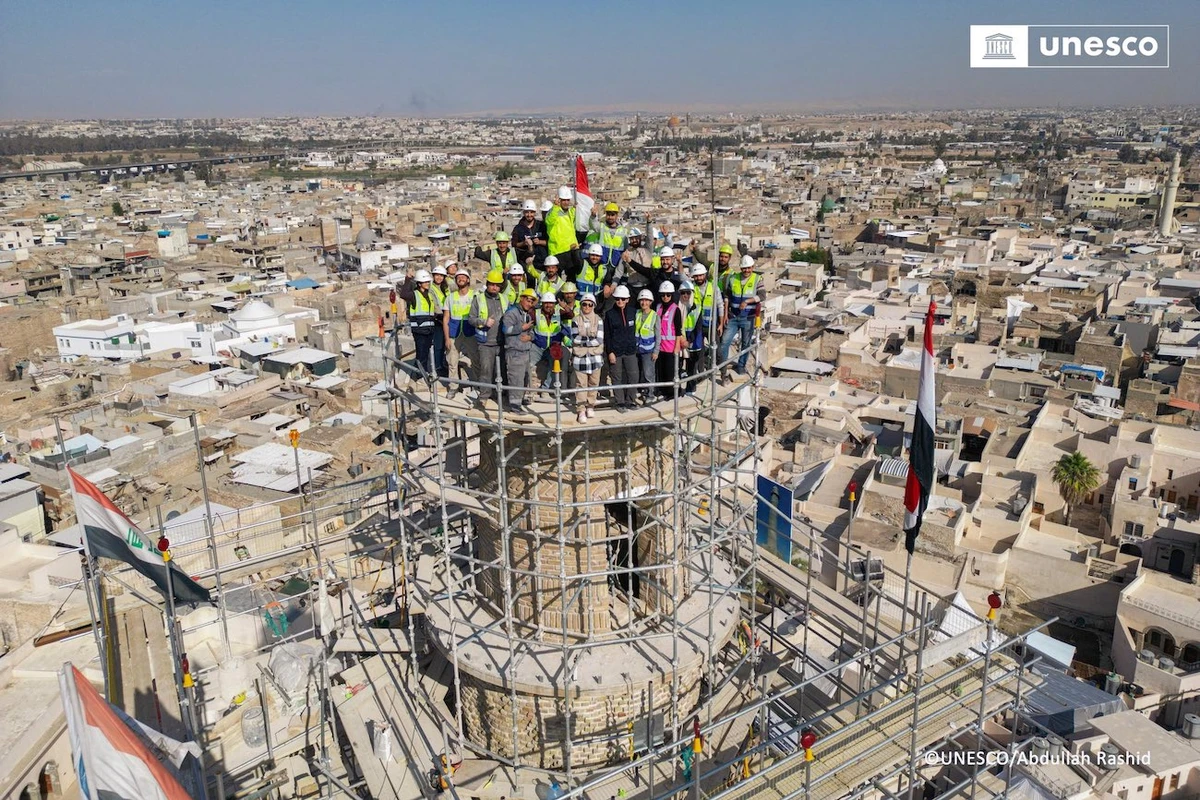
UNESCO Director-General Audrey Azoulay thanked all those involved in painstakingly reconstructing the 12th Century minaret. (UNESCO)
‘A symbol of resilience’ — workers in Iraq complete reconstruction of famous Mosul minaret
2 / 2
The Al-Habda minaret was rebuilt using traditional stone and brick masonry skills. (UNESCO)
Short Url
Updated 14 November 2024
Follow

‘A symbol of resilience’ — workers in Iraq complete reconstruction of famous Mosul minaret

‘A symbol of resilience’ — workers in Iraq complete reconstruction of famous Mosul minaret
  • Workers complete reconstruction of 12th-century minaret of Al-Nuri Mosque
  • Tower and mosque were blown by Daesh extremists in 2017

High above the narrow streets and low-rise buildings of Mosul’s old city, beaming workers hoist an Iraqi flag into the sky atop one of the nation’s most famous symbols of resilience.

Perched precariously on scaffolding in high-vis jackets and hard hats, the workers celebrate a milestone in Iraq’s recovery from the traumatic destruction and bloodshed that once engulfed the city.

On Wednesday, the workers placed the last brick that marked the completed reconstruction of the 12th-century minaret of Al-Nuri Mosque. The landmark was destroyed by Daesh in June 2017 shortly before Iraqi forces drove the extremist group from the city.

Known as Al-Hadba, or “the hunchback,” the 45-meter-tall minaret, which famously leant to one side, dominated the Mosul skyline for centuries. The tower has been painstakingly rebuilt as part of a UNESCO project, matching the traditional stone and brick masonry and incorporating the famous lean.

“Today UNESCO celebrates a landmark achievement,” the UN cultural agency’s Iraq office said. “The completion of the shaft of the Al-Hadba Minaret marks a new milestone in the revival of the city, with and for the people of Mosul. 

“UNESCO is grateful for the incredible teamwork that made this vision a reality. Together, we’ve created a powerful symbol of resilience, a true testament to international cooperation. Thank you to everyone involved in this journey.”

The restoration of the mosque is part of UNESCO’s Revive the Spirit of Mosul project, which includes the rebuilding of two churches and other historic sites. The UAE donated $50 million to the project and UNESCO said that the overall Al-Nuri Mosque complex restoration will be finished by the end of the year.

UNESCO Director-General Audrey Azoulay celebrated the completion of the minaret by posting “We did it!” on social media site X.

She thanked donors, national and local authorities in Iraq and the experts and professionals, “many of whom are Moslawis,” who worked to rebuild the minaret.

“Can’t wait to return to Mosul to celebrate the full completion of our work,” she said.

The Al-Nuri mosque was built in the second half of the 12th century by the Seljuk ruler Nur Al-Din. 

After Daesh seized control of large parts of Iraq in 2014, the group’s leader, Abu Bakr Al-Baghdadi, declared the establishment of its so-called caliphate from inside the mosque.

Three years later, the extremists detonated explosives to destroy the mosque and minaret as Iraqi forces battled to expel them from the city. Thousands of civilians were killed in the fighting and much of Mosul was left in ruins.
UN secretary-general warns that war in Sudan is ‘spiraling out of control’

UN secretary-general warns that war in Sudan is ‘spiraling out of control’
Updated 04 November 2025
Follow

UN secretary-general warns that war in Sudan is ‘spiraling out of control’

UN secretary-general warns that war in Sudan is ‘spiraling out of control’
  • UN chief offers stark warning about El-Fasher and calls for an immediate ceasefire in the two-year conflict

DUBAI: The United Nations secretary-general warned Tuesday that the war in Sudan is “spiraling out of control” after a paramilitary force seized the Darfur city of El-Fasher.

Speaking at a UN summit in Qatar, Antonio Guterres offered a stark warning about El-Fasher and called for an immediate ceasefire in the two-year conflict that’s become one of the world’s worst humanitarian crises.

“Hundreds of thousands of civilians are trapped by this siege,” Guterres said. “People are dying of malnutrition, disease and violence. And we are hearing continued reports of violations of international humanitarian law and human rights.”

He added that there also were “credible reports of widespread executions since the Rapid Support Forces entered the city.”

UN officials have warned of a rampage by the paramilitary Rapid Support Forces after it took over the city of El-Fasher, reportedly killing more than 450 people in a hospital and carrying out ethnically targeted killings of civilians and sexual assaults.

The RSF has denied committing atrocities, but testimonies from those fleeing, online videos and satellite images offer an apocalyptic vision of the aftermath of their attack. The full scope of the violence remains unclear because communications are poor in the region.

The RSF besieged El-Fasher for 18 months, cutting off much of the food and other supplies needed by tens of thousands of people. Last week, the paramilitary group seized the city.

Asked if he thought there was a role for international peacekeepers in Sudan, Guterres said it was important to “gather all the international community and all those that have leverage in relation to Sudan to stop the fighting.”

“One thing that is essential to stop the fighting is to make sure that no more weapons come into Sudan,” he said. “We need to create mechanisms of accountability because the crimes that are being committed are so horrendous.”

The war between the RSF and the Sudanese military has been tearing apart Sudan since April 2023. More than 40,000 people have been killed, according to UN figures, but aid groups say the true death toll could be many times higher. The fighting has driven more than 14 million people from their homes and fueled disease outbreaks. Meanwhile, two regions of war-torn Sudan are enduring a famine that is at risk of spreading.

“It is clear that we need a ceasefire in Sudan,” Guterres said. “We need to stop this carnage that is absolutely intolerable.”