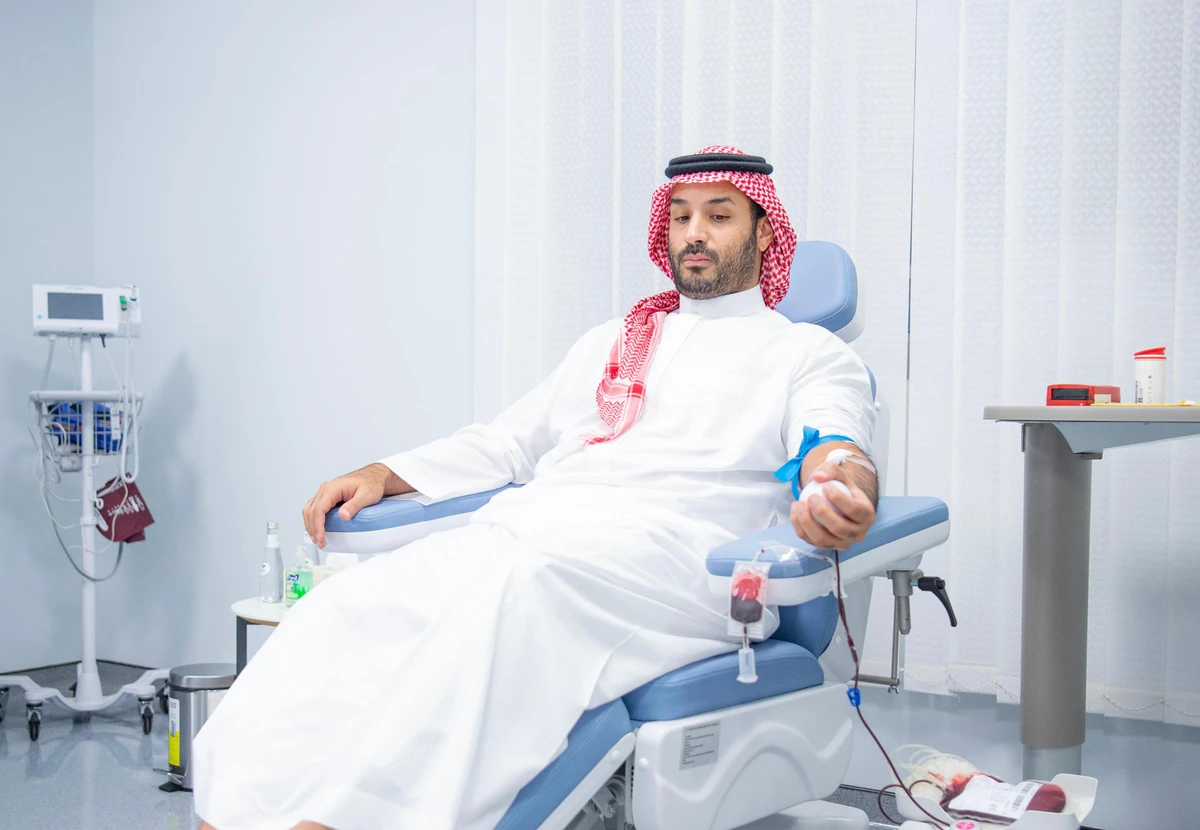
Crown Prince Mohammed bin Salman donates blood to launch annual campaign

Saudi Crown Prince Mohammed bin Salman donates blood on Thursday. (SPA)
1 / 2
Saudi Crown Prince Mohammed bin Salman donates blood on Thursday. (SPA)
2 / 2
Saudi Crown Prince Mohammed bin Salman donates blood on Thursday. (SPA)
Short Url
Updated 24 August 2025
Follow

Crown Prince Mohammed bin Salman donates blood to launch annual campaign

Saudi Crown Prince Mohammed bin Salman donates blood on Thursday. (SPA)
  • Aim of campaign is to raise awareness of the importance of voluntary donations so that the Kingdom can become self sufficient in supplies of blood

RIYADH: Saudi Arabia’s Crown Prince Mohammed bin Salman donated blood on Thursday to launch the annual national blood donation campaign, in a move described as a gracious gesture and an extension of Saudi leadership’s humanitarian approach by top Saudi officials.

The aim of the campaign is to raise awareness of the importance of voluntary donations so that the Kingdom can become self-sufficient in supplies of blood and related products, thereby ensuring the availability of safe and sustainable stocks that meet the needs of the population.

More than 800,000 donors gave blood in 2024, officials said.

The crown prince and King Salman have actively encouraged several health-related initiatives in recent years, including setting examples by receiving the COVID-19 vaccine, and enrolling in the national organ-donation program.

Applauding the crown prince’s gesture, the Ministry of Health posted on X: “The Leader’s Giving ... A Role Model for the Nation. The donation of His Highness #Crown_Prince is a humanitarian message to establish blood donation as a national value, support the voluntary work system in the health sector, and ensure the provision of safe blood supplies to meet the need.”

Health Minister Fahad Al-Jalajel thanked the crown prince for his generous blood donation and unlimited support for humanitarian work through the launch of the blood donation canpaign.

This initiative embodies a firm commitment to promoting a culture of giving and community solidarity, and to raising the rate of voluntary blood donations support the health sector, he said.

Al-Jalajel explained that the campaign is an extension of the other humanitarian initiatives undertaken by the Saudi leadership, including receiving the COVID-19 vaccine and registering in the organ donation program.

“These initiatives reflect a solid approach to healthcare and improving quality of life,” said the minister, calling on all members of society to donate blood.

Dr. Abdullah Al-Rabeeah, advisor to the Royal Court and supervisor-general of the King Salman Humanitarian Aid and Relief Center, said the donation embodies the highest form of humanitarian giving and represents a noble message of compassion and solidarity, as each donation contributes to saving lives.

“This initiative is an extension of the leadership’s generosity and humanitarian approach. It is not limited to supporting the health sector alone, but rather embodies the profound humanitarian values instilled by the Kingdom’s leaders in the society. It encourages citizens and residents alike to donate blood as a noble humanitarian act.”

Riyadh Gov. Prince Faisal bin Bandar said this initiative reflects the crown prince’s special attention to humanitarian work and his commitment to instilling the values of solidarity and giving in society.

The initiative carries a noble message aimed at raising community awareness of the importance of voluntary blood donation and providing sufficient safe supplies to blood banks and hospitals across the Kingdom, he added.

Prince Saud bin Naif bin Abdulaziz, Eastern Province governor, said: “The crown prince’s donation represents an inspiring example and reflects a direct interest in the health of citizens and residents. It also contributes to raising community awareness of the importance of voluntary blood donation and its role in saving lives.”

Minister of Islamic Affairs, Call and Guidance Sheikh Abdullatif bin Abdulaziz Al-Sheikh stressed that this step embodies the highest values of giving and altruism, and represents an inspiring example of humanitarian work.

He added that this annual campaign is an extension of the crown prince’s generous patronage of humanitarian work and an encouragement for all segments of society to donate blood, in compliance with the Almighty’s words: “And whoever saves a life, it is as if he had saved mankind entirely.”

Dr. Hisham bin Saad Al-Jadhey, CEO of the Saudi Food and Drug Authority, noted that the donation not only granted life, but also redefined the relationship between citizens and the healthcare sector, making every individual a partner in building an informed, sustainable healthcare system.

He emphasized that the annual campaign reflects the generosity of the Kingdom and its leaders and embodies the values of humanitarian work, and contributes to strengthening blood banks and supplying hospitals and healthcare centers.
Afghanistan earthquake survivors spend the night in the open; the quake damaged historical sites

Updated 2 sec ago
Follow

Afghanistan earthquake survivors spend the night in the open; the quake damaged historical sites

Afghanistan earthquake survivors spend the night in the open; the quake damaged historical sites
The temblor also damaged historical sites, including Afghanistan’s famed Blue Mosque in the northern city of Mazar-e-Sharif
The most severely damaged historical monument in the province was the 19th century Bagh-e Jehan Nama Palace

KABUL: Survivors of a powerful earthquake in northern Afghanistan that killed more than 25 people and injured nearly 1,000 were digging through the rubble of their homes Tuesday, trying to salvage what belongings they could after spending the night outside in the bitter cold.
Rain was forecast for the region, further compounding the misery for survivors.
The 6.3 magnitude quake struck just before 1 a.m. local time Monday, with an epicenter 22 kilometers (14 miles) west-southwest of the town of Khulm in Samangan province. By early Tuesday afternoon, the death stood at 27, while another 956 people were injured, Public Health Ministry spokesman Sharafat Zaman said in a statement.
The temblor also damaged historical sites, including Afghanistan’s famed Blue Mosque in the northern city of Mazar-e-Sharif, which is one of Afghanistan’s most revered religious landmarks, and the Bagh-e-Jahan Nama Palace in Khulm.
The Blue Mosque’s minaret was badly damaged, while some bricks and tiles had fallen from some of the mosque’s walls and cracks appeared in other parts of the centuries-old site, said Mahmoodullah Zarar, Head of Information and Culture of Balkh Province.
“The Holy Shrine is a valuable monument of Islamic values and the history of the Islamic era, ... (and) is in dire need of repair and restoration,” he said, adding that information on the damage had been shared with the ministry of art and culture.
The mosque is a major gathering place during Islamic and cultural festivals.
The most severely damaged historical monument in the province was the 19th century Bagh-e Jehan Nama Palace, said Firozuddin Munib, Samangan province’s Head of Information and Culture. The palace, built in 1890-1892, and its adjoining gardens are a popular site for visitors.
“The restoration of this palace is very important because winter is coming and the area is cold, and it is raining, which may cause further damage,” Munib said, adding that the quake caused a surrounding wall and one tower to collapse and also led to cracks in the palace and other towers.
In Khulm, aftershocks rattled survivors, who spent the night out in the open.
“People are still scared because of last night’s earthquake because small tremors were felt during the day,” said local resident Asadullah Samangani. “We spent the night in the open ground last night, the weather was very cold, we couldn’t sleep, we feel like there will be another earthquake now.”
He said authorities had sent tents and basic necessities, but that his home was “completely destroyed, nothing was left intact to use. Our children were all sick in the morning because we had spent the night in the cold, and all the household items were under the rubble.
“People from other areas came to help, but our belongings are still under rubble and damaged. Our women are facing great difficulties, we do not have a toilet and we do not have a place where our women can spend the night.”
Rescue crews were still operating in some areas on Tuesday, and were expected to finish by the end of the day.
The World Health Organization said partial damage had been reported in several health facilities, while the laboratory at the Samangan Provincial Hospital had collapsed, destroying critical medical equipment. Emergency response operations with health teams and rescue units were ongoing, it said.
Impoverished Afghanistan often faces difficulty in responding to natural disasters, especially in remote regions. Buildings tend to be low-rise constructions, mostly of concrete and brick, with homes in rural and outlying areas made from mud bricks and wood, many poorly built.
In August, a quake in eastern Afghanistan killed more than 2,200 people.