Palestinian president’s office urges US to reinstate his visa ahead of key UN meetings

Palestinian president’s office urges US to reinstate his visa ahead of key UN meetings
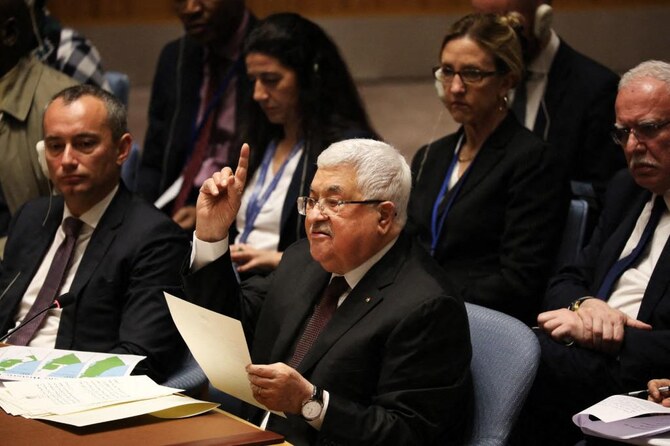
Palestinian President Mahmoud Abbas’ office on Saturday urged the US government to reverse its unusual decision to revoke his visa, weeks before he was meant to appear at the UN’s main annual meeting and an international conference about creating a Palestinian state. (AFP/File)
Short Url
Updated 30 August 2025
Follow

Palestinian president’s office urges US to reinstate his visa ahead of key UN meetings

Palestinian president’s office urges US to reinstate his visa ahead of key UN meetings
  • “This decision will only increase tension and escalation," Palestinian presidential spokesperson Nabil Abu Rudeineh said
  • “We have been in contact since yesterday with Arab and foreign countries, especially those directly concerned with this issue”

RAMALLAH: Palestinian President Mahmoud Abbas’ office on Saturday urged the U.S. government to reverse its unusual decision to revoke his visa, weeks before he was meant to appear at the U.N.’s main annual meeting and an international conference about creating a Palestinian state.

U.S. Secretary of State Marco Rubio rescinded the visas of Abbas and 80 other officials ahead of next month’s annual high-level meeting of the U.N. General Assembly, the State Department disclosed Friday. Abbas has addressed the General Assembly for many years, and generally leads the Palestinian delegation.

“We call upon the American administration to reverse its decision. This decision will only increase tension and escalation," Palestinian presidential spokesperson Nabil Abu Rudeineh told The Associated Press in Ramallah on Saturday.

“We have been in contact since yesterday with Arab and foreign countries, especially those directly concerned with this issue. This effort will continue around the clock," he said.

He urged other countries to put pressure on the Trump administration to reverse the decision, notably the countries that have organized a high-level conference on Sept. 22 about reviving efforts for a two-state solution for the Middle East. It is co-hosted by France and Saudi Arabia.

French Foreign Minister Jean-Noël Barrot protested restrictions on access to the U.N. General Assembly, and said he would discuss the issue with EU counterparts.

“The United Nations headquarters is a place of neutrality, a sanctuary dedicated to peace, where conflicts are resolved," he said Saturday. “The UN General Assembly … cannot suffer any restrictions on access.”

Abu Rudeineh also urged an end to Israel’s offensive in Gaza and "escalation in the West Bank, because none of this will lead to any solution.”

The move came as the Israeli military declared Gaza’s largest city a combat zone. Israel says Gaza City remains a stronghold of Hamas.

The Trump administration has taken several steps to target Palestinians with visa restrictions.

“It is in our national security interests to hold the PLO (Palestinian Liberation Organization) and PA (Palestinian Authority) accountable for not complying with their commitments, and for undermining the prospects for peace,” the State Department said in a statement.

The Palestinian Authority denounced the visa withdrawals as a violation of U.S. commitments as the host country of the United Nations. U.N. spokesman Stephane Dujarric said the world body would be seeking clarification from the State Department.


Gaza authorities ‘levy fees on some privately imported goods’

Palestinians sell fish during a ceasefire between Israel and Hamas, at the seaport of Gaza City, November 12, 2025. (REUTERS)
Updated 4 sec ago
Follow

Gaza authorities ‘levy fees on some privately imported goods’

Palestinians sell fish during a ceasefire between Israel and Hamas, at the seaport of Gaza City, November 12, 2025. (REUTERS)
  • Ghaith Al-Omari, a senior fellow at the Washington Institute think tank, said Hamas’ actions aimed to show Gazans and foreign powers alike that it cannot be bypassed

CAIRO: From regulating the price of chicken to levying fees on cigarettes, Hamas is seeking to widen control over Gaza as US plans for its future slowly take shape, Gazans say, adding to rivals’ doubts over whether it will cede authority as promised.
After a ceasefire began last month, Hamas swiftly reestablished its hold over areas from which Israel withdrew, killing dozens of Palestinians it accused of collaborating with Israel, theft, or other crimes. Foreign powers demand that the group disarm and leave the government, but have yet to agree on who will replace them.
Now, a dozen Gazans say they are increasingly feeling Hamas’ control in other ways. 

The prices are high. There’s no income, circumstances are difficult, life is hard, and winter is coming.

Mohammed Khalifa, Shopper in Nuseirat area

Authorities monitor everything entering areas of Gaza held by Hamas, levying fees on some privately imported goods, including fuel and cigarettes, and fining merchants seen as overcharging for goods, according to 10 Gazans, three of them merchants with direct knowledge.
Ismail Al-Thawabta, head of the media office of the Gaza government, said accounts of authorities taxing cigarettes and fuel were inaccurate, denying that the government was raising any taxes.
The authorities were only carrying out urgent humanitarian and administrative tasks whilst making “strenuous efforts” to control prices, Al-Thawabta said. 
He reiterated Hamas’ readiness to hand over to a new technocratic administration, saying it aimed to avoid chaos in Gaza: “Our goal is for the transition to proceed smoothly.”
Hatem Abu Dalal, owner of a Gaza mall, said prices were high because not enough goods were coming into Gaza. Government representatives were trying to bring order to the economy — touring around, checking goods and setting prices, he said.
Mohammed Khalifa, shopping in central Gaza’s Nuseirat area, said prices were constantly changing despite attempts to regulate them. “It’s like a stock exchange,” he said.
“The prices are high. There’s no income, circumstances are difficult, life is hard, and winter is coming,” he said.
Reuters, citing multiple sources, reported this week that Gaza’s de facto partition appeared increasingly likely, with Israeli forces still deployed in more than half the territory and efforts to advance the plan faltering.
Nearly all of Gaza’s 2 million people live in areas controlled by Hamas.
Ghaith Al-Omari, a senior fellow at the Washington Institute think tank, said Hamas’ actions aimed to show Gazans and foreign powers alike that it cannot be bypassed.
“The longer that the international community waits, the more entrenched Hamas becomes,” Omari said.
Asked for comment on Gazans’ accounts of Hamas levying fees on some goods, among other reported activities, a US State Department spokesperson said: “This is why Hamas cannot and will not govern in Gaza.”
The PA is pressing for a say in Gaza’s new government, though Israel rejects the idea of it running Gaza again.
Munther Al-Hayek, a Fatah spokesperson in Gaza, said Hamas’ actions “give a clear indication that Hamas wants to continue to govern.”
In the areas held by Israel, small Palestinian groups that oppose Hamas have a foothold, a lingering challenge to it.
Gazans continue to endure dire conditions, though more aid has entered since the ceasefire.
A senior Gazan food importer said Hamas hadn’t returned to a full taxation policy, but they “see and record everything.”
They monitor everything that enters, with checkpoints along routes, and stop trucks and question drivers, he said, declining to be identified. 
Price manipulators are fined, which helps reduce some prices, but they are still much higher than before the war began, and people complain they have no money.
The Gaza government employed up to 50,000 people, including policemen, before the war. 
Al-Thawabta said that thousands of them were killed, and those remaining were ready to continue working under a new administration.
Gaza authorities continued paying them salaries during the war, though it cut the highest, standardizing wages to 1,500 shekels ($470) a month, Hamas sources and economists familiar with the matter said. 
It is believed that Hamas drew on stockpiled cash to pay the wages, a diplomat said.
The Gaza government replaced four regional governors who were killed, sources close to Hamas said. 
A Hamas official said the group also replaced 11 members of its Gaza politburo who died.
Gaza City activist and commentator Mustafa Ibrahim said Hamas was exploiting delays in the US plan “to bolster its rule.”
“Will it be allowed to continue doing so? I think it will continue until an alternative government is in place,” he said.