- “In a few decades, ... people will become younger and perhaps even achieve immortality,” Putin says
- “Some predict that within this century, it may be possible ... may be able to live up to 150 years old,” Xi responds
BEIJING: Chinese leader Xi Jinping and Russia President Vladimir Putin chatted about how advances in science could prolong the human life span in a rare hot mic moment in the Chinese capital.
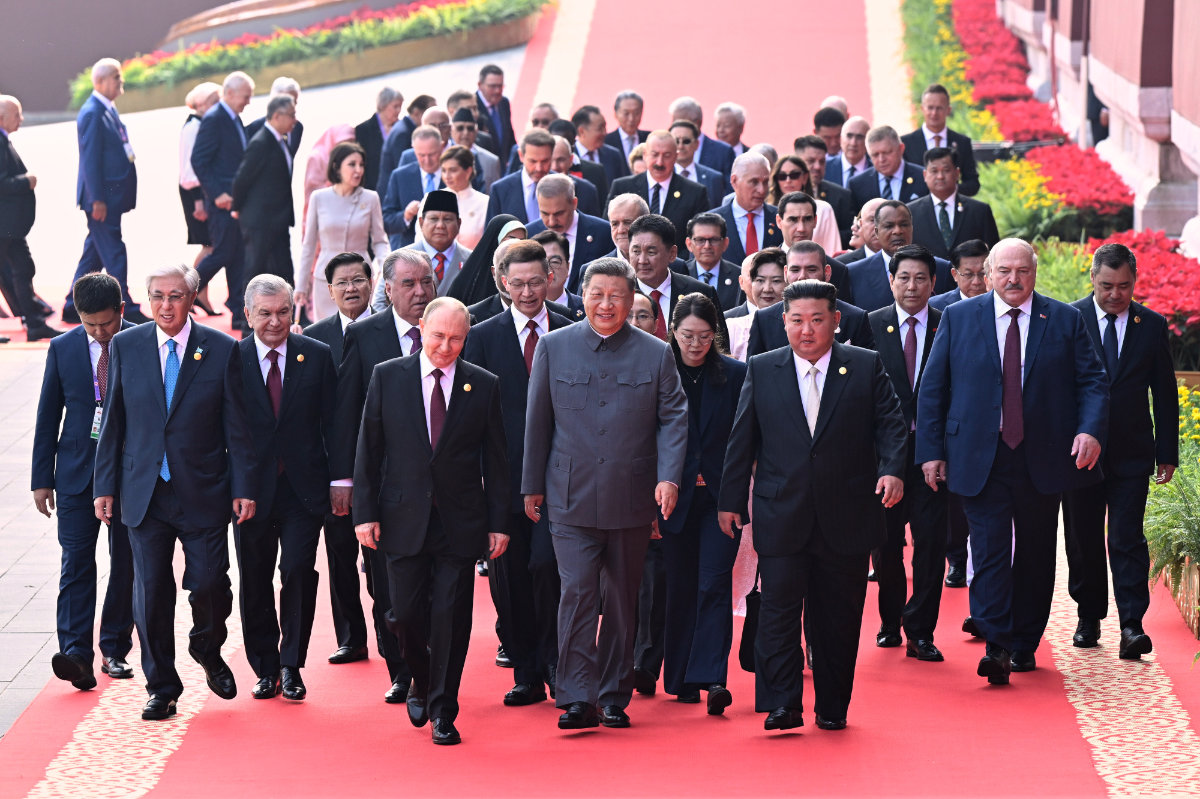
The brief exchange was captured on a live news video feed of Xi and Putin as they walked on a red carpet with North Korean leader Kim Jong Un at the head of a large cluster of high-level guests. The group was going toward the viewing platform for a major Chinese military parade on Wednesday.
Xi spoke first, and although only parts of his words can be made out, a translator followed in Russian: “Before it’s said to be very rare to live up to 70, and now it’s said that you are still a child at 70.”
Putin, turning toward Xi, gesticulated with pointed fingers as he responded. Kim, on the other side of Xi, turned in to listen to both, breaking into an occasional smile.
The Russian president’s words are inaudible, but after he spoke, an interpreter can be heard translating what he said into Chinese.
“In a few decades, as biotechnology continues to develop, human organs will continue to be transplanted and people will become younger and perhaps even achieve immortality,” the interpreter said.
Xi appeared to break into a slight smile as the interpreter spoke, turning his head once to look at Putin briefly.
The live feed then switched to an overhead view of the viewing platform on historic Tiananmen Gate, but the audio from the walking leaders continued.
A voice that sounded like Xi said, “Some predict that within this century, it may be possible ... .”
Then the audio paused briefly. When it came back, someone can be heard saying at much lower volume, ” ... may be able to live up to 150 years old.”
The second phrase follows naturally from the first one in Chinese, but it’s not clear whether the second one is also Xi or someone else. A translator than said in Russian, “There are forecasts that in this world a person will live up to 100.”
The feed was provided by the parade media center to international news agencies including The Associated Press.
Xi presided over a parade that marked the 80th anniversary of the end of World War II. The fighter jets, missiles and other military hardware were a display of strength intended in part to show the progress the country has made under Communist Party rule.
Later in the day, Putin said at a news conference that Xi had brought up life expectancy while they were walking to the parade.
“The chairman mentioned this,” he said, referring to the Chinese leader. He added that former Italian Prime Minister Silvio Berlusconi had actively promoted the topic in the past.
“Modern health and medical technologies, surgical procedures connected with organ replacements and so on give humanity reason to hope that an active life can continue differently than now,” Putin said. “The average age varies across countries, of course, but life expectancy is significantly increasing.”