- Israel escalates its offensive as Egypt prepares to host peace talk delegates
- Palestinians wonder when Donald Trump’s Gaza plan will be implemented
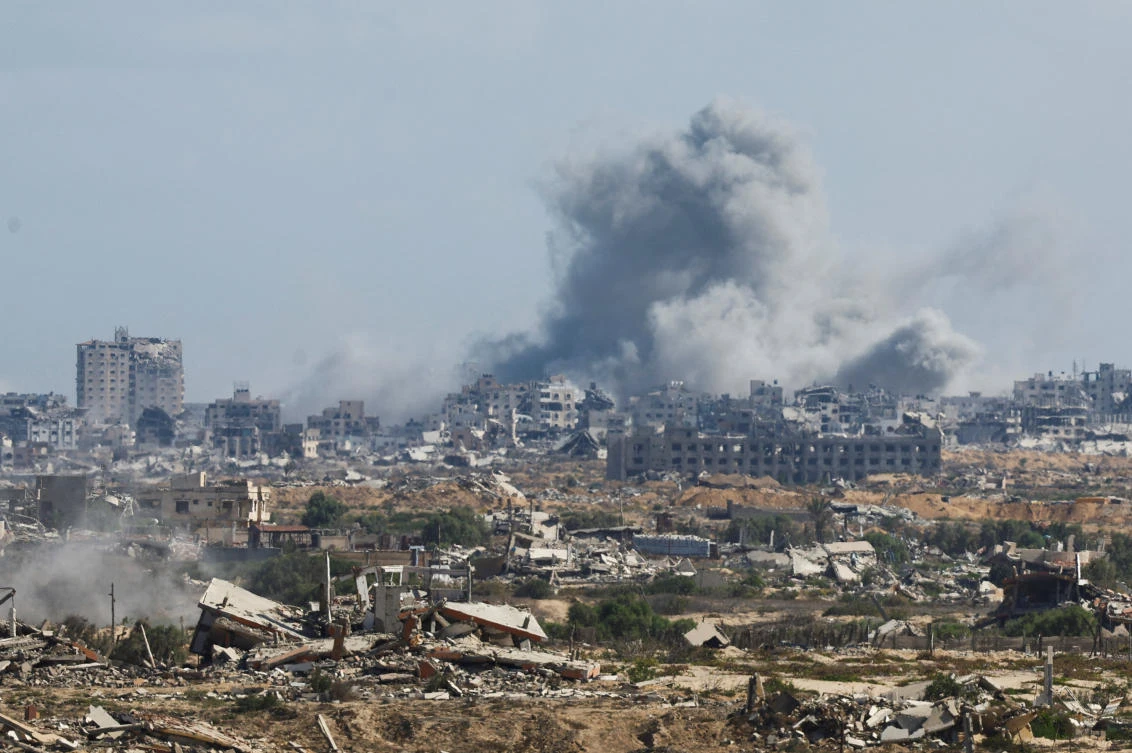
CAIRO/JERUSALEM: Israeli planes and tanks pounded areas across the Gaza Strip overnight and on Sunday, destroying several residential buildings, witnesses said, as traumatized Palestinians hoped a US plan to end the war would soon ease their suffering.
US President Donald Trump, who had called for an end to the bombing, said on Saturday on his Truth Social platform that Israel had agreed to an “initial withdrawal line” inside Gaza and that “when Hamas confirms, the Ceasefire will be IMMEDIATELY effective.”
Israel escalated its offensive as Egypt prepares to host delegates from Hamas, Israel and the United States, and Qatar, to kick off talks over the implementation of the most advanced effort yet to halt the conflict.
Cairo talks will tackle unresolved issues
Hamas had drawn a welcoming response from Trump on Friday by saying it accepted certain key parts of his 20-point peace proposal, including ending the war, Israel’s withdrawal, and the release of Israeli hostages and Palestinian captives.
But the group left some issues up for further negotiation, as well as questions unanswered, such as whether it would be willing to disarm, a key demand from Israel to end the war.
“Progress would depend on whether Hamas would agree to the map, which shows the Israeli army would remain in control of most of the Gaza Strip,” said a Palestinian official, close to the talks.
“Hamas may also ask for a strict timetable for the Israeli withdrawal from Gaza. The first phase of talks will determine how things are going to proceed,” he told Reuters, asking not to be named.
In a sign of Israeli optimism over the Trump plan, the shekel currency hit a three-year high against the dollar and Tel Aviv stocks reached an all-time high.
Domestically, Israeli Prime Minister Benjamin Netanyahu is caught between growing pressure to end the war — from hostage families and a war-weary public — and demands from hard-line members of his coalition who insist there must be no let-up in Israel’s campaign in Gaza.
Far-right Finance Minister Bezalel Smotrich said on X that halting attacks on Gaza was a “grave mistake.”
Smotrich and Security Minister Itamar Ben-Gvir, also a hard-liner, have significant influence in Netanyahu’s government and have threatened to bring it down if the Gaza war ends.
Arab states welcome Hamas response to Trump plan
But opposition leader Yair Lapid of the centrist Yesh Atid party has said political cover will be provided so the Trump initiative can succeed and “we won’t let them torpedo the deal.”
Trump has won backing from Arab and other Muslim states.
Saudi Arabia, the United Arab Emirates, Egypt, Qatar, Jordan, Turkiye, Indonesia, and Pakistan issued a joint statement welcoming the steps taken by Hamas regarding Trump’s Gaza plan.
“The Foreign Ministers reiterated their joint commitment to support efforts toward the implementation of the proposal, to work for the immediate end of the war on Gaza, and achieve a comprehensive agreement,” they said in the joint statement.
In Gaza City, which Israel describes as one of Hamas’ last bastions, Israeli forces continued attacks and warned residents who left against returning, saying it was a “dangerous combat zone.”
On Sunday, witnesses said Israeli planes escalated attacks against targets across the city, Gaza’s biggest urban center.
This followed a tense night in which drones dropped grenades on the rooftops of residential buildings and troops blew up explosive-laden vehicles, demolishing dozens of houses in two Gaza City neighborhoods, Sabra and Sheikh Radwan.
Hamas keen to reach deal
A senior Hamas official on Sunday said the Palestinian militant group is eager to reach an agreement to end the war and implement a prisoner swap with Israel, as negotiators converge in Egypt for talks.
Israeli and Hamas negotiators are set to iron out details during talks in Egypt in a bid to end nearly two years of war in Gaza, after Hamas approved a peace plan proposed by US President Donald Trump.
“Hamas is very keen to reach an agreement to end the war and immediately begin the prisoner exchange process in accordance with the field conditions,” he said.
“The occupation must not obstruct the implementation of President Trump’s plan. If the occupation has genuine intentions to reach an agreement, Hamas is ready.”
A Palestinian source close to Hamas told AFP that the two delegations would be in the same building but away from media coverage.
“The negotiations aim to discuss the timeline for preparing field conditions for the transfer of captives held in Gaza, as a prelude to launching the prisoner exchange process,” he added.
“During communications with mediators, Hamas insisted that it is essential for Israel to halt military operations across all areas of the Gaza Strip, cease all air, reconnaissance, and drone activity, and withdraw from inside Gaza City,” the source said.
“In parallel with the cessation of Israeli military activity, Hamas and the resistance factions will also halt their military operations and actions,” he added.
Gazans desperate for start of Trump’s truce plan
“Where is Trump in all of this?” said Rami Mohammad-Ali, 37, from Gaza City, now displaced on the city’s western side.
“The explosions don’t stop, the drones drop bombs everywhere, as if nothing has happened. Where is the truce Trump told us about?” he asked.
Local health authorities said at least one Palestinian was killed, and several others were wounded in those attacks. Three other people were killed in separate Israeli strikes across the enclave, medics said.
Amjad Al-Shawa, head of the Palestinian NGOs Network, which liaises with the United Nations and international humanitarian organizations, said Gaza City has begun experiencing acute shortages of food and fuel, days after Israel blocked the route from the south to the north.
Under Trump’s plan, all Israeli hostages, alive and deceased, were due to be released within 72 hours of Israel publicly accepting the agreement. Israel says 48 hostages remain, 20 of whom are alive.
There may be logistical challenges too. Sources close to Hamas told Reuters handing over living hostages could prove relatively straightforward, but retrieving bodies of dead ones amid the huge devastation and rubble of Gaza may take longer than a few days to achieve.
Trump said on Friday he believed Hamas had shown it was “ready for a lasting PEACE” and he called on Netanyahu’s government to halt airstrikes in Gaza.
With Agencies