Greta Thunberg among Gaza flotilla detainees to leave Israel

Greta Thunberg among Gaza flotilla detainees to leave Israel
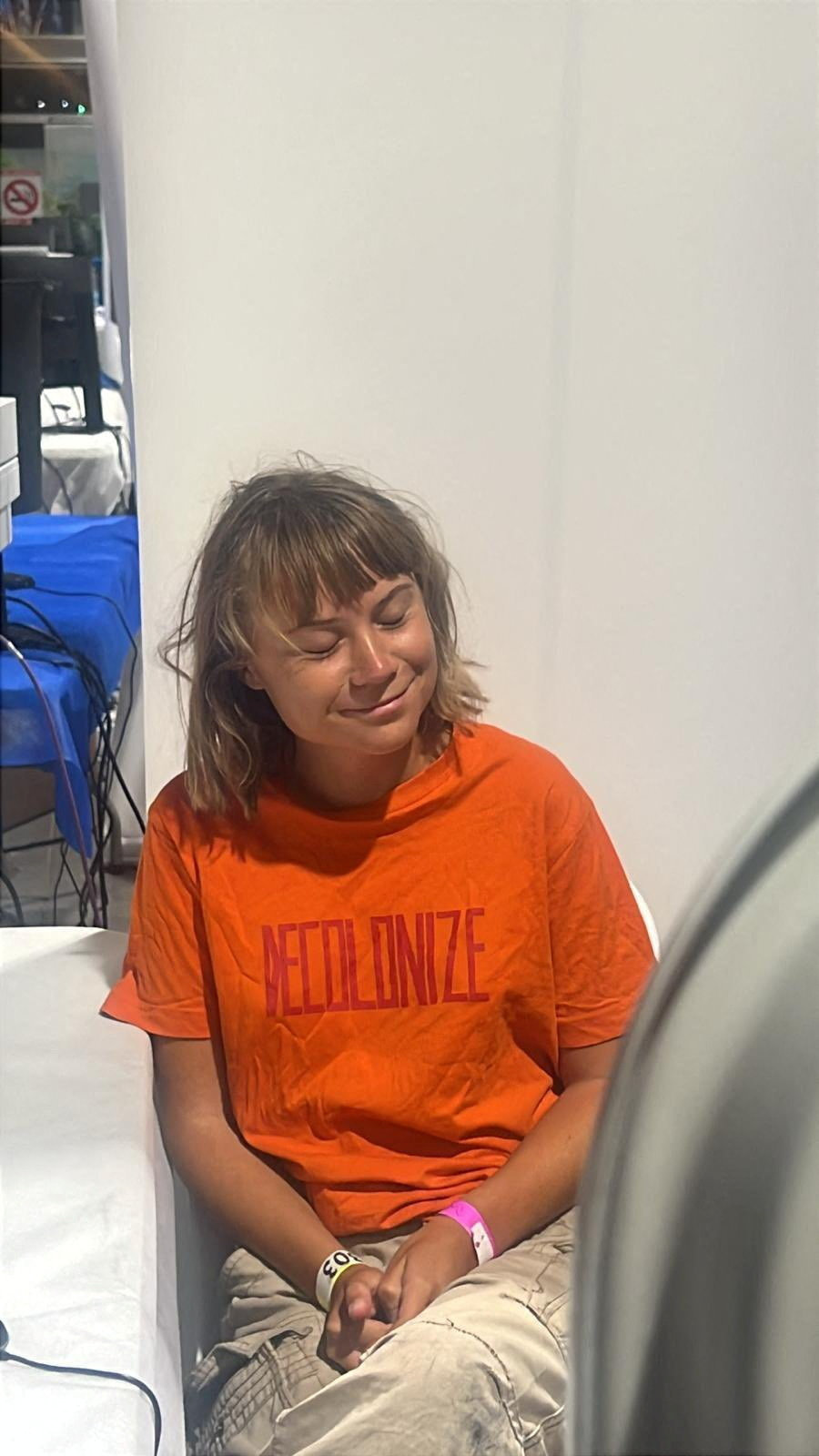
Swedish activist Greta Thunberg sits at an unknown location, after Israel intercepted the vessels of the Global Sumud Flotilla aiming to reach Gaza and break Israel's naval blockade, in this handout image released on October 3, 2025. (Reuters)
Short Url
Updated 06 October 2025
Follow

Greta Thunberg among Gaza flotilla detainees to leave Israel

Greta Thunberg among Gaza flotilla detainees to leave Israel
  • Those flying out of Israel on Monday include 28 French citizens, 27 Greeks, 15 Italians, and nine Swedes

ATHENS: Swedish activist Greta Thunberg will be among more than 70 people of different nationalities to leave Israel on Monday after they were seized aboard an intercepted Gaza aid flotilla.
Most, if not all, those being released from Israeli detention will be flown to Greece, where they will be able to get flights to their home countries, their respective governments said on Sunday.
Those flying out of Israel on Monday include 28 French citizens, 27 Greeks, 15 Italians, and nine Swedes.
Twenty-one Spaniards separately returned to Spain on Sunday from Israel.
The release still leaves several foreigners in Israeli custody, including 28 Spanish nationals.
All had been on board the 45-vessel Global Sumud Flotilla carrying activists and politicians, who had been aiming to get past an Israeli blockade to deliver aid to Gaza, where the United Nations says famine has taken hold.
Israel started intercepting the ships in international waters on Wednesday. An Israeli official said on Thursday that boats with more than 400 people on board had been prevented from reaching the Palestinian territory.
The Italian and Greek foreign ministries said their released nationals would on Monday fly from Israel to Athens. Italian Foreign Minister Antonio Tajani said on X that the 15 Italians would have assistance for a subsequent transfer to Italy.
France’s foreign ministry said the 28 French citizens would be flown to Greece. They accounted for most of the 30 French nationals Israel seized aboard the flotilla.
The Swedish foreign ministry did not say where the Swedes would fly to, but Swedish media said they, too, could be put on the flight to Greece.

- ‘Treated like monkeys’ -

A first group of 26 Italians already left Israel on Saturday. But the last 15 had to wait for their judicial expulsion from the country as they refused to sign a form allowing their voluntary release.
Several of the Italians in the first group said after returning to their country that they were subjected to degrading treatment by the Israeli authorities.
Saverio Tommasi, a journalist for the online media site Fanpage, said he was hit in the back and on the head by his Israeli captors.
“We were treated like old monkeys in the worst circuses of the 1920s,” said Tommasi, cited by the Ansa press agency.
Sweden’s Foreign Minister Maria Malmer Stenergard told AFP that embassy staff in Tel Aviv had been able to visit the nine Swedes in detention.
“Late Sunday, the Israeli authorities informed us that they were set to authorize the Swedish citizens to leave Israel tomorrow (Monday) by plane,” she said.
One of the Spaniards who returned home on Sunday, Rafael Borrego, told reporters that those detained by Israel had suffered “repeated physical and mental abuse,” including receiving blows and being forced to the ground.
Kurdish leader Barzani pushes for leverage with Baghdad in Iraq vote

Kurdish leader Barzani pushes for leverage with Baghdad in Iraq vote
Updated 14 sec ago
Follow

Kurdish leader Barzani pushes for leverage with Baghdad in Iraq vote

Kurdish leader Barzani pushes for leverage with Baghdad in Iraq vote
  • Veteran Kurdish leader still shapes politicsBarzani’s political journey has been shaped by decades of rebellion, betrayal, and uneasy truces with successive Iraqi governments
  • His legacy looms large over the race for seats in the national parliament in Baghdad

BAGHDAD: Masoud Barzani, the Iraqi Kurdish leader who first took up arms against Saddam Hussein as a teenage guerrilla, remains a towering figure in Kurdish politics as Iraq heads into its November 11 election.
Though he no longer holds an official post, Barzani’s Kurdistan Democratic Party (KDP) is urging a strong Kurdish turnout to safeguard regional interests and strengthen its hand in fraught negotiations with Baghdad.
Barzani’s political journey has been shaped by decades of rebellion, betrayal, and uneasy truces with successive Iraqi governments. Now in his late 70s, he continues to wield influence behind the scenes, often referred to as “President” in Kurdish media and diplomatic circles.
His legacy looms large over the race for seats in the national parliament in Baghdad, a contest that could either reinforce Kurdish autonomy or expose deepening fractures within the Kurdish political landscape.
A strong KDP performance would give Barzani’s camp more leverage in disputes with the central government over oil revenues and budget allocations — issues that have sharply escalated tensions between Irbil and Baghdad in 2025.
A weak showing, however, could embolden rival Kurdish factions and strengthen the central government’s position.

FROM MOUNTAIN FIGHTER TO POLITICAL POWER BROKER
Barzani’s long career has been marked by cunning and patience, qualities that helped the Kurds in northern Iraq to survive brutality under Saddam.
Following the 1991 Gulf war, the Kurds rose up against Saddam’s dictatorship, and Barzani and his peshmerga fighters came down from the mountains and captured several cities.
But the victorious US-led allies balked at the prospect of a Kurdish split from Baghdad and initially gave Saddam’s troops a free hand to put down the uprising.
Facing strategic defeat, the quietly spoken Barzani was forced to do the unthinkable and negotiate with Saddam, who had gassed the Kurds and buried them in mass graves years before.
Barzani was saved by a US and British no-fly zone over the north which allowed him and his Kurdish rival Jalal Talabani to retake the area. The longest period of Kurdish autonomy in modern history followed, but the experience was scarred by war between Barzani and Talabani’s Patriotic Union of Kurdistan.
Barzani invited Iraqi government tanks into the enclave in 1996 to seize the regional capital Irbil, sending not only Talabani but CIA agents and their local employees fleeing.

GAMBLE ON INDEPENDENCE ENDS IN FAILURE
After decades of struggle, and Saddam’s overthrow in a 2003 US-led invasion, critics say Barzani made one of his biggest errors by seeking a referendum on Kurdish independence in 2017.
The Baghdad government rejected it as illegal and sent troops to seize the oil city of Kirkuk, which the Kurds regard as the heart of any future homeland. A bitter Barzani stepped down as president of the regional government.
“I am the same Masoud Barzani, I am a Peshmerga and will continue to help my people in their struggle for independence,” Barzani said in a televised address.
“Nobody stood up with us, other than our mountains.”
Barzani was born in 1946, soon after his legendary father, Mulla Mustafa Barzani, known as the Lion of Kurdistan, founded a party to fight for the rights of Iraqi Kurds.
Masoud Barzani became a guerrilla as a teenager, and over time he would become familiar with an abiding theme in Kurdish history — betrayal by regional and Western powers.
Exiled and dying of cancer in a US hospital in 1976, Mulla Mustafa lamented that he had ever trusted the United States.
A year earlier, Mulla Mustafa had been fighting a guerrilla war against Baghdad backed by Iran’s pro-Western shah, but he was cut adrift when then-US Secretary of State Henry Kissinger brokered a deal that allowed Saddam to crush the Kurds.
During the 1980-88 Iran-Iraq war, Barzani allied the KDP with Tehran once more. As a result, some 8,000 Barzani tribesmen were rounded up and paraded through Baghdad before being executed. In Saddam’s words: “They went to hell.”
In March 1988 Saddam’s warplanes bombed the Kurdish town of Halabja with poison gas killing up to 5,000 people.
Despite the massacres, Barzani retained enough of a fighting force to respond to President George Bush’s appeal for an uprising during the 1991 Gulf War, when a US-led coalition routed Saddam’s army in Kuwait.
After Saddam’s fall, Barzani became a central figure in the drive to create an autonomous Kurdish state in northern Iraq. Kurdish leaders kept their territory relatively free of the sectarian bloodshed that plagued most of Iraq. Western oil executives flocked to the region seeking deals.

STRAINS WITH BAGHDAD OVER OIL RESURFACE
Kurds showed their military capability by joining Iraqi government troops and Iranian-backed paramilitary forces to drive Daesh militants out of Mosul.
Confident that the time was right for an independent homeland, Barzani pursued the disastrous referendum. A day after the vote he recalled the Kurds’ seemingly endless suffering.
“I’ve been fighting for half a century. With my people I have been through mass killings, deportations, gassings. I remember times when we thought we were done for, headed for extermination,” he told the Kurdish Rudaw news agency.
“I remember times, as in 1991 after the first war against Saddam, when the democracies came to our rescue but left the dictatorship in place, thus casting us back into the shadows.”
Barzani’s arch-enemy Saddam was executed in 2007. But tensions persist between the Kurds and Baghdad authorities.
Relations soured once again in February 2022 when Iraq’s federal court deemed an oil and gas law regulating the oil industry in Iraqi Kurdistan unconstitutional and demanded that Kurdish authorities hand over their crude oil supplies.
Barzani criticized the move as a “completely political decision” aimed at opposing the Kurdistan region.
Barzani has kept a hand in politics through his KDP. The party swept the Kurdish vote in a 2021 election after forming an alliance with Shiite cleric Moqtada Al-Sadr.