Hamas official says hostage and prisoner lists exchanged

Update Hamas official says hostage and prisoner lists exchanged
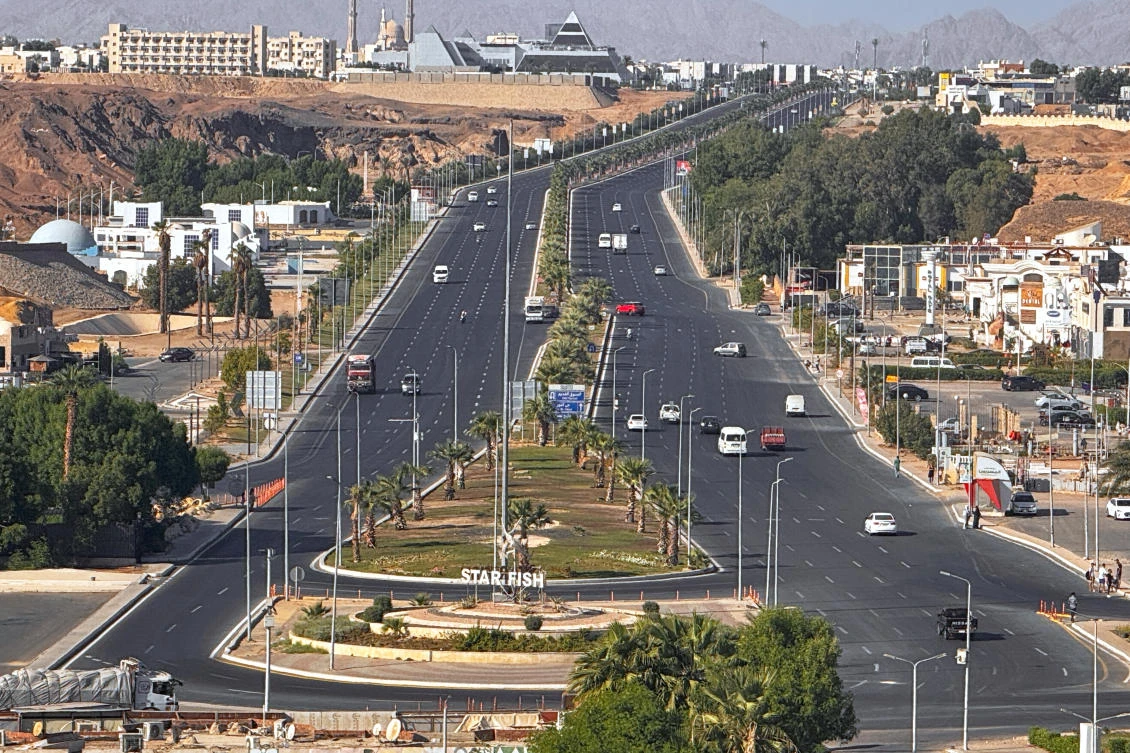
Vehicle drive on the main road in Sharm el-Sheikh, Egypt, where Israeli and Hamas officials are set to hold indirect talks, Monday, Oct. 6, 2025. (AP)
Short Url
Updated 08 October 2025
Follow

Hamas official says hostage and prisoner lists exchanged

Hamas official says hostage and prisoner lists exchanged
  • Israel and Hamas are holding indirect negotiations in the Egyptian resort town of Sharm El-Sheikh
  • Hamas’s top negotiator, Khalil Al-Hayya, said the Islamist group wants "guarantees from President Trump"

CAIRO: Senior Hamas official Taher Al-Nounou said on Wednesday that negotiators from his group and Israel have exchanged lists of prisoners and hostages who would be released should a deal be reached during the ongoing Gaza ceasefire talks in Egypt.
Al-Nounou also said Hamas expressed optimism about reaching a deal, stating that the group has demonstrated the necessary positivity. 

Qatar’s prime minister and senior delegates from the United States and Turkiye joined Hamas and Israeli negotiators on Wednesday for a third day of talks aimed at ending the Gaza war.
Israel and Hamas are holding indirect negotiations in the Egyptian resort town of Sharm El-Sheikh, based on a 20-point plan proposed by US President Donald Trump last month.
Qatar’s Prime Minister Sheikh Mohammed bin Abdulrahman Al Thani, Turkiye’s intelligence chief Ibrahim Kalin, Trump’s special Middle East envoy Steve Witkoff and son-in-law Jared Kushner are all due to attend the talks.
“There’s a real chance that we could do something,” Trump told reporters in the Oval Office on Tuesday, adding that US negotiators were also involved in the talks.
“I think there’s a possibility that we could have peace in the Middle East. It’s something even beyond the Gaza situation. We want a release of the hostages immediately.”
Trump said the United States would do “everything possible to make sure everyone adheres to the deal” if Hamas and Israel do agree on a ceasefire.
Global pressure to end the war has escalated, with much of Gaza flattened, a UN-declared famine unfolding and Israeli hostage families still longing for their loved ones’ return.
A UN probe accused last month Israel of genocide. 
Hundreds of thousands of protesters joined pro-Palestinian mass demonstrations in cities across the world last weekend, calling for an immediate end to the war, including in Italy, Spain, Ireland and Britain.
Demonstrators in the Netherlands called for their government to recognize a Palestinian state, while tens of thousands in Britain defied Prime Minister Keir Starmer’s calls to skip rallies, holding vigils and gatherings on the October 7 anniversary.

‘Guarantees’ 

Hamas’s top negotiator, Khalil Al-Hayya, said the Islamist group wants “guarantees from President Trump and the sponsor countries that the war will end once and for all.”
Trump’s plan calls for a ceasefire, the release of all the hostages, Hamas’s disarmament and a gradual Israeli withdrawal from Gaza.
The plan received positive responses from both Israel and Hamas and prompted indirect talks in Egypt since Monday.
A Palestinian source close to the Hamas negotiating team said Tuesday’s session included Hamas discussing “the initial maps presented by the Israeli side regarding the withdrawal of troops as well as the mechanism and timetable for the hostage-prisoner exchange.”
US representatives Witkoff and Kushner were expected to arrive in Egypt on Wednesday, according to Egyptian Foreign Minister Badr Abdelatty, after they were initially expected to arrive last weekend.
“The primary guarantee of success at this stage is US President Trump himself... even if it comes to a point to require him imposing a vision,” he said.
Israel’s military campaign in Gaza has killed at least 67,160 people, according to the health ministry in the territory, figures the United Nations considers credible.

With Agencies

Lebanon warns Israeli violations threaten stability as UN peacekeepers enter final phase of mission

Lebanon warns Israeli violations threaten stability as UN peacekeepers enter final phase of mission
Updated 18 sec ago
Follow

Lebanon warns Israeli violations threaten stability as UN peacekeepers enter final phase of mission

Lebanon warns Israeli violations threaten stability as UN peacekeepers enter final phase of mission
  • UN envoy accuses Israel of jeopardizing ‘hard-won progress’ by undermining Lebanese sovereignty and territorial integrity through airstrikes and border violations
  • He says Lebanon’s army commander has presented to ministers his second progress report on a plan to extend state authority country-wide and limit weapons to state control

NEW YORK CITY: Lebanon has warned that Israeli airstrikes and border violations risk undermining progress toward achieving stability in southern Lebanon, as the UN peacekeeping mission in the country begins preparations for its withdrawal.

Speaking before the UN General Assembly’s Fourth Committee, Lebanon’s permanent representative to the organization, Ahmad Arafa, welcomed the recent renewal of the UN Interim Force in Lebanon’s mandate under Security Council Resolution 2790. This authorized the extension of the force’s operations until Dec. 31, 2026, followed by an “orderly, safe and coordinated” drawdown within a year.

“The Lebanese Armed Forces have been working tirelessly to ensure full implementation of Resolution 1701,” Arafa said, referring to the 2006 resolution that ended the war that year between Israel and Hezbollah.

It calls for the disarmament of all militias in Lebanon, including Hezbollah. The US has consistently pressured Lebanese authorities to disarm the group, designating it a terrorist organization.

The November 2024 ceasefire deal with Israel also requires Lebanon to disarm Hezbollah and establish a state monopoly on arms. The agreement states that only state security forces should bear arms, which is interpreted by Israel and others as requiring the full disarmament of Hezbollah. The group insists it applies only to southern Lebanon.

Arafa said the commander of the Lebanese army has presented to the Council of Ministers his second progress report on a plan to extend state authority throughout the country and confine possession of weapons to legitimate state institutions.

However, he accused Israel of jeopardizing the “hard-won progress” that has been made, through what he described as ongoing violations of Lebanon’s sovereignty and territorial integrity, including airstrikes, the continued occupation of Lebanese territory, and the creation of “so-called buffer zones.”

UNIFIL spokesperson Dany Ghafri said last week that Israel had carried out more than 7,000 airspace violations since the cessation of hostilities in November last year, Arafa noted. UNIFIL has warned that the airstrikes breach Resolution 1701, “threaten the safety of civilians, and undermine progress toward a political and diplomatic solution,” he added

Lebanon also condemned Israeli attacks on UNIFIL personnel and positions, describing them as “a blatant violation of international law.”

Arafa expressed gratitude to the leadership of the UN force, and the countries that contribute troops, for their “dedication and sacrifice” since the mission was established in 1978. He called for the avoidance of any “security vacuum” during the upcoming transitional period, while maintaining stability and respect for Lebanon’s sovereignty.