‘We need win after win’: Crunch time looms for Germany in World Cup qualifying

‘We need win after win’: Crunch time looms for Germany in World Cup qualifying
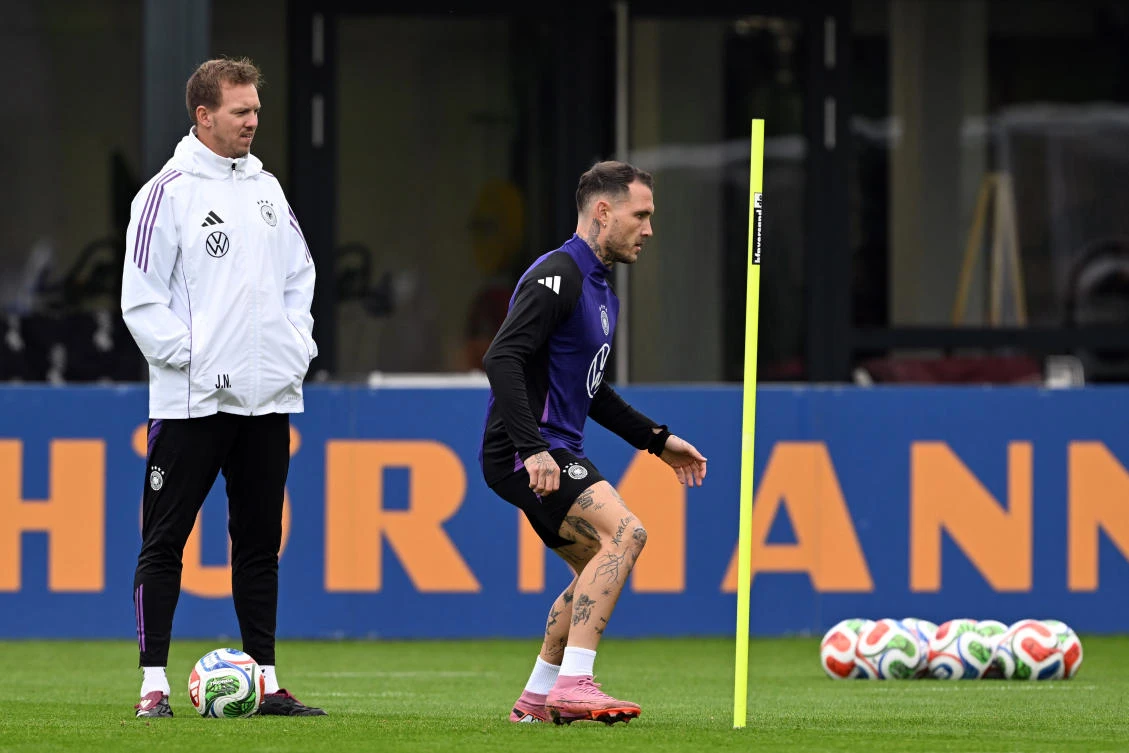
Germany’s head coach Julian Nagelsmann and player David Raum attend a training session of the German national team in Herzogenaurach, Germany, on Oct. 7, 2025, ahead of the World Cup qualifier match against Luxembourg. (AP)
Short Url
Updated 09 October 2025
Follow

‘We need win after win’: Crunch time looms for Germany in World Cup qualifying

‘We need win after win’: Crunch time looms for Germany in World Cup qualifying
  • “Everyone expects of us that we’ll beat every opponent 5-0, 6-0 but that’s no longer possible,” midfielder Nadiem Amiri said
  • Until their loss in Slovakia last month, Germany had never lost a World Cup qualifying game away from home

BERLIN: A World Cup without Germany used to be unthinkable. Now the four-time champion needs to turn things around to ensure a spot at next year’s tournament.
A shock 2-0 loss to Slovakia in World Cup qualifying means Julian Nagelsmann’s team may need a perfect record in the rest of their qualifiers, starting with wins over Luxembourg on Friday and Northern Ireland on Monday.
“Everyone expects of us that we’ll beat every opponent 5-0, 6-0 but that’s no longer possible,” midfielder Nadiem Amiri said in comments reported by German agency dpa.
“The times have simply changed. Everyone’s good, everyone can hold their own. For us it’s just important to win. We need win after win.”
The qualifying format — a four-team group where only the winner qualifies automatically — means Germany must win each of their remaining games unless Slovakia slips up, and get ahead of Slovakia on goal difference too.
Second place would put Germany into a bracket of four teams competing for one spot early next year.
Making history the wrong way
If Germany did fail to make it to the expanded, 48-team World Cup, it would be a historic shock.
Until their loss in Slovakia last month, Germany had never lost a World Cup qualifying game away from home. The only times they missed the men’s World Cup were the inaugural 13-team 1930 event, which they skipped along with most of Europe, and 1950, when they were excluded following World War II.
Of course, even when they have qualified, Germany haven’t always produced the goods.
Group-stage exits in 2018 and 2022 were huge disappointments for a team which had top-class individual players but didn’t seem to gel as a team. A goose-themed motivational talk by then-coach Hansi Flick at the 2022 World Cup fell flat and seemed to typify the lack of enthusiasm.
That all means Germany haven’t played a World Cup knockout game since winning the 2014 final.
Overcoming injuries
Germany’s qualification fight has been made harder by injuries.
Barcelona’s Marc-André ter Stegen would be first-choice goalkeeper if fit but hasn’t played all year, while Real Madrid defender Antonio Rüdiger is out with a muscle injury and Bayern Munich’s attacking midfield star Jamal Musiala likely won’t return until the new year.
Nagelsmann seems intent on forging a partnership between Florian Wirtz and Newcastle’s Nick Woltemade, but Wirtz has yet to find his best form since his Liverpool move and Woltemade has had a flu-like illness this week. That meant the tall striker was training separately Wednesday.
There’s extra attention on new player Nathaniel Brown, a left back from Eintracht Frankurt who would also be eligible for the United States. Brown faces the challenge of doing better than his Frankfurt teammate Nnamdi Collins, who was dropped after costly errors on debut in the Slovakia loss.
In Morocco, exiled Afghan women footballers find hope on the pitch

In Morocco, exiled Afghan women footballers find hope on the pitch
Updated 05 November 2025
Follow

In Morocco, exiled Afghan women footballers find hope on the pitch

In Morocco, exiled Afghan women footballers find hope on the pitch
  • The team played their first international matches at the FIFA Unites: Women’s Series late last month in Morocco
  • Twenty-year-old midfielder Mina Ahmadi said “a dream was taken away from us” back home, “but when FIFA recognized us, it was as if a part of that dream came true“

CASABLANCA: Manoozh Noori said she “wanted to die” when the Taliban returned to power in Afghanistan in 2021. That meant she could no longer do what she loved most: playing football.
Noori, now 22, fled the country where the United Nations say authorities have implemented a “gender apartheid,” and has been playing in a team of Afghan refugee women, recently taking part in a first-of-its-kind tournament in Morocco.
“I had asked myself: do I want to stay in this country with people who want to forbid women from studying, from playing football, from doing anything?” Noori told AFP.
The Taliban authorities, who say that women’s rights are protected by Islamic law, have banned girls and women from schools beyond the age of 12, and also from most jobs and public services — and from playing sports.


Noori had defied family pressure to represent Afghanistan professionally by playing for the country’s national women’s squad before a Taliban government returned to power.
She said she buried her trophies and medals in her family’s backyard and left the country for Australia.
Noori’s team, Afghan Women United, was formed between Europe and Australia, where other teammates have also been living since 2021.

- ‘A beautiful story’ -

The team played their first international matches at the FIFA Unites: Women’s Series late last month in Morocco — and Noori scored the team’s first goal in the opening game against Chad.
They went on to lose both to Chad and Tunisia although they registered a big 7-0 win against Libya. But the tournament overall was a major win for the Afghan women.
FIFA President Gianni Infantino, who attended one of their games, described their participation as “a beautiful story” that the women were writing “for so many girls and women all over the world.”
Nilab Mohammadi, a 28-year-old striker and former soldier who also represented the Afghan national team, said football was “not just a sport — it represents life and hope.”
“There is no more freedom in Afghanistan, especially for Afghan women,” Mohammadi added. “But now, we are going to be their voice.”
Twenty-year-old midfielder Mina Ahmadi said “a dream was taken away from us” back home, “but when FIFA recognized us, it was as if a part of that dream came true.”
“This new adventure is a happy moment for us,” added Ahmadi, who is now studying medical sciences in Australia.
“It won’t stop anytime soon, because we will keep moving forward.”

- ‘Just to play football’ -

FIFA has yet to decide whether the refugee team can compete in official international matches as representing Afghanistan, but the players remain determined to get there.
The Afghan Women United now have one goal: to have the squad recognized by FIFA as the Afghan national women’s team since women in the country are not allowed to play the game.
“These women are incredible,” said Aish Ravi, a researcher on gender equity in sports who worked with several of the players when they first arrived in Australia in 2021.
“They are strong and inspiring,” she added. “They’ve had to overcome enormous adversity just to play football.
“This sport is more than a game,” Ravi said. “It symbolizes freedom for them.”
Ahmadi said she dreamed of playing in Europe one day, but being far from home can prove difficult.
“It’s very hard to get used to a country where you didn’t grow up,” she said. “You miss your family and friends... But we have to keep moving forward.”