- Omar Awadallah says the Trump peace plan could revive Palestinian statehood — something the PA is working toward “relentlessly”
- Deputy minister for foreign affairs insists PA reform is underway, says Hamas disarmament and reconciliation with Fatah is possible
RIYADH: For two years, the world has watched Gaza burn. Tens of thousands have been killed, and yet amid the rubble, talk of peace has returned in the form of a new US-led plan that promises not only reconstruction but perhaps even a renewed path toward Palestinian statehood.
The 20-point peace plan outlined by US President Donald Trump, endorsed by several Arab and Western governments and accepted at least in part by Israel and Hamas, outlines a roadmap for ending the conflict and reviving the moribund peace process.
But with Israeli Prime Minister Benjamin Netanyahu rejecting the two-state solution outright — and Israeli strikes killing dozens in Gaza even after the plan’s announcement — many question whether the deal has any real chance of success.
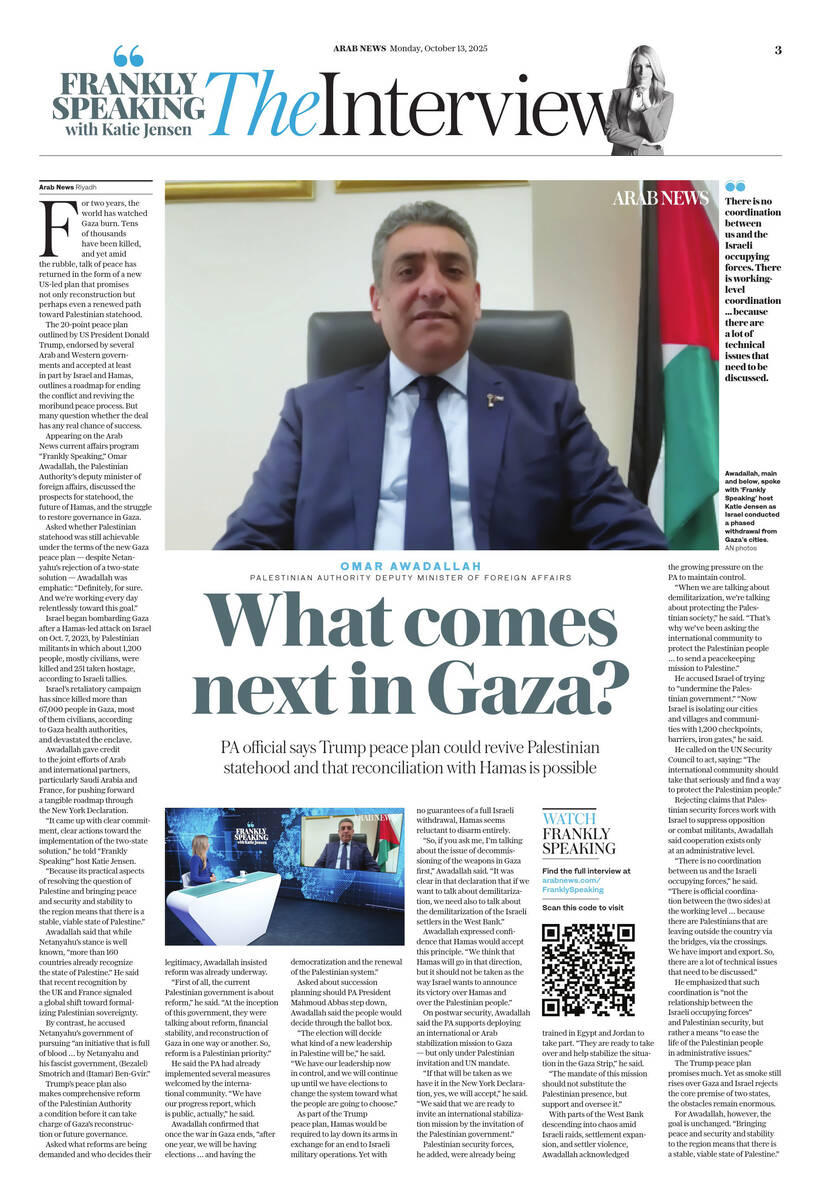
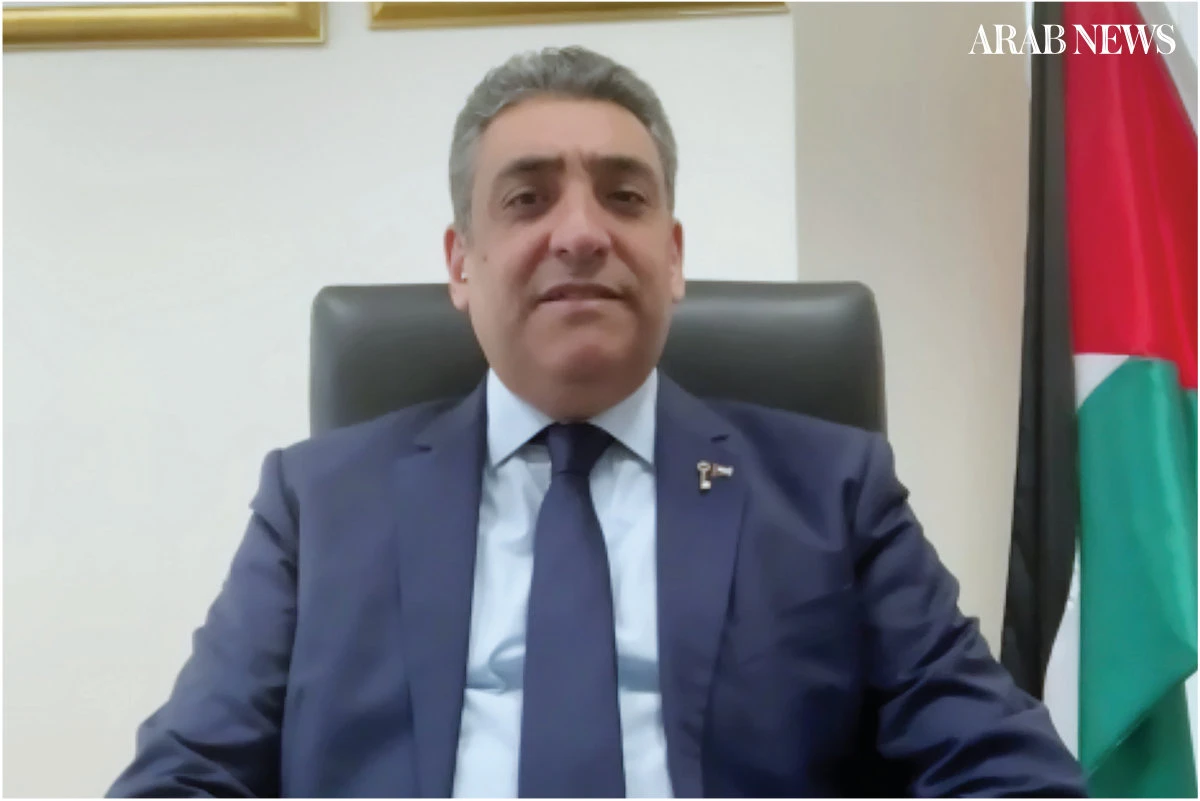
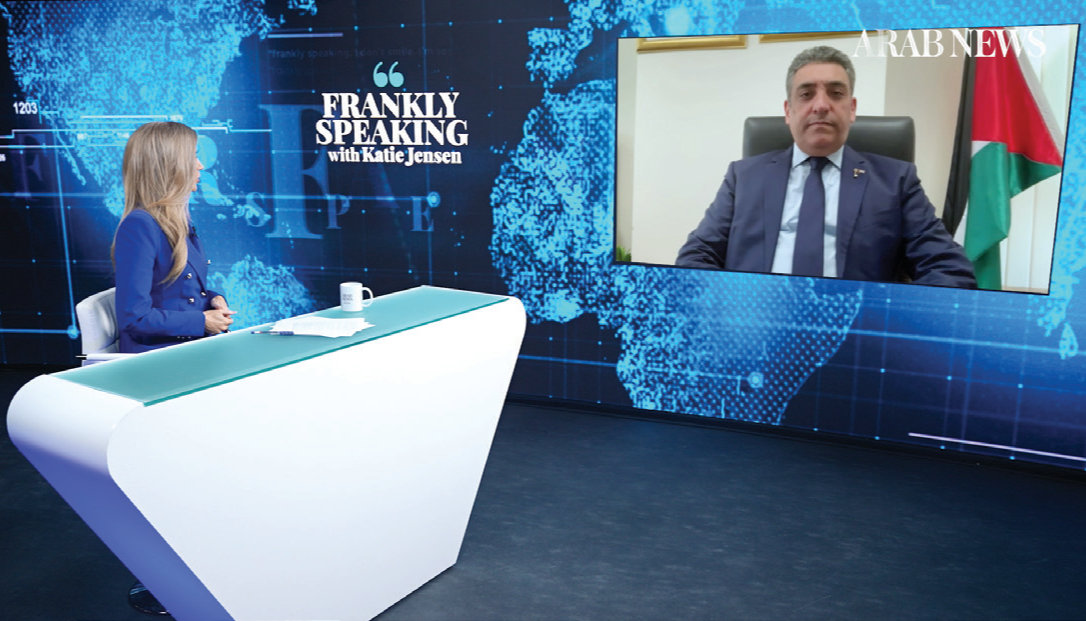
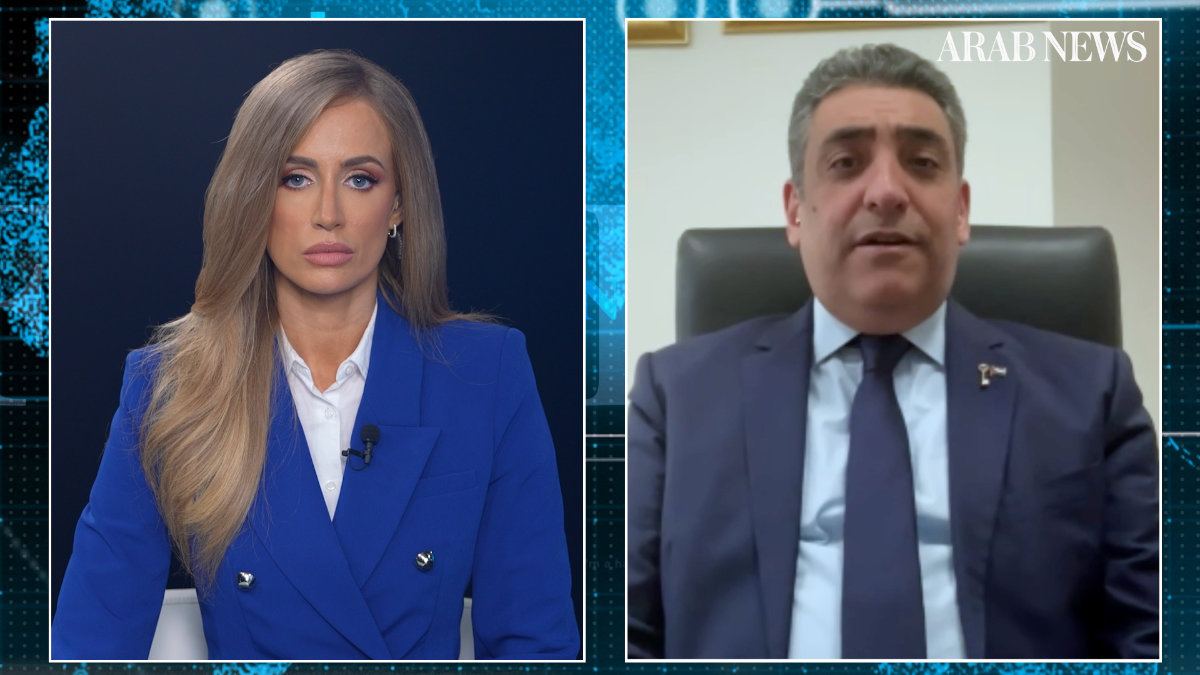
Appearing on the Arab News current affairs program “Frankly Speaking,” Omar Awadallah, the Palestinian Authority’s deputy minister foreign of foreign affairs, discussed the prospects for statehood, the future of Hamas, and the struggle to restore governance in Gaza.
Asked whether Palestinian statehood was still achievable under the terms of the new Gaza peace plan — despite Netanyahu’s rejection of a two-state solution — Awadallah was emphatic: “Definitely, for sure. And we’re working every day relentlessly toward this goal.”
Israel began bombarding Gaza after a Hamas-led attack on Israel on Oct. 7, 2023, by Palestinian militants in which about 1,200 people, mostly civilians, were killed and 251 taken hostage, according to Israeli tallies.
Israel’s retaliatory campaign has since killed more than 67,000 people in Gaza, most of them civilians, according to Gaza health authorities, and devastated the enclave.
Awadallah gave credit to the joint efforts of Arab and international partners, particularly Saudi Arabia and France, for pushing forward a tangible roadmap through the New York Declaration.
“It came up with clear commitment, clear actions toward the implementation of the two-state solution,” he told “Frankly Speaking” host Katie Jensen.
“Because its practical aspects of resolving the question of Palestine and bringing peace and security and stability to the region means that there is a stable, viable state of Palestine.”
Awadallah said that while Netanyahu’s stance is well known, “more than 160 countries already recognize the state of Palestine.” He said that recent recognition by the UK and France signaled a global shift toward formalizing Palestinian sovereignty.
“We believe that the ball moved by the international community, by these countries to recognize the state of Palestine, supporting the Saudi-French initiative toward having the state of Palestine as a prerequisite for peace,” he said.
“It’s a tangible, irreversible step toward the stabilization, peace, and security of the region.”
By contrast, he accused Netanyahu’s government of pursuing “an initiative that is full of blood … by Netanyahu and his fascist government, (Bezalel) Smotrich and (Itamar) Ben-Gvir.”
Trump’s peace plan also makes comprehensive reform of the Palestinian Authority a condition before it can take charge of Gaza’s reconstruction or future governance.
Asked what reforms are being demanded and who decides their legitimacy, Awadallah insisted reform was already underway.
“First of all, the current Palestinian government is about reform,” he said. “At the inception of this government, they were talking about reform, financial stability, and reconstruction of Gaza in one way or another. So reform is a Palestinian priority.”
He said the PA had already implemented several measures welcomed by the international community. “We have our progress report, which is public, actually,” he said.
“We are engaging on a daily basis with so many international players … because we are looking at reform as upgrade, update, develop, renewing and consolidating the Palestinian institutions. We don’t look at it from the perspective that this government … is a corrupted PA.”
Pressed on whether the leadership could claim legitimacy after nearly two decades without elections, Awadallah rejected the premise that the Palestinian Authority was at fault.
“We are not the ones who prevented the elections in East Jerusalem,” he said. “Israel did that at the critical juncture of time when Mr. Trump recognized Jerusalem as a unified capital for Israel. We cannot, as Palestinians, accept any elections without East Jerusalem.”
He confirmed that once the war in Gaza ends, “after one year, we will be having elections … and having the democratization and the renewal of the Palestinian system.”
Asked about succession planning should PA President Mahmoud Abbas step down, Awadallah said the people would decide through the ballot box.
“The election will decide what kind of a new leadership in Palestine will be,” he said. “We have our leadership now in control, and we will continue up until we have elections to change the system toward what the people are going to choose.”
On the question of intra-Palestinian unity, Awadallah said Fatah is committed to reconciliation with Hamas — but only under clear terms.
“We wish to have a Palestinian reconciliation process where all the Palestinians are under the PLO umbrella,” he said. “Accepting its obligations, its programs, its signed agreements with the international community, and the status of the state of Palestine all over the international community.”
He said unity was essential to prevent “anyone … from undermining our Palestinian national project.”
As part of the Trump peace plan, Hamas would be required to lay down its arms in exchange for an end to Israeli military operations. Yet with no guarantees of a full Israeli withdrawal, Hamas seems reluctant to disarm entirely.
“So, if you ask me, I’m talking about the issue of decommissioning of the weapons in Gaza first,” Awadallah said. “It was clear in that declaration that if we want to talk about demilitarization, we need also to talk about the demilitarization of the Israeli settlers in the West Bank.”
Pressed further on Hamas disarmament, he reaffirmed the PA’s guiding principle: “We are one state, one government, one rule of law and one gun.
“Any gun in Palestine, including Gaza … should be only with the sole legitimate representative of the Palestinian people, which is the Palestinian government,” he said.
Awadallah expressed confidence that Hamas would accept this principle. “We think that Hamas will go in that direction, but it should not be taken as the way Israel wants to announce its victory over Hamas and over the Palestinian people.”
He said demilitarization must form part of a comprehensive project addressing Gaza’s future, including the withdrawal of Israeli forces and protection of civilians.
“It’s not only about demilitarization without protecting the Palestinian people in Gaza that Israel is still bombing,” he said.
On postwar security, Awadallah said the PA supports deploying an international or Arab stabilization mission to Gaza — but only under Palestinian invitation and UN mandate.
“If that will be taken as we have it in the New York Declaration, yes, we will accept,” he said. “We said that we are ready to invite an international stabilization mission by the invitation of the Palestinian government.”
Palestinian security forces, he added, were already being trained in Egypt and Jordan to take part. “They are ready to take over and help stabilize the situation in the Gaza Strip,” he said.
“The mandate of this mission should not substitute the Palestinian presence, but support and oversee it.”
With parts of the West Bank descending into chaos amid Israeli raids, settlement expansion, and settler violence, Awadallah acknowledged the growing pressure on the PA to maintain control.
“When we are talking about demilitarization, we’re talking about protecting the Palestinian society,” he said. “That’s why we’ve been asking the international community to protect the Palestinian people … to send a peacekeeping mission to Palestine.”
He accused Israel of trying to “undermine the Palestinian government” through blockades, financial pressure, and by carving up Palestinian areas. “Now Israel is isolating our cities and villages and communities with 1,200 checkpoints, barriers, iron gates,” he said.
“Israel is trying to extend its genocide from Gaza to the West Bank by forcibly displacing more than 42,000 Palestinians. And their houses have already been demolished. What they are doing in East Jerusalem is the same.”
He called on the UN Security Council to act, saying: “The international community should take that seriously and find a way to protect the Palestinian people.”
Rejecting claims that Palestinian security forces work with Israel to suppress opposition or combat militants, Awadallah said cooperation exists only at an administrative level.
“There is no coordination between us and the Israeli occupying forces,” he said. “There is an official coordination between the working level … because there are Palestinians that are leaving outside the country via the bridges, via the crossings. We have import and export. So there are a lot of technical issues that need to be discussed.”
He emphasized that such coordination is “not the relationship between the Israeli occupying forces” and Palestinian security, but rather a means “to ease the life of the Palestinian people in administrative issues.”
On Oct. 5 and 6, within hours of Trump’s calls for an end to the bombing, Israeli planes and tanks pounded areas in Gaza, while in Gaza City Israeli forces pressed ahead with attacks and warned residents who left against returning. More than 50 Palestinians reportedly died in those attacks.
The Trump peace plan promises much. Yet as smoke still rises over Gaza and Israel rejects the core premise of two states, the obstacles remain enormous.
For Awadallah, however, the goal is unchanged. “Bringing peace and security and stability to the region means that there is a stable, viable state of Palestine.”