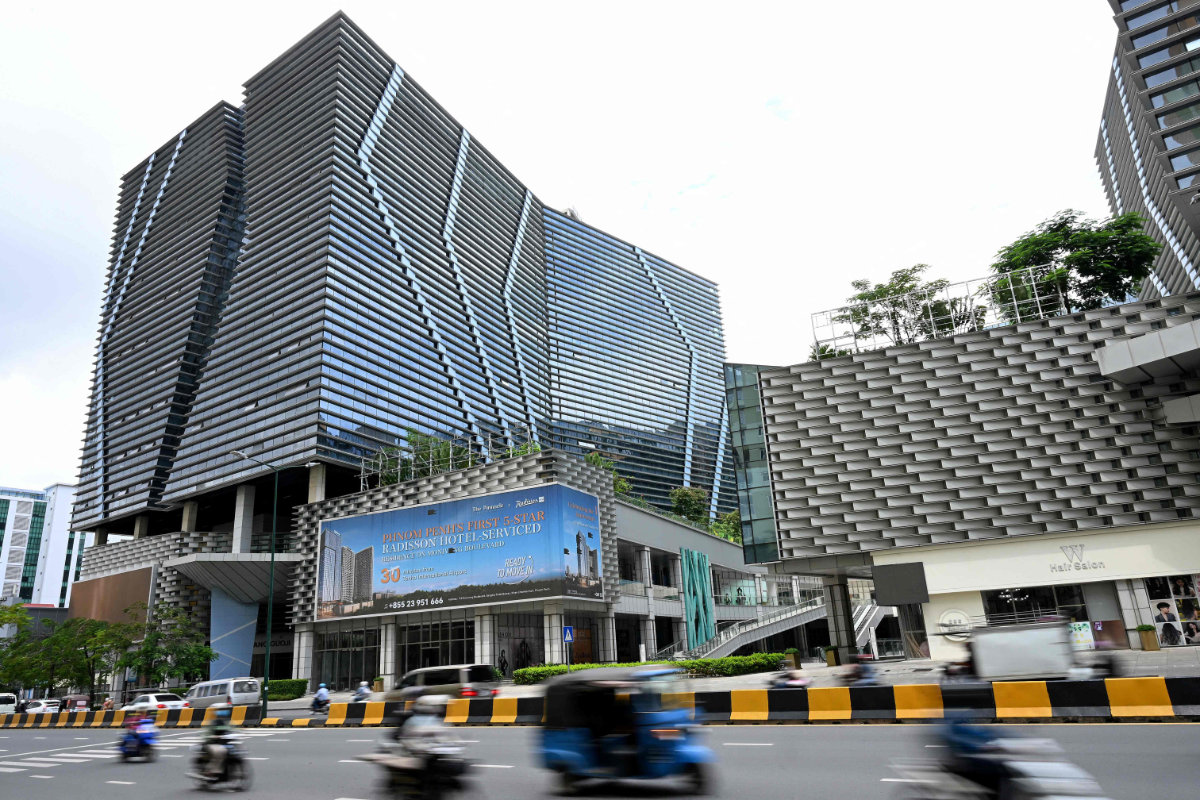
- Prince Holding Group has operated across more than 30 countries with interests in real estate, financial services and consumer businesses
- US and UK authorities have accused the company of running cyberscam operations where workers, some trafficked, carry out transnational fraud schemes
PHNOM PENH: US and UK authorities unveiled sanctions this week against Chen Zhi, a British-Cambodian tycoon accused of running cyberscam operations where workers, some trafficked, carry out transnational fraud schemes that have netted billions of dollars.
AFP takes a look at the man, indicted in the US, and his sanctioned company, Prince Group.
Who is Chen Zhi and Prince Group?
One of Cambodia’s largest conglomerates, Prince Holding Group has operated across more than 30 countries with interests in real estate, financial services and consumer businesses since 2015.
The business empire is ubiquitous in the Southeast Asian country, boasting $2 billion in real estate investments, including a large shopping mall, Prince Plaza, in the capital Phnom Penh.
Its 37-year-old chairman, Chen Zhi, was born in China, according to media reports, and holds both British and Cambodian citizenship.
Chen has served as an adviser to Prime Minister Hun Manet and his father, former leader Hun Sen, and holds the government-bestowed honorific “Neak Oknha”, meaning “prominent tycoon”.
Transnational crime expert Jacob Sims called Chen “a deeply state-embedded actor in Cambodia”.
“His influence runs through every layer of government, and Prince Group has long functioned as a major patron organization for the ruling party,” Sims told AFP.
Prince has said similar statements made in a report by Sims published this year were “defamatory assertions made without evidence or court rulings”.
On its website, Prince says it hopes to play an “important role” in Cambodia “through partnerships or direct investments into key industries for the betterment of Cambodians and the local economy”.
Why has Prince been sanctioned?
The US Department of Justice said Prince served as a front for “one of Asia’s largest transnational criminal organizations”.
The indictment “represents one of the most significant strikes ever against the global scourge of human trafficking and cyber-enabled financial fraud”, US Attorney General Pam Bondi said.
Chen and top executives allegedly used political influence and bribed officials in multiple countries to protect the illicit operations.
The US and UK sanctions freeze Chen’s businesses and properties in both countries, while Washington’s indictment charges him with fraud and money laundering involving Bitcoin worth about $15 billion.
The two countries allege he directed operations of forced labour compounds across Cambodia where thousands of workers were held in compounds surrounded by high walls and barbed wire.
Under threat of violence, many were forced to execute “pig butchering” scams —cryptocurrency investment schemes that build trust with victims over time before stealing their funds.
The scams targeted victims worldwide, causing billions of dollars in losses.
“Chen Zhi, Prince Group, and their co-conspirators within the upper echelons of the Cambodian government have presided over a system of gross exploitation whose malign effects are felt worldwide,” said Sims.
Prince Group did not respond to AFP’s requests for comment about the US and UK sanctions.
Both Chen and the company have previously denied allegations of criminality.
Will the sanctions have an impact?
Cambodia’s interior ministry spokesman told AFP that the government would cooperate with other nations in the case against Chen.
“We are not protecting individuals that violate the law,” Touch Sokhak said.
“But it does not mean that we are accusing Prince Group or Chen Zhi of committing crimes like the allegations made by the US or the UK.”
Organized crime expert Lindsey Kennedy told AFP that the UK and US sanctions this week were “so important and so groundbreaking”.
“We’ve never seen actors in this industry who looked so untouchable face these kinds of asset seizures and coordinated enforcement efforts before”, said Kennedy, the research director of The Eyewitness Project.
But with some countries’ economies so reliant on the scam industry, she said the law enforcement actions potentially leave “a vacuum for other organized crime types to swoop in”.