Los Angeles declares state of emergency over immigration raids

Los Angeles declares state of emergency over immigration raids
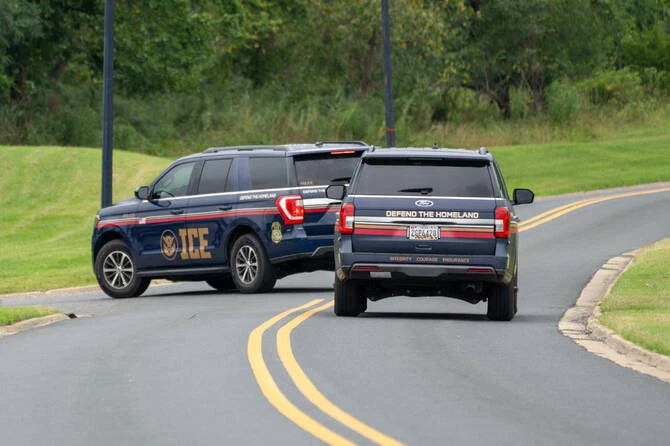
Los Angeles County was under a state of emergency Wednesday, declared over federal immigration raids, in the latest effort to push back on President Donald Trump's hardline policies. (AFP/File)
Short Url
Updated 16 October 2025
Follow

Los Angeles declares state of emergency over immigration raids

Los Angeles declares state of emergency over immigration raids
  • Supporters of the move say broad-based migrant raids being carried out by masked agents are untargeted and focused on people who speak Spanish or appear to be Hispanic
  • The raids have spread to other, mostly Democratic-run cities, including Chicago and Portland, Oregon

LOS ANGELES, USA: Los Angeles County was under a state of emergency Wednesday, declared over federal immigration raids, in the latest effort to push back on President Donald Trump’s hard-line policies.
The declaration, which is usually issued in times of natural disaster, frees up resources that can be used to help those affected in the county, home to a large number of undocumented migrants and one of the most diverse parts of the United States.
Supporters of the move say broad-based migrant raids being carried out by masked agents are untargeted and focused on people who speak Spanish or appear to be Hispanic.
They claim the fear the raids cause is preventing breadwinners from going to work and creating genuine hardship in immigrant communities, with one recent survey finding average weekly earnings among immigrants down by over 60 percent.
Janice Hahn, one of the county supervisors who voted 4-1 in favor of the declaration on Tuesday, said it was needed in response to “the fear, the pain and the disorder these... raids are causing our community.”
“We have entire families who are destitute because their fathers or mothers were taken from their workplaces.
“I want our immigrant communities to know that we are in this emergency with them, we see them and we understand what they are going through.”
Raids by armed Immigration and Customs Enforcement (ICE) agents, as well as other officials from agencies under the Department of Homeland Security, sparked uproar in Los Angeles when they unfolded several months ago.
Weeks of unruly protests were met by Trump’s decision to send National Guard soldiers onto the streets of America’s second largest city, a move criticized as heavy-handed and inflammatory by critics.
The raids have spread to other, mostly Democratic-run cities, including Chicago and Portland, Oregon, where the federal government has also tried to send National Guard troops.
Tuesday’s decision by county supervisors opens the door to a later eviction moratorium and other tenant protections for those who have fallen behind on their rent because of the raids.
Board of Supervisors Chair Kathryn Barger said she was voting against the proclamation because she feared it would simply prompt costly legal action from the federal government.
“We need real solutions, not symbolic gestures,” she said in a statement after the vote.
“I’ll continue to support targeted, community-centered programs like legal aid and rental assistance that provide meaningful help to vulnerable families while respecting legal limits, protecting County resources, and preserving public trust.”

Indonesian activists protest plan to name Suharto as national hero

Indonesian activists protest plan to name Suharto as national hero
Updated 08 November 2025
Follow

Indonesian activists protest plan to name Suharto as national hero

Indonesian activists protest plan to name Suharto as national hero
  • Suharto’s 32-year rule was marked by corruption, human rights violations
  • Activists are citing his role in some of the darkest periods in Indonesia’s history

JAKARTA: Indonesian activists are rallying against a government proposal to name as national hero the late military ruler Suharto who led the country for over three decades.

Suharto’s New Order military dictatorship was considered one of the most brutal and corrupt of the 20th century. The former president, who died in 2008, held power for 32 years before student-led protests forced him to step down in 1998, amid an economic crisis and deadly riots in Jakarta.

He was included in a list of 49 candidates to receive the national hero title this year, an honor bestowed annually on National Heroes’ Day on Nov. 10 for those considered to have made a significant contribution to the country.

The plan, which has yet to be finalized, has sparked protests among members of Indonesia’s civil society, who pointed to widespread allegations of human rights abuses and corruption during Suharto’s regime.

“In his 32-year reign, Suharto committed many human rights violations. He also came to power through a coup … corruption, collusion, and nepotism were also widespread during his rule,” Damairia Pakpahan, an Indonesian women’s rights activist based in Yogyakarta, told Arab News.

Pakpahan was part of a coalition of hundreds of Indonesian citizens and organizations, who signed a letter demanding the government to remove Suharto from the list of national hero candidates. A similar petition published online has received over 13,500 signatures so far.

Suharto “did not deserve to be granted a National Hero title,” the coalition said in the letter issued on Oct. 30, before detailing at least nine cases of gross human rights violations that took place under his rule.

This includes the unsolved violence during the riots in May 1998 as well as the 1965-66 killings, a series of countrywide political purges targeting members and alleged sympathizers of Partai Komunis Indonesia — at the time the third-largest communist party after China and the Soviet Union.

While an accurate and verified count of the dead is unlikely ever to be known, historians say that a total of 500,000 to 1 million people had been killed. Another 1.5 million had been imprisoned, while their family members still face stigma and discrimination, and many were prevented from holding government jobs up until recently.

“(The) Suharto government’s track record, particularly during the New Order era, demonstrates a pattern of authoritarian and repressive rule that had a far-reaching impact on the lives of the Indonesian people,” the civil society coalition said.

“Numerous policies and security operations implemented under Suharto’s rule resulted in serious human rights violations, ranging from murder and enforced disappearances, torture, sexual violence, to land grabbing and systematic social discrimination.”

On Thursday, about 100 activists rallied near the presidential palace in Jakarta to protest Suharto’s candidacy for the national hero title. Some carried posters that read: “Stop the Whitewashing of the General of Butchery” and “Thousands Died But The Country Chose to Forget.”

Indonesia’s social and culture ministries have said that public input was part of the process to nominate national hero candidates. 

Culture Minister Fadli Zon, who heads the committee in charge of naming national heroes, said at a press conference that “there was never evidence” that Suharto was involved in the 1960s massacres, which scholars have said amounted to genocide due to its scale. 

“Every one of these candidates have fulfilled all the requirements … their struggles are clear, their background and life history, all of it has undergone academic evaluation … This includes (former) President Suharto, whose name has been suggested two, three times now … We are looking at their extraordinary contributions (to the country),” he told reporters earlier this week.

Andreas Harsono, senior Indonesia researcher at Human Rights Watch, told Arab News that the process to grant national hero status has always been controversial in Indonesia.

“Gen. Suharto, for instance, is a hero to some groups in Indonesia, but obviously, not a hero to many other groups, especially those who have suffered from his authoritarian regime, including the 1965 genocide,” he told Arab News.

“It’s much better if (the Indonesian government) is to end these jokes about national heroes. Let historians do their work and let the public decide their own respective heroes.”