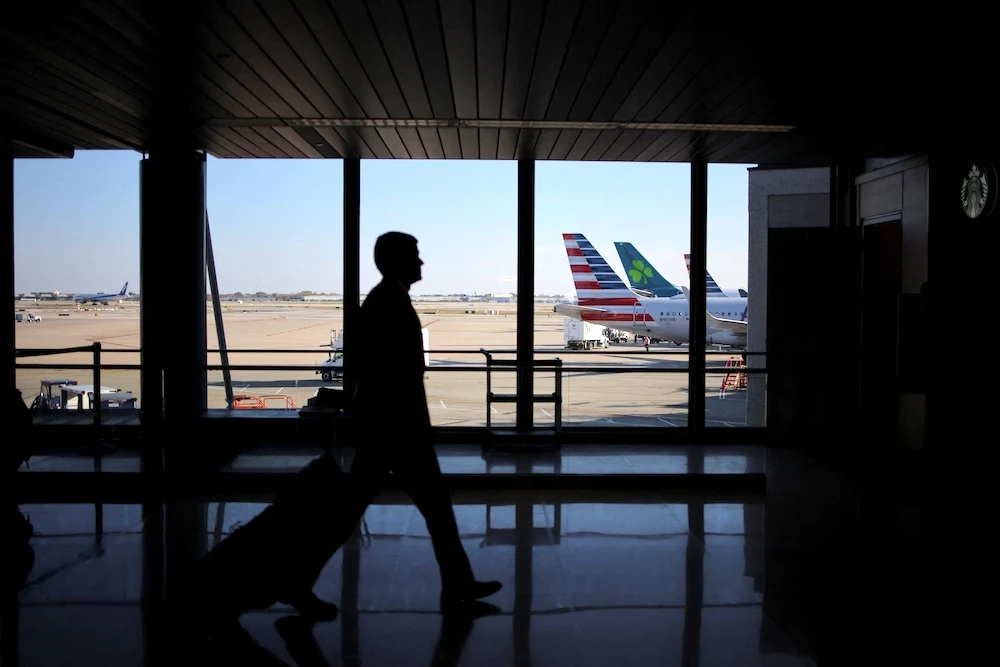
More than 8,000 US flights delayed as air traffic control absences persist

Update More than 8,000 US flights delayed as air traffic control absences persist
Short Url
Updated 27 October 2025
Follow

More than 8,000 US flights delayed as air traffic control absences persist

More than 8,000 US flights delayed as air traffic control absences persist
  • Federal Aviation Administration experienced air traffic control staffing issues at 22 locations on Saturday
  • Increased air travel delays and cancelations are being closely watched

WASHINGTON: More than 8,000 flights were delayed across the US on Sunday as air traffic controller absences continued to disrupt travel and a federal government shutdown reached its 26th day.

US Transportation Secretary Sean Duffy said the Federal Aviation Administration experienced air traffic control staffing issues at 22 locations on Saturday, and added additional shortages were expected to lead to more flight delays and cancelations in the days ahead.

According to FlightAware, a flight-tracking website, there were more than 8,000 US flight delays by 11 p.m. ET on Sunday (0400 GMT on Monday), an increase from about 5,300 on Saturday. Delays have often been above average since the government shutdown began on October 1.
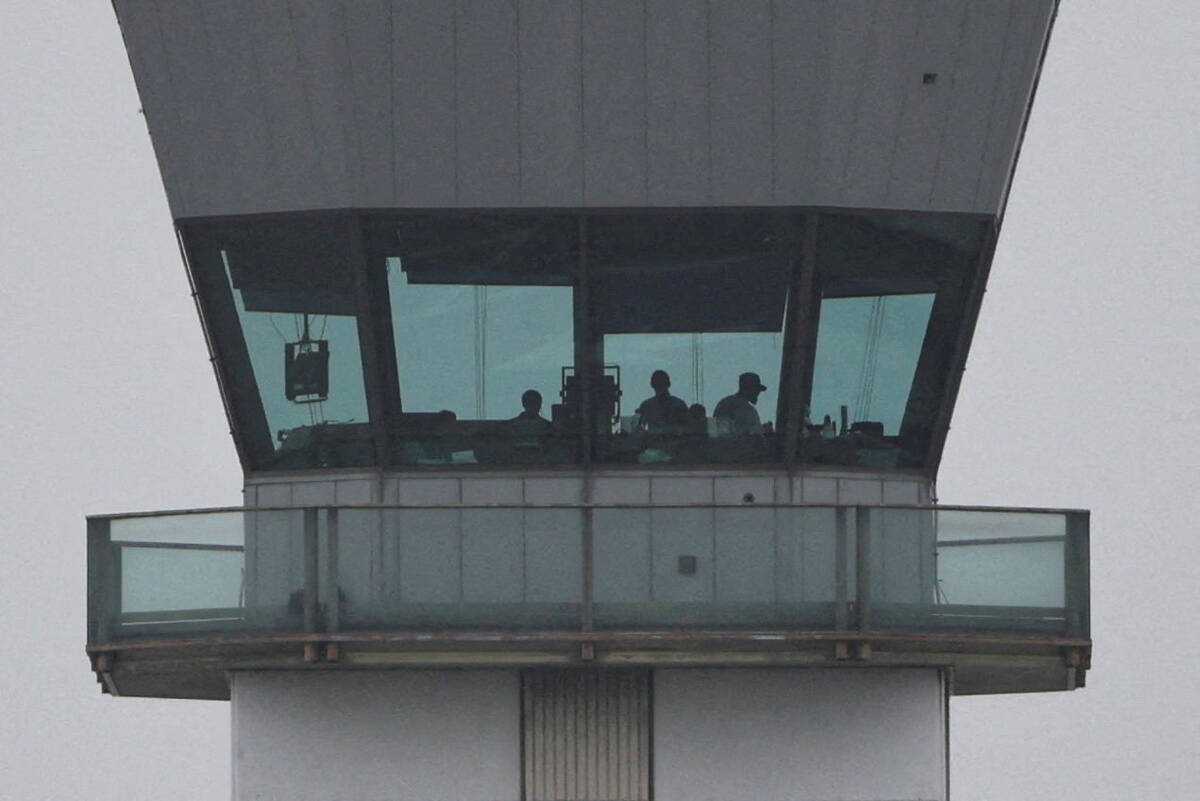


Air traffic controllers resume operations a day after Hollywood Burbank Airport operated for hours without a staffed control tower due to staffing shortages amid the US government shutdown, in Burbank, California, on Oct. 7, 2025. (Reuters file photo)

Southwest Airlines had 45 percent, or 2,000 flights delayed on Sunday, while American Airlines had nearly 1,200, or a third of its flights delayed, according to FlightAware. United Airlines had 24 percent, or 739 flights, delayed and Delta Air Lines had 610 flights, or 17 percent, delayed.

Some 13,000 air traffic controllers and about 50,000 Transportation Security Administration officers must work even though they are not being paid during the shutdown.

Increased air travel delays and cancelations are being closely watched as observers look for indications that the shutdown is making life harder for Americans. That, in turn, could pressure lawmakers to break the budget deadlock that led to the shutdown.

The FAA on Saturday had 22 “triggers” that indicated shortages of air traffic controllers, Duffy told the Fox News “Sunday Morning Futures” program. He said the figure was “one of the highest that we’ve seen in the system” since October 1.

“That’s a sign that the controllers are wearing thin,” Duffy said.

The FAA said ground delay programs had been issued because of staffing shortages on Sunday at Chicago’s O’Hare Airport, Washington’s Reagan National Airport and Newark Liberty International Airport. An earlier ground stop was issued at Los Angeles International Airport, but that was later withdrawn.

The Trump administration has warned that flight disruptions will increase as controllers miss their first full paycheck on Tuesday.

Air traffic controllers received a paycheck two weeks ago at 90 percent of their regular pay. But Tuesday’s payday would have been for their first pay period solely for work in October.

Controllers facing the prospect of missing a federal paycheck are looking for other sources of income, Duffy said.

“They’re taking second jobs, they’re out there looking,” he said.

The FAA is about 3,500 air traffic controllers short of targeted staffing levels and many had been working mandatory overtime and six-day weeks even before the shutdown.

In 2019, during a 35-day shutdown, the number of absences by controllers and TSA officers rose as workers missed paychecks, extending wait times at some airport checkpoints. Authorities were forced to slow air traffic in New York and Washington.

Duffy and other Republicans have criticized Democrats for opposing a “clean” short-term funding bill with no strings attached. Democrats have criticized President Donald Trump and Republicans for refusing to negotiate over health care subsidies that expire at the end of the year.


Truckers defy death to supply militant-hit Mali with fuel

Truckers defy death to supply militant-hit Mali with fuel
Updated 3 sec ago
Follow

Truckers defy death to supply militant-hit Mali with fuel

Truckers defy death to supply militant-hit Mali with fuel
TENGRELA: Tanker driver Baba steeled himself for yet another perilous journey from Ivory Coast to Mali loaded up with desperately needed fuel — and fear.
“You never know if you’ll come back alive,” he said.
Even before they hit the road, the mere mention of a four-letter acronym is enough to scare Baba and his fellow drivers.
JNIM, the Al-Qaeda-linked Group to Support Islam and Muslims, known by its Arabic acronym, declared two months ago that no tanker would cross into Mali from any neighboring country.
Hundreds of trucks carrying goods from the Ivorian economic hub Abidjan or the Senegalese capital Dakar have since been set on fire.
The JNIM’s strategy of economic militant aims to choke off Mali’s capital Bamako and the ruling military junta, which seized power in back-to-back coups in 2020 and 2021.
The fuel blockade has made everyday life in the west African country all but impossible.
“By economically strangling the country, the JNIM is looking to win popular support by accusing the military government of incompetence,” Bakary Sambe from the Dakar-based Timbuktu Institute think tank said.
On top of that, Mali has a “structural problem of insecurity,” he added.
Despite it all, dozens of tanker truckers still brave the roads, driven on by “necessity” and “patriotism,” they say.
AFP spoke to several along the more than 300-kilometer (185-mile) road between the northern Ivorian towns of Niakaramandougou and Tengrela, the last one before the Malian border.

- Dying ‘for a good cause’ -

“We do it because we love our country,” Baba, whose name AFP has changed out of security concerns, said.
“We don’t want Malians to be without fuel,” added the 30-year-old in a Manchester United shirt.
Taking a break parked up at Niakaramandougou, five hours from the border, Mamadou Diallo, 55, is similarly minded.
“If we die, it’s for a good cause,” he confided.
Further north at Kolia, Sidiki Dembele took a quick lunch with a colleague, their trucks lined up on the roadside, engines humming.
“If the trucks stop, a whole country will be switched off,” he said, between mouthfuls of rice.
Two years ago, more than half of the oil products exported by Ivory Coast went to Mali.
Malian trucks load up at Yamoussoukro or Abidjan and then cross the border via Tengrela or Pogo, traveling under military escort once inside Mali until their arrival in Bamako.
Up to several hundred trucks can be escorted at a time, but even with the military by their side, convoys are still frequently targeted, especially on two key southern axes.
“Two months ago, I saw militants burn two trucks. The drivers died. I was just behind them. Miraculously they let me through,” Moussa, 38, in an oil-stained red polo T-shirt, said.
Bablen Sacko also narrowly escaped an ambush.
“Apprentices died right behind us,” he recalled, adding firmly: “Everyone has a role in building the country. Ours is to supply Mali with fuel. We do it out of patriotism.”


- ‘Risk premium’ -

But their pride is mixed with bitterness over their working conditions.
“No contract, no insurance, no pension. If you die, that’s that. After your burial, you’re forgotten,” Sacko said.
With monthly pay of barely 100,000 CFA francs ($175, 152 euros) and a small bonus of 50,000 CFA francs per trip, Yoro, one of the drivers, has called for a risk premium.
Growing insecurity has prompted some Ivorian transport companies to halt road travel into Mali.
In Boundiali, Broulaye Konate has grounded his 45-strong fleet.
“I asked a driver to deliver fertilizer to Mali. He refused. The truck is still parked in Abidjan,” he said.
Ivorian trucker Souleymane Traore has been driving to Mali for seven years but said lately “you take to the road with fear in your heart.”
He recently counted 52 burnt-out tankers on his way back to Ivory Coast and another six on a further stretch of road.
Malian Prime Minister Abdoulaye Maiga has referred to the fuel that manages to get through as “human blood,” in recognition of the soldiers and drivers killed on the roads.
Analyst Charlie Werb from Aldebaran Threat Consultants said he did not anticipate the fuel situation easing in the coming days but said the political climate was more uncertain.
“I do not believe JNIM possesses the capability or intent to take Bamako at this time, though the threat it now poses to the city is unprecedented,” he added.