Nigerian Nobel laureate Wole Soyinka says US visa revoked

Nigerian Nobel laureate Wole Soyinka says US visa revoked
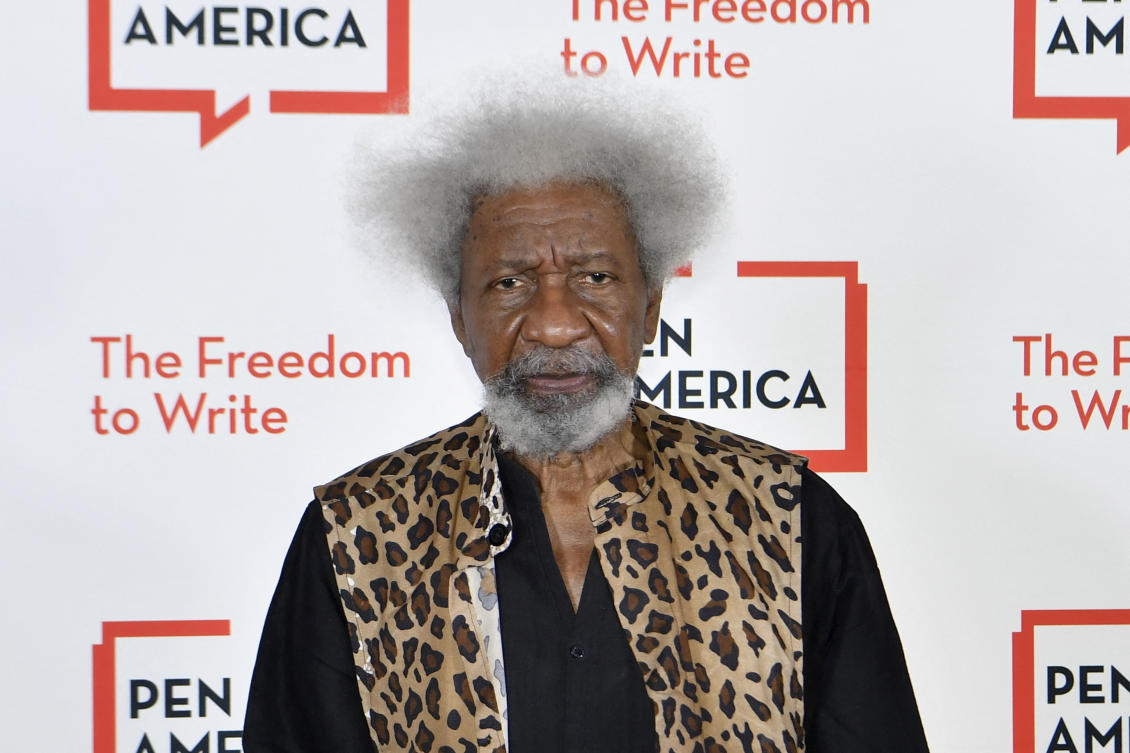
Nigerian writer Wole Soyinka attends the Pen America Literary Gala at the American Museum of Natural History on October 5, 2021 in New York City. (AFP)
Short Url
Updated 28 October 2025
Follow

Nigerian Nobel laureate Wole Soyinka says US visa revoked

Nigerian Nobel laureate Wole Soyinka says US visa revoked
  • “I want to assure the consulate... that I’m very content with the revocation of my visa,” Soyinka said
  • Soyinka previously held permanent residency in the United States

LAGOS: The United States consulate in Lagos has revoked the visa of Nigerian writer Wole Soyinka, the Nobel laureate said Tuesday.
“I want to assure the consulate... that I’m very content with the revocation of my visa,” Soyinka, a famed playwright and author who won the 1986 Nobel Prize for Literature, told a news conference.
Soyinka previously held permanent residency in the United States, though he destroyed his green card after Donald Trump’s first election in 2016.
He has remained critical of the US president, who is now serving his second term, and speculated that his recent comments comparing Trump to former Ugandan dictator Idi Amin might have struck a nerve.
Soyinka said earlier this year that the US consulate in Lagos had called him in for an interview to re-assess his visa.
According to a letter from the consulate addressed to Soyinka, seen by AFP, officials cited US State Department regulations that allow “a consular officer, the Secretary, or a Department official to whom the Secretary has delegated this authority... to revoke a nonimmigrant visa at any time, in his or her discretion.”
Reading the letter aloud to journalists in Lagos, Nigeria’s economic capital, Soyinka said that officials asked him to bring his passport to the consulate so that his visa could be canceled in-person.
He jokingly called it a “rather curious love letter from an embassy,” while telling any organizations hoping to invite him to the United States “not to waste their time.”
“I have no visa. I am banned,” Soyinka said.

- ‘Like a dictator’ -

The Trump administration has made visa revocations a hallmark of its wider crackdown on immigration, notably targeting university students who were outspoken about Palestinian rights.
The US embassy in Abuja, the Nigerian capital, did not respond to a request for comment.
“Idi Amin was a man of international stature, a statesman, so when I called Donald Trump Idi Amin, I thought I was paying him a compliment,” Soyinka said.
“He’s been behaving like a dictator, he should be proud.”
The 91-year-old playwright behind “Death and the King’s Horseman” has taught at and been awarded honors from top US universities including Harvard and Cornell.
Soyinka spoke at Harvard in 2022 alongside American literary critic Henry Louis Gates.
His latest novel, “Chronicles from the Land of the Happiest People on Earth,” a satire about corruption in Nigeria, was published in 2021.
Asked if he would consider going back to the United States, Soyinka said: “How old am I?“
He however left the door open to accepting an invitation should circumstances change, but added: “I wouldn’t take the initiative myself because there’s nothing I’m looking for there. Nothing.”
A car fleeing police slams into a bar in Florida, killing 4 and injuring 11

A car fleeing police slams into a bar in Florida, killing 4 and injuring 11
Updated 09 November 2025
Follow

A car fleeing police slams into a bar in Florida, killing 4 and injuring 11

A car fleeing police slams into a bar in Florida, killing 4 and injuring 11
  • Officers identified the suspect as 22-year-old Silas Sampson, who was booked Saturday and was being held at the Hillsborough County Jail

A speeding car fleeing police slammed into a crowded bar early Saturday, killing four people and injuring 11 in a historic district of Tampa, Florida, that is known for its nightlife and tourists.
An air patrol unit spotted the silver sedan driving recklessly on a freeway at about 12:40 a.m. after it was seen street racing in another neighborhood, the Tampa Police Department said in a statement.
The Florida Highway Patrol caught up with the vehicle and tried to perform a PIT maneuver, which involves bumping the rear fender to cause a spinout, but it was unsuccessful.
Highway patrol officers “disengaged” as the vehicle sped toward historic Ybor City near downtown, police said, and ultimately the driver lost control and hit more than a dozen people outside the bar, Bradley’s on 7th.
Three people died at the scene, and a fourth died at a hospital. As of Saturday afternoon, two people were hospitalized in critical condition, seven were listed as stable and two had been treated and discharged, police said. Additionally there were two people who had only minor injuries and declined treatment at the scene.
“What happened this morning was a senseless tragedy, our hearts are with the loved ones of the victims and all those who were impacted,” Police Chief Lee Bercaw said in a statement.
Officers identified the suspect as 22-year-old Silas Sampson, who was booked Saturday and was being held at the Hillsborough County Jail.
Court documents show Sampson was charged with four counts of vehicular homicide and four counts of aggravated fleeing or eluding with serious bodily injury or death, all first-degree felonies.
No attorney was immediately listed for Sampson who could speak on his behalf.
“Our entire city feels this loss,” Mayor Jane Castor, who also served as Tampa’s first female police chief, said on social media. She added that the investigation is ongoing.
In recent years some states and local agencies have pushed to restrict high-speed car chases to protect both civilians and officers. Following a rise in fatalities, a 2023 study funded by the US Department of Justice called for chases to be rare, saying the dangers often outweigh the immediate need to take someone into custody.
Nevertheless, Florida’s highway patrol has loosened limits on car chases and PIT maneuvers, tactics that the Justice Department-backed report characterized as “high-risk” and “controversial.”