Israel bans Red Cross visits to detained Palestinian combatants

Israel bans Red Cross visits to detained Palestinian combatants
1 / 2
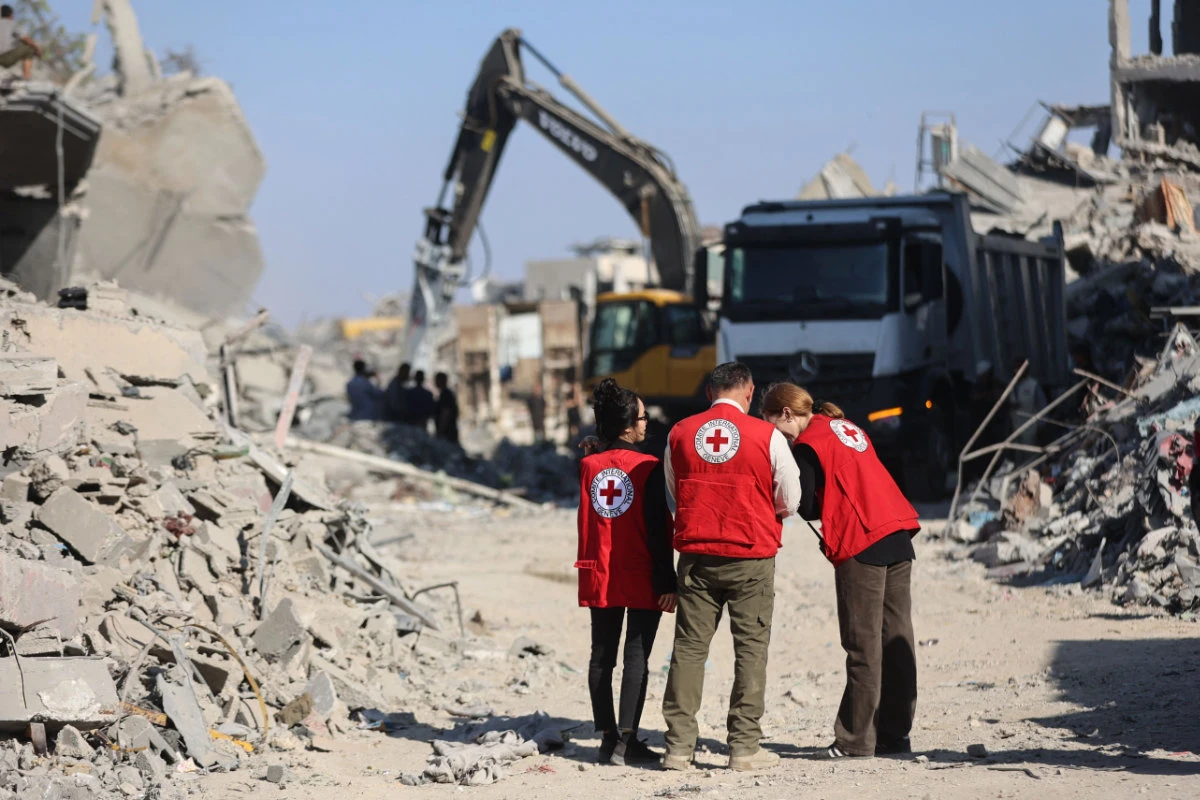
Red Cross staff are seen amid the rubble of destroyed buildings in the al-Tuffah neighborhood of Gaza City, where a recovery operation of the bodies of Israeli hostages was ongoing, on October 27, 2025. (AFP)
Israel bans Red Cross visits to detained Palestinian combatants
2 / 2
A Red Cross ambulance transports the body of a deceased hostage, who had been held in Gaza since the deadly October 7, 2023, attack, after it was handed over by Hamas militants as part of a ceasefire and a hostages-prisoners swap deal with Israel, on October 27, 2025. (Reuters)
Short Url
Updated 30 October 2025
Follow

Israel bans Red Cross visits to detained Palestinian combatants

Israel bans Red Cross visits to detained Palestinian combatants
  • ICRC says the purpose of its visits to places of detention and those deprived of their liberty "is purely humanitarian” 
  • But Defense Minister Israel Katz says "Red Cross visits to terrorists in prisons would seriously harm the state’s security"

JERUSALEM: Israel has banned the International Committee of the Red Cross (ICRC) from visiting Palestinian prisoners detained under a law targeting “unlawful combatants,” the country’s defense minister said on Wednesday.
“The opinions presented to me leave no doubt that Red Cross visits to terrorists in prisons would seriously harm the state’s security. The safety of the state and our citizens comes first,” Israel Katz said, according to a statement from his office.
The order, which was issued just hours before the country’s top court had a hearing on the issue, prohibits the ICRC from visiting thousands of detainees named in a list attached to it.
In practice, the order will make law of the status quo that has prevailed since the war in Gaza started after Hamas’s unprecedented October 7, 2023 attack on Israel.
Under Israeli law, the category of “unlawful combatants,” introduced in 2002, allows for indefinite detention of individuals without charge in military detention centers.
The ICRC says it has not been allowed to visit detainees in jail since then, save for pre-release interviews conducted under Gaza ceasefire and prisoner exchange deals.
“The purpose of the ICRC visits to places of detention and those deprived of their liberty is purely humanitarian,” it said.
“We aim to assess the treatment and conditions of detainees and work with the detaining authorities on ensuring these conditions are according to international standards, as well as restoring contact between the detainees and their families.”
Several NGOs had already told AFP, even before the decree, of delays and complications faced by lawyers seeking to visit Palestinian prisoners.

‘Violation’ 

According to the NGOs, the Israeli prison administration argues that such visits could be used to send or receive messages to and from Palestinian Islamist groups.
During Wednesday’s court hearing the state’s lawyer Ron Rosenberg said that a decision had been made to allow the “transfer of information to the Red Cross,” which would be implented “in the coming days.”
“The information will only include names and detention facilities,” Rosenberg said, and would only be given for prisoners not associated with Gaza or Hamas.
However, Rosenberg said that access to prisoners would be prevented “until all hostages are back” from Gaza.
The Association for Civil Rights in Israel (ACRI), which filed a petition to grant the ICRC access to Israeli prisons, told AFP that some of the combatants are held in military detention centers, and others in regular Israeli jails.
It said that before the ceasefire deal that began on October 10, the Israeli Prison Service “was holding 2,673 prisoners categorized as unlawful combatants.”
It added that hundreds were released under the deal in exchange for hostages held in the Gaza Strip.
In a statement, Hamas said the ban on ICRC visits “constitutes a violation of a fundamental right of our prisoners.”
“This adds to a series of systematic and criminal violations they are subjected to, including killing, torture, starvation, medical neglect, and the withholding of information,” the Palestinian Islamist movement added.
On Tuesday, the Israeli military accused Hamas of faking its search for the bodies of deceased hostages still in Gaza in order to stall the return process.
Providing drone footage as evidence, it said that Hamas staged a body’s discovery in front of ICRC staff, who have facilitated the transfer of hostages and prisoners.
The ICRC said it was unaware the body had been pre-positioned ahead of its team’s arrival, and called the staged discovery “unacceptable,” noting “so much depends on this agreement being upheld.”


Iraq can disarm factions only when the US withdraws, prime minister says 

Iraq can disarm factions only when the US withdraws, prime minister says 
Updated 04 November 2025
Follow

Iraq can disarm factions only when the US withdraws, prime minister says 

Iraq can disarm factions only when the US withdraws, prime minister says 
  • Sudani highlights US investment in Iraq’s energy sector
  • Sudani confident in election victory, aims for second term

BAGHDAD: Iraq has pledged to bring all weapons under the control of the state, but that will not work so long as there is a US-led coalition in the country that some Iraqi factions view as an occupying force, the prime minister said on Monday.
Prime Minister Mohammed Shia Al-Sudani said a plan was still in place to have the multinational anti-Daesh coalition completely leave Iraq, one of Iran’s closest Arab allies, by September 2026 because the threat from Islamist militant groups had eased considerably.
“There is no Daesh. Security and stability? Thank God it’s there ... so give me the excuse for the presence of 86 states (in a coalition),” he said in an interview in Baghdad, referring to the number of countries that have participated in the coalition since it was formed in 2014.
“Then, for sure there will be a clear program to end any arms outside of state institutions. This is the demand of all,” he said, noting factions could enter official security forces or get into politics by laying down their arms.
‘No side can pull Iraq to war’, says Sudani
Iraq is navigating a politically sensitive effort to disarm Iran-backed militias amid pressure from the US, which has said it would like Sudani to dismantle armed groups affiliated with the Popular Mobilization Forces, an umbrella group of mostly Shiite factions. The PMF was formally integrated into Iraq’s state forces and includes several groups aligned with Iran.
At the same time, the US and Iraq have agreed on a phased withdrawal of American troops, with a full exit expected by the end of 2026. An initial drawdown began in 2025.
Asked about growing international pressure on non-state armed groups in the region such as Lebanon’s Hezbollah, part of Iran’s so-called Axis of Resistance created to counter US and Israeli influence in the Middle East, Sudani said:
“There is time enough, God willing. The situation here is different than Lebanon.”
“Iraq is clear in its stances to maintain security and stability and that state institutions have the decision over war and peace, and that no side can pull Iraq to war or conflict,” said Sudani.
Shiite power Iran has gained vast influence in Iraq since a US-led invasion toppled Saddam Hussein in 2003, with heavily armed pro-Iranian paramilitary groups wielding enormous political and military power.
Successive Iraqi governments have faced the challenge of keeping both arch-foes Iran and the US as allies. While the US slaps sanctions on Iran, Iraq does business with it.
Securing major US investment is a top priority for Iraq, which has faced severe economic problems and years of sectarian bloodletting since 2003.
Us companies increasingly active in Iraq, says Sudani
“There is a clear, intensive and qualitative entrance of US companies into Iraq,” said Sudani, including the biggest ever agreement with GE for 24,000 MW of power, equivalent to the country’s entire current generation capacity, he said.
In August, Iraq signed an agreement in principle with US oil producer Chevron (CVX.N), for a project at Nassiriya in southern Iraq that consists of four exploration blocks in addition to the development of other producing oil fields.
Sudani said an agreement with US LNG firm Excelerate to provide LNG helped Iraq cope with rolling power cuts.
Sudani praised a recent preliminary agreement signed with ExxonMobil, and he said the advantage of this agreement is that for the first time Iraq is agreeing with a global company to develop oilfields along with an export system.
Sudani said that US and European companies had shown interest in a plan for the building of a fixed platform for importing and exporting gas off the coast of the Grand Faw Port, which would be the first project there.
Sudani said the government had set a deadline for the end of 2027 to stop all burning of gas and to reach self-sufficiency in gas supplies, and to stop gas imports from Iran.
“We burn gas worth four to five billion (dollars) per year and import gas with 4 billion dollars per year. These are wrong policies and it’s our government that has been finding solutions to these issues,” he said.
Sudani is running against established political parties in his ruling coalition in Iraq’s November 11 election and said he expects to win. Many analysts regard him as the frontrunner.
“We expect a significant victory,” he said, adding he wanted a second term. “We want to keep going on this path.”
Sudani said he believed this year’s elections would see a higher turnout than last year’s roughly 40 percent in parliamentary polls, which was down from around 80 percent two decades ago.
Sudani campaigns as Iraq’s builder-in-chief
He has portrayed himself as the builder-in-chief, his campaign posters strategically laid out at key sites of Baghdad construction, including a new dual-carriageway along the Tigris in the center of the capital.
He ticks off the number of incomplete projects he inherited from previous governments – 2,582, he said — and notes he spent a fraction of their initial cost to finish them.
Many Iraqis have been positive about the roads, bridges and buildings they have seen go up, helping to somewhat alleviate the choking traffic in the city.
But it has come at a cost.
Sudani’s three-year budget was the largest in Iraq’s history at over $150 billion a year.
He also hired about 1 million employees into the already-bloated state bureaucracy, buying social stability at the cost of severely limiting the government’s fiscal room for maneuver.
“I am not worried about Iraq’s financial and economic situation. Iraq is a rich country with many resources, but my fear is that the implementation of reforms is delayed,” he said.