
Nation states always prioritize the welfare of their citizens by providing security for them. American and European literature about Saudi Arabia frequently refers to the Kingdom’s concern for its security as if it is an exception to that rule.
They imply that insecurity drives its policy options. However, in the Middle East, the Kingdom has been the most secure country.
While the process of unifying the Kingdom by King Abdulaziz started at the turn of the 20th century, when all of the Arabian Peninsula suffered from insecurity, by the time of the actual unification in 1932 the Kingdom had got over the threats that impinged on her security.
The external threats from the Sharifi Kingdoms in Jordan and Iraq had receded. The threat from Yemen, although not yet diminished, was solved in 1934 when a peace agreement was reached with the Imam Yahya.
Internally, the state had successfully pacified the tribal disturbances that plagued the Kingdom in the twenties, and peace and tranquility reigned. The initial agreement with Great Britian signed in 1915 had been amended by the Jeddah agreement in 1927 certifying full independence for the Kingdom.
Various other agreements were signed with Yemen, Iraq, Jordan, and the Gulf states which were under British protection. A new term in international relations was introduced (the neutral zone) to apply to the borders with Iraq and Kuwait to delineate what territories between them and the Kingdom were amicably agreed to remain undelineated.
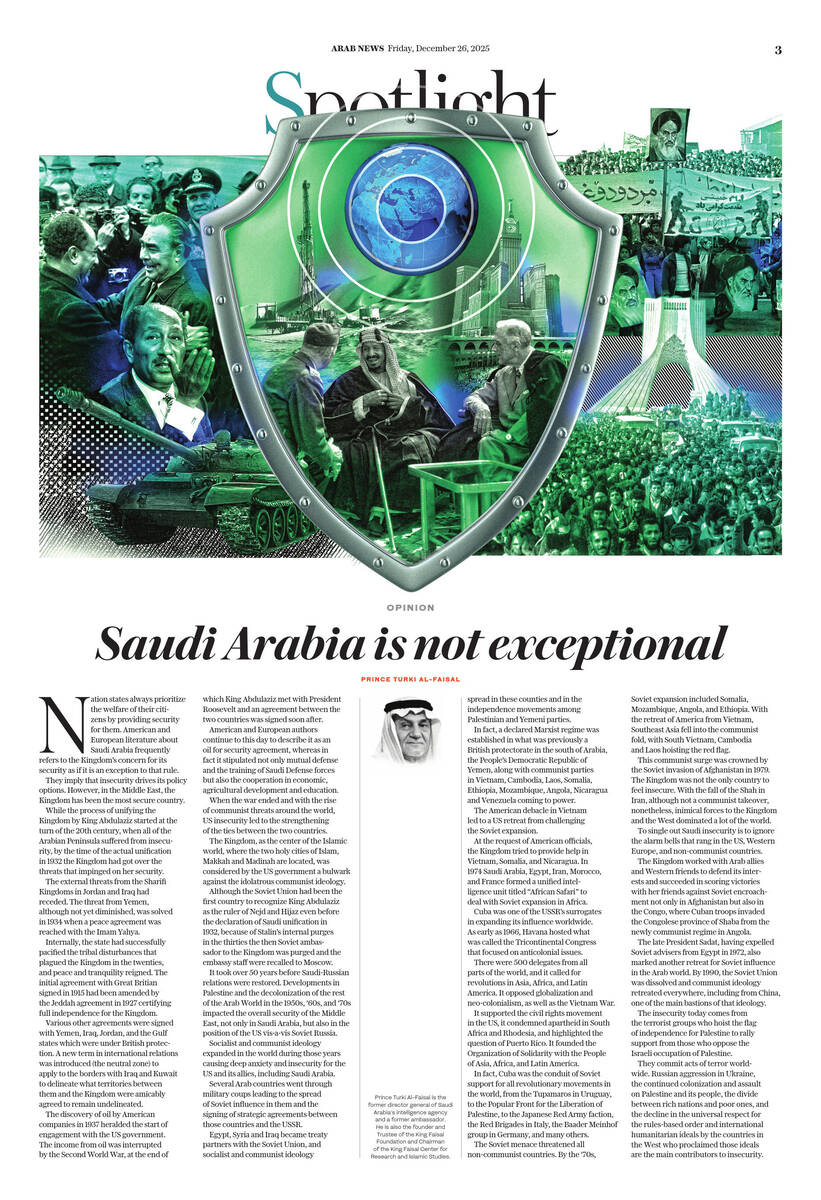
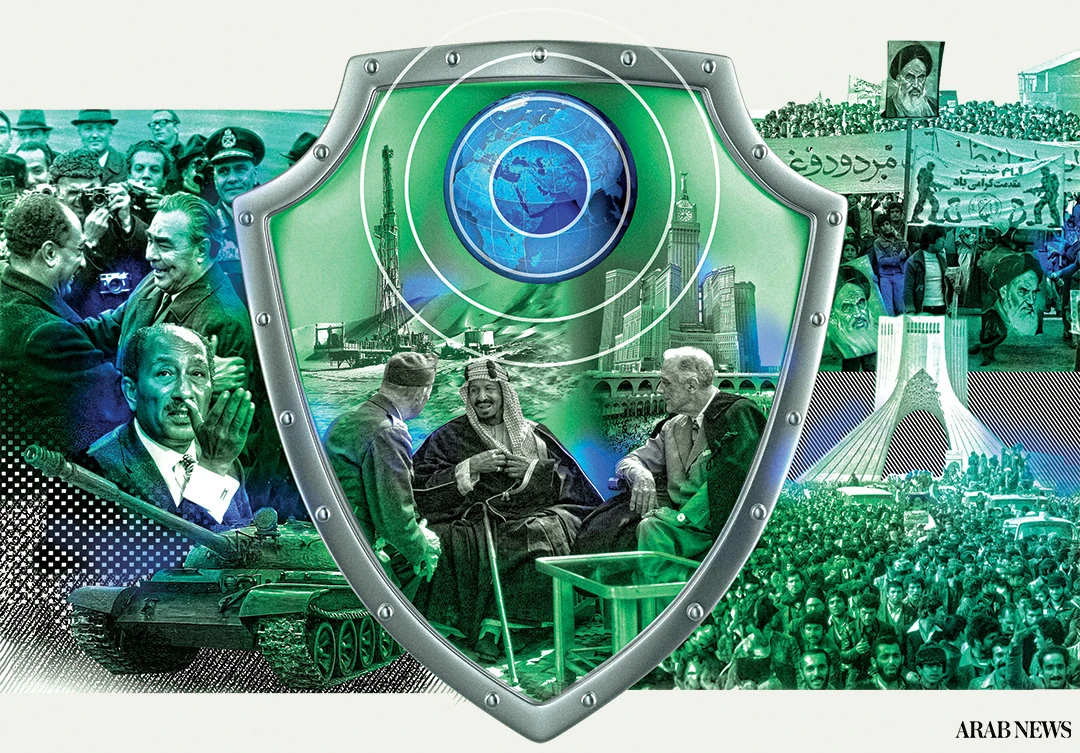
The discovery of oil by American companies in 1937 heralded the start of engagement with the US government. The income from oil was interrupted by the Second World War, at the end of which King Abdulaziz met with President Roosevelt and an agreement between the two countries was signed soon after.
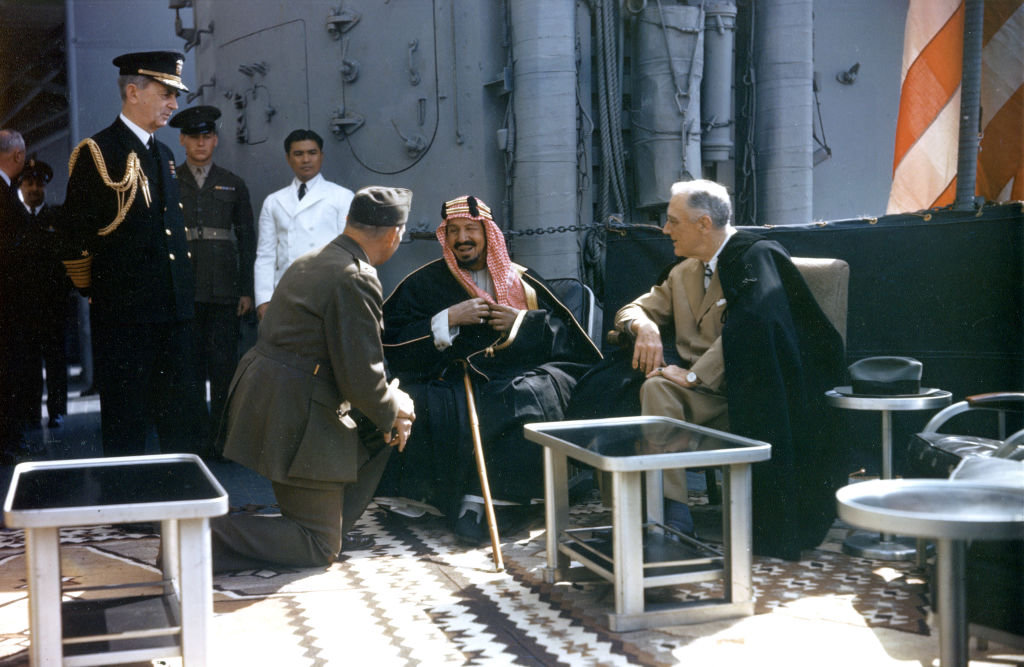
American and European authors continue to this day to describe it as an oil for security agreement, whereas in fact it stipulated not only mutual defense and the training of Saudi Defense forces but also the cooperation in economic, agricultural development and education.
When the war ended and with the rise of communist threats around the world, US insecurity led to the strengthening of the ties between the two countries.
The Kingdom, as the center of the Islamic world, where the two Holy Cities of Islam, Makkah and Madinah are located, was considered by the US government a bulwark against the idolatrous communist ideology.
Although the Soviet Union had been the first country to recognize King Abdulaziz as the ruler of Nejd and Hijaz even before the declaration of Saudi unification in 1932, because of Stalin’s internal purges in the thirties the then Soviet ambassador to the Kingdom was purged and the embassy staff were recalled to Moscow.
It took over 50 years before Saudi-Russian relations were restored. Developments in Palestine and the decolonization of the rest of the Arab World in the 1950s, 60s, and 70s impacted the overall security of the Middle East, not only in Saudi Arabia, but also in the position of the US vis-a-vis Soviet Russia.
Socialist and communist ideology expanded in the world during those years causing deep anxiety and insecurity for the US and its allies, including Saudi Arabia.
The Kingdom, as the center of the Islamic world, where the two Holy Cities of Islam, Makkah and Madinah are located, was considered by the US government a bulwark against the idolatrous communist ideology.
Prince Turki Al-Faisal
Several Arab countries went through military coups leading to the spread of Soviet influence in them and the signing of strategic agreements between those countries and the USSR.
Egypt, Syria and Iraq became treaty partners with the Soviet Union, and socialist and communist ideology spread in these counties and in the independence movements among Palestinian and Yemeni parties.
In fact, a declared Marxist regime was established in what was previously a British protectorate in the south of Arabia, the People’s Democratic Republic of Yemen, along with communist parties in Vietnam, Cambodia, Laos, Somalia, Ethiopia, Mozambique, Angola, Nicaragua and Venezuela coming to power.
The American debacle in Vietnam led to a US retreat from challenging the Soviet expansion.
At the request of American officials, the Kingdom tried to provide help in Vietnam, Somalia, and Nicaragua. In 1974 Saudi Arabia, Egypt, Iran, Morocco, and France formed a unified intelligence unit titled “African Safari” to deal with Soviet expansion in Africa.
Cuba was one of the USSR’s surrogates in expanding its influence worldwide. As early as 1966, Havana hosted what was called the Tricontinental Congress that focused on anticolonial issues.
There were 500 delegates from all parts of the world, and it called for revolutions in Asia, Africa, and Latin America. It opposed globalization and neo-colonialism, as well as the Vietnam War.
It supported the civil rights movement in the US, it condemned apartheid in South Africa and Rhodesia, and highlighted the question of Puerto Rico. It founded the Organization of Solidarity with the People of Asia, Africa, and Latin America.
In fact, Cuba was the conduit of Soviet support for all of the revolutionary movements in the world, from the Tupamaros in Uruguay, to the Popular Front for the Liberation of Palestine, to the Japanese Red Army faction, the Red Brigades in Italy, the Baader Meinhof group in Germany, and many others.
The Soviet menace threatened all non-communist countries. By the 70s, Soviet expansion included Somalia, Mozambique, Angola, and Ethiopia. With the retreat of America from Vietnam, Southeast Asia fell into the communist fold, with South Vietnam, Cambodia and Laos hoisting the red flag.
This communist surge was crowned by the Soviet invasion of Afghanistan in 1979. The Kingdom was not the only country to feel insecure. With the fall of the Shah in Iran, although not a communist takeover, nonetheless, inimical forces to the Kingdom and the West dominated a lot of the World.
The insecurity today comes from the terrorist groups who hoist the flag of independence for Palestine to rally support from those who oppose the Israeli occupation of Palestine.
Prince Turki Al-Faisal
To single out Saudi insecurity is to ignore the alarm bells that rang in the US, Western Europe, and non-communist countries.
The Kingdom worked with Arab allies and Western friends to defend its interests and succeeded in scoring victories with her friends against Soviet encroachment not only in Afghanistan but also in the Congo, where Cuban troops invaded the Congolese province of Shaba from the newly communist regime in Angola.
The late President Sadat, having expelled Soviet advisers from Egypt in 1972, also marked another retreat for Soviet influence in the Arab world. By 1990, the Soviet Union was dissolved and communist ideology retreated everywhere, including from China, one of the main bastions of that ideology.
The insecurity today comes from the terrorist groups who hoist the flag of independence for Palestine to rally support from those who oppose the Israeli occupation of Palestine.
They commit acts of terror worldwide. Russian aggression in Ukraine, the continued colonization and assault on Palestine and its people, the divide between rich nations and poor ones, and the decline in the universal respect for the rules-based order and international humanitarian ideals by the countries in the West who proclaimed those ideals are the main contributors to insecurity.
• Prince Turki Al-Faisal is the former director general of Saudi Arabia’s intelligence agency and a former ambassador. He is also the founder and Trustee of the King Faisal Foundation and Chairman of the King Faisal Center for Research and Islamic Studies.