



ISLAMABAD: Pakistan on Wednesday pledged to continue efforts toward a comprehensive settlement of the US-Iran conflict and urged both sides to uphold a ceasefire announced earlier by US President Donald Trump, as uncertainty lingered over planned talks in Islamabad.
Prime Minister Shehbaz Sharif thanked Trump for extending the truce at Pakistan’s request and said Islamabad would keep working to facilitate dialogue aimed at a lasting resolution.
“On my personal behalf and on behalf of Field Marshal Syed Asim Munir, I sincerely thank President Trump for graciously accepting our request to extend the ceasefire to allow ongoing diplomatic efforts to take their course,” he said in a social media post.
Sharif maintained that Pakistan would continue its “earnest efforts for negotiated settlement” to the war.
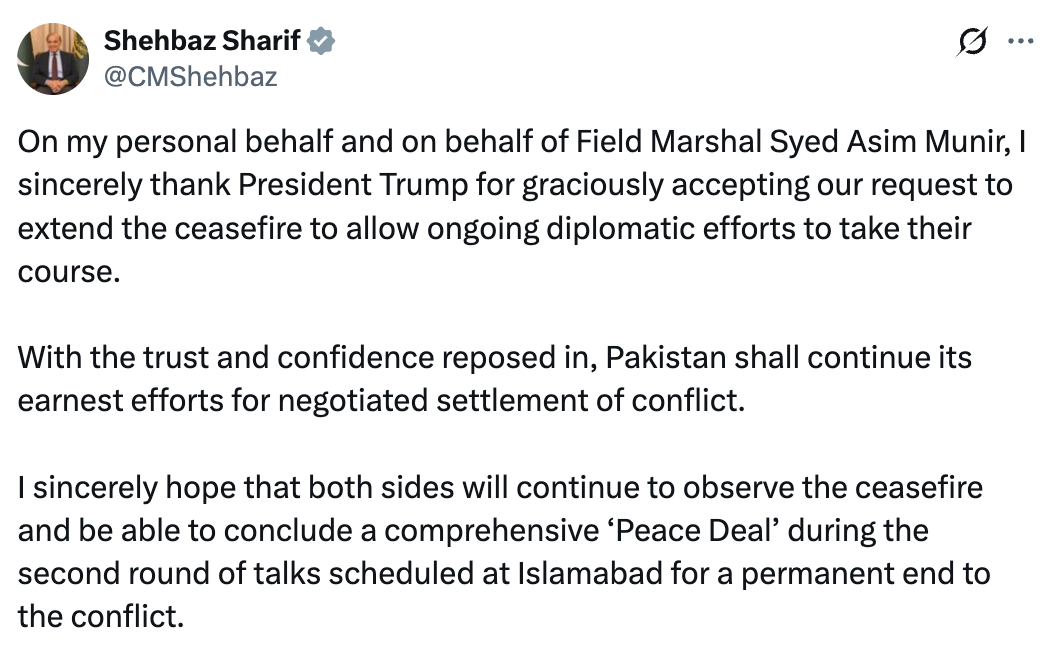
Screenshot of PM Shehbaz Sharif's post on X
“I sincerely hope that both sides will continue to observe the ceasefire and be able to conclude a comprehensive ‘Peace Deal’ during the second round of talks scheduled at Islamabad for a permanent end to the conflict,” he added.
Trump earlier said he had agreed to extend the ceasefire after being approached by Pakistan’s leadership, while keeping US forces on standby and maintaining pressure on Iran.
The extension came as a fragile truce announced on Apr. 8 — following weeks of conflict triggered by US and Israeli strikes on Iran — was due to expire, raising fears of renewed escalation.
The war has disrupted global energy markets and maritime trade, with Iran targeting shipping in the Strait of Hormuz, a key route for roughly one-fifth of global oil and gas supplies, and the United States enforcing a counter-blockade, including the seizure of vessels linked to Tehran.
A first round of direct US-Iran talks held in Islamabad on Apr. 11 ended without a breakthrough, with disagreements persisting over Iran’s nuclear program, sanctions relief and regional security.
Iran has yet to confirm its participation in the second round of talks, with its foreign ministry spokesperson Esmail Baqai saying on Tuesday evening that a final decision had not been made, citing “contradictory messages” and “unacceptable actions” by the United States.





