Riyadh: Learning Arabic has become essential for expatriate employees seeking professional and social integration in Saudi Arabia.
Prof. Saad Al-Qahtani, head of the educational programs sector at the King Salman Global Academy for Arabic Language, confirmed plans to expand the scope of the “Wesal” program to include other Saudi cities, following the success of its first two courses.
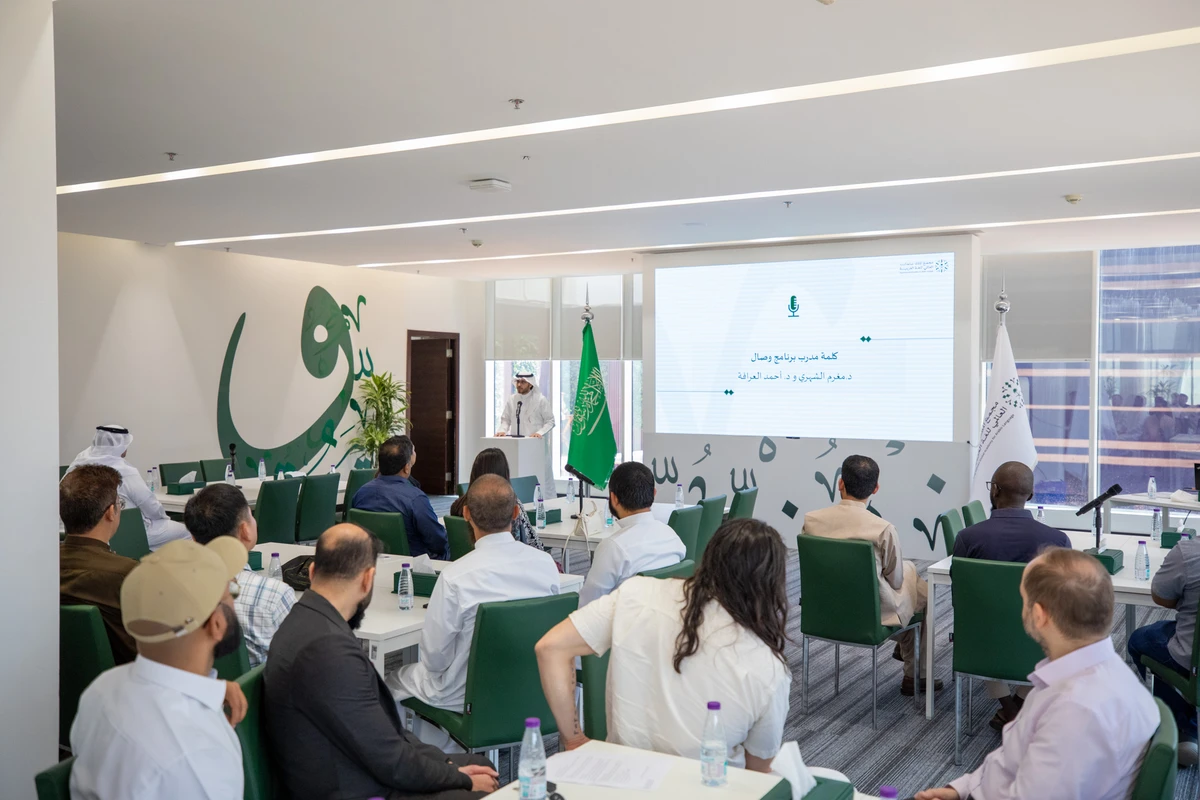
The program, designed for non-Arabic-speaking employees in both the government and private sectors, aims to enable effective communication.
It delivers 60 training hours over three months using a blended learning model (in-person and online).
Al-Qahtani said that the program had achieved a notable impact, enhancing the diversity of nationalities and developing language skills. As a result, the potential for Wesal to expand into other Saudi cities, such as Jeddah and Dammam, continued to grow.
Building on these successes, Al-Qahtani said that the need for Arabic language programs for communication purposes was no longer confined to a specific city. Instead, it was increasingly recognized as a requirement in various work environments across the Kingdom.
To meet this growing demand, he said that the academy was working to build partnerships with government and private entities to ensure the program reached a wider audience.
Al-Qahtani said that while Arabic was an essential gateway to integration, on its own it was not sufficient for full inclusion of residents.
He emphasized that language learning was part of a broader experience, which also included cultural understanding and human interaction.
The program extended beyond language teaching to include cultural activities, he said. For example, the interactions of previous trainees with expressions such as “absher” and “sam” had helped them to connect more closely with colleagues and communicate more smoothly during daily work.
Al-Qahtani said that the program’s success in improving employee performance after only 60 hours was not only reflected in the hours spent but also in the positive impact on trainees’ working lives.
He cited examples of trainees who started with almost no knowledge of Arabic, yet by the end of the second edition were able to deliver speeches to the audience in Arabic.
Al-Qahtani described the transformation as reflecting the impact of continuity and an educational methodology based on practice and genuine communication.
Yasser Aljuwysir, director of public relations and media at KSGAAL, highlighed significant growth in the private sector’s awareness of the program’s value.
Aljuwysir said that the academy was now receiving increased interest from entities and companies seeking to implement it.
The National Policy for the Arabic Language, recently approved by the Council of Ministers, represents an important step in enhancing Arabic’s presence and in raising awareness among entities about the importance of empowering their non-Arabic-speaking employees, he said.