
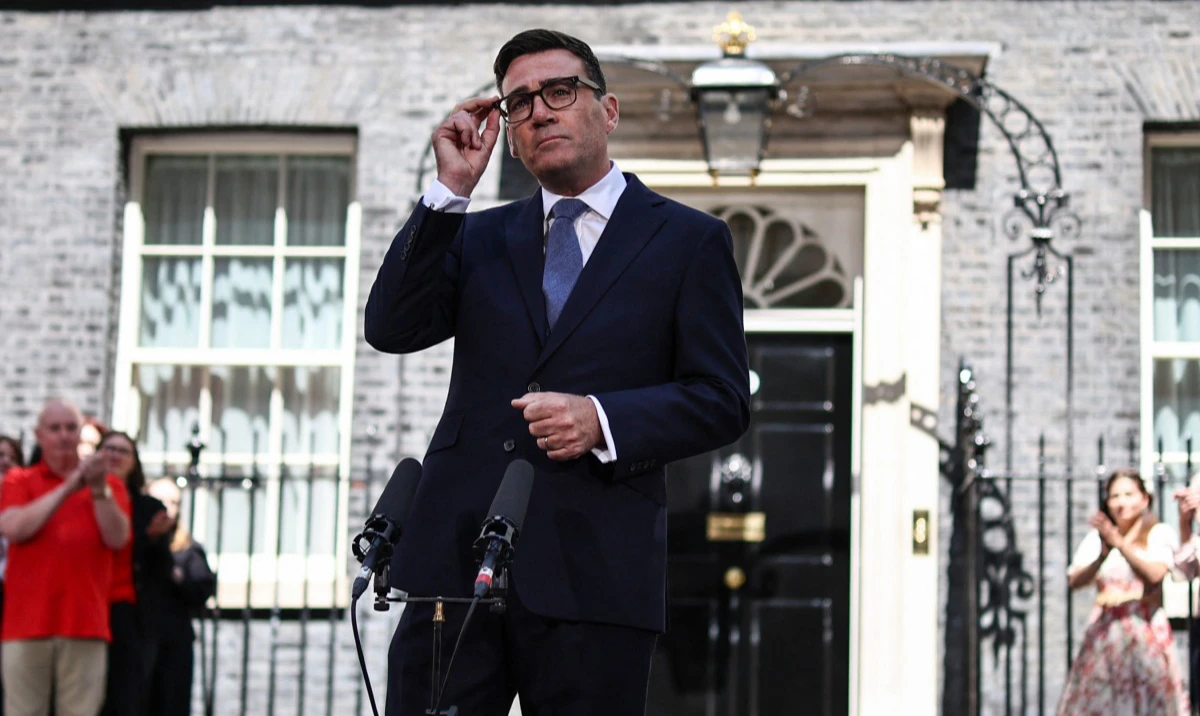

The most predictable outcome of the Labour Party leadership contest — to become its next leader and, with it, the coveted prize of becoming the UK’s prime minister — was confirmed last Friday. The winner was the newly elected MP for Makerfield and former mayor of Greater Manchester Andy Burnham. He secured the backing of 379 of Labour’s 403 MPs, along with overwhelming support from the trade unions, making the contest resemble more of a coronation than a genuine political race.
Now that the “easy” part is over and Burnham on Monday succeeded Keir Starmer as resident of 10 Downing Street, the real work begins. Burnham inherits not only the office but also the immense weight of public expectation.
He is being welcomed not simply as a new leader but almost as a political savior.
That means Burnham must hit the ground running if he is to fulfill even some of those expectations. Although he is one of the best-known figures in British politics, he has been absent from Westminster for almost a decade. He barely knows any of Labour’s MPs, most of whom entered Parliament after the party’s landslide victory in 2024.
Politics is a profession with a remarkably short memory: what matters is not how successful one was in winning the previous election but whether colleagues believe you can lead the party to victory at the next. With less than three years until the next general election, that reality is bound to shape Burnham’s priorities, as well as those of his newly assembled Cabinet, at least to some extent.
Prime ministers come and go, bringing different leadership styles and priorities. What changes far less easily are the scale and complexity of the challenges they inherit. There are clear limits to what any British prime minister can influence internationally, though their impact should not be ignored. Domestically, however, Burnham signaled in his acceptance speech that the country requires a comprehensive reset in many areas.
This first speech was largely about seeking common ground within the party and, wherever possible, with rival parties. Equally important was his commitment to empowering every region of the UK, rather than concentrating opportunity in one part of the country, and him not being afraid to challenge the thus-far-untouchable Thatcher era and float the need for reindustrialization.
Unlike his predecessor, Burnham possesses a difficult-to-define political asset: he has been able to project trust and optimism, even before detailed policies have been unveiled. In his acceptance speech, he pledged to have the “courage to fix the big things that politics has neglected,” while promising to keep both his own and his party’s ears to the ground. However, it has not simply been a lack of courage that has prevented reform but a shortage of long-term vision that has also hindered the country’s ability to maintain its position as one of the world’s leading middle powers.
The problems are both tangible and perceptual. Britain’s aging infrastructure requires major investment, but so too does its national mindset. Too often, privilege of birth continues to shape opportunity, while wealth creation, cultural influence and economic prosperity remain heavily concentrated in London, the southeast and a handful of other prosperous enclaves elsewhere, rather than being replicated across the country.
One factor that may serve Burnham well is his near-decade-long tenure as mayor of Greater Manchester.
Yossi Mekelberg
One factor that may serve Burnham well is his near-decade-long tenure as mayor of Greater Manchester, where he oversaw the transformation of one of Britain’s largest city regions. That experience gave him far closer contact with the everyday concerns of ordinary people than many recent prime ministers have enjoyed.
Although often described as being on the left of the Labour Party, Burnham demonstrated throughout his mayoralty that he is fundamentally pragmatic. He worked with the private sector to expand affordable housing while maintaining constructive relationships with businesses. At the same time, he was prepared to bring Greater Manchester’s bus services back under public control, increasing services and introducing capped fares without nationalizing the operators themselves.
His approach, as outlined in his acceptance speech, is to support business without allowing economic growth to come at the expense of working people or to widen the gap between the wealthiest and everyone else.
There is no magic formula for government, nor are there quick fixes. The public’s priorities are hardly a mystery. People want to see public services improve at a pace they can actually feel. They want affordable housing after decades of soaring house prices and rents that have placed enormous pressure on household finances. They want secure employment at a time when technological change increasingly threatens traditional jobs.
Burnham’s proposal to relocate parts of Whitehall to Manchester may strike some as symbolic politics, a gimmick, but there is a practical logic behind it. In a country where geographical inequality remains deeply entrenched, moving parts of government closer to the communities they serve could help rebalance both decision-making and economic opportunity.
The transition from leading a city, even if it is one of Britain’s largest, to governing the country could never be straightforward. One of the greatest challenges facing any new prime minister is the unavoidable pull of international affairs. Whether dealing with the war in Ukraine, instability in the Middle East or other global crises, foreign policy inevitably consumes a significant share of a prime minister’s attention. Yet that cannot come at the expense of addressing domestic concerns.
Burnham must remain engaged with the daily challenges facing citizens while also managing a parliamentary party whose MPs expect to be heard and whose constituents expect their concerns to be represented. All this unfolds under relentless scrutiny from both traditional media and an increasingly influential social media landscape.
New prime ministers enjoy only a brief political honeymoon and Burnham’s is likely to be even shorter given the unusual circumstances in which he assumed office. To establish his premiership successfully, people in every part of the UK must quickly feel that something has changed for the better. Whether through shorter National Health System waiting times, improved transport, better schools, more secure employment or lower crime, voters will judge his government by tangible improvements rather than lofty rhetoric.
Above all, Burnham must restore a belief among people across these islands that their prime minister understands their concerns, has their interests at heart and remains connected to the realities of everyday life. If he can achieve that, the hardest part of becoming prime minister may ultimately prove worth the effort.
• Yossi Mekelberg is a professor of international relations and an associate fellow of the MENA Program at Chatham House.
X: @YMekelberg


