
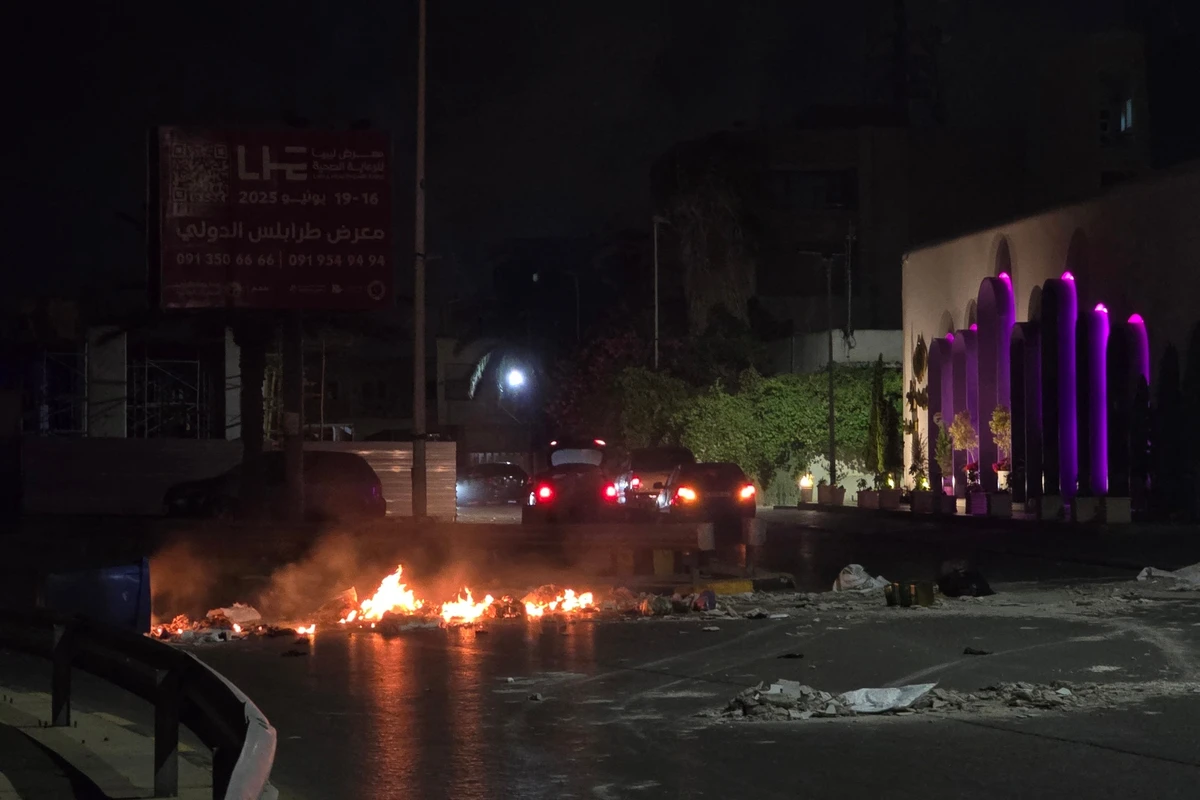

The latest protests in Tripoli and across western Libya did not begin with a sweeping political slogan. They were triggered by something far more immediate: prolonged power cuts during an intense summer heatwave.
Yet once protesters took to the streets, their demands quickly moved beyond electricity. What began as anger over a failing public service developed into a confrontation with an entire political system that, in the eyes of a growing number of Libyans, has lost any convincing justification for its continued rule.
The organizers did not target hospitals, ambulances or other humanitarian services. Instead, they used earth barriers to close government institutions and publicly owned companies, including telecommunications offices and the Audit Bureau, while threatening to extend the action to branches of the Central Bank of Libya. In Zawiya, protesters announced the suspension of work at several public institutions and facilities, while explicitly exempting hospitals and emergency services.
In this sense, the barriers were no longer merely a means of closing a building or disrupting an institution; they became a symbolic withdrawal of public recognition from bodies that protesters no longer regard as capable of serving citizens or representing them.
When the General Services Company made moves to remove the barriers and reopen the buildings, protesters warned it against doing so and threatened further escalation. This exposed the most dangerous question raised by the unrest: who actually has the power to open and close state institutions — the government, the people on the streets, or the armed groups operating in the space between them?
If public spending has been unified but electricity has not improved, where has the money gone?
Dr. Abdellatif El-Menawy
Electricity was the spark but cannot, in itself, explain the eruption. Behind the protests lie a long accumulation of political, administrative and security failures: the collapse of the planned December 2021 elections; the continued rule of Prime Minister Abdul Hamid Dbeibah’s government under the banner of a transitional phase that was supposed to be temporary; the proliferation of weapons; deteriorating public services; and mounting allegations of corruption and mismanagement of public funds.
The most significant feature of the protests is the fact that the anger is no longer directed solely at Dbeibah and his Government of National Unity; protest statements have also held the House of Representatives, the High Council of State, and the Presidential Council responsible, while calling for the removal of the existing political bodies and an end to the current transitional arrangements.
This shift deserves attention. It suggests that sections of the Libyan public are beginning to move beyond the familiar east-west divide in the country. They no longer see the conflict simply as a confrontation between two competing political projects, but increasingly as a network of overlapping interests among forces that sometimes fight one another but at other times share power and resources.
For years, the political elite in Libya have used division as an argument for their own survival. The government in Tripoli invokes international recognition. The House of Representatives in the east clings to an electoral mandate dating back to 2014. The High Council of State derives its continued existence from political arrangements now more than a decade old. Armed groups, meanwhile, impose their own legitimacy on the ground.
All of these actors claim to support an end to the transitional period. Yet few appear willing to risk elections that might remove them from power.
Public frustration has been heightened by the fact that Libya approved its first unified budget in 13 years last April, worth approximately 190 billion Libyan dinars ($29.7 billion). It was presented as a step toward the unification of state institutions, improved financial stability and the restoration of public services. Yet Libyans entered the summer facing darkness and deteriorating infrastructure.
The question for ordinary citizens is therefore inevitable: if public spending has been unified but electricity has not improved, where has the money gone? What value does financial reconciliation have if it produces no visible change in people’s daily lives?
In the background, international and regional initiatives are also seeking to rearrange Libya’s political order. Among the formulas reportedly under discussion is one that would retain Dbeibah as prime minister while giving Saddam Haftar a central role in managing the next phase.
To outside actors, such an arrangement might appear to offer a practical compromise between the eastern and western camps, particularly if it helps to unify state institutions and increase oil production. To many Libyans, however, it could look less like a national settlement than an agreement between powerful families to redistribute authority among themselves, rather than return it to the electorate.
It is against this broader atmosphere of distrust that the continuing uncertainty surrounding the assassination of Saif Al-Islam Qaddafi must be understood. His killing on Feb. 3 was not a direct cause of the present protests, but it has become part of a wider climate of suspicion and declining confidence in Libya’s political and judicial institutions.
Prosecutors announced that they had identified three suspects and the vehicles used in the crime, and arrest warrants had been issued. Yet the suspects’ names have not been disclosed, it remains unclear whether any of them have been detained, and neither the group behind the assassination nor its political motive has been revealed.
The most immediate danger is that an armed group might intervene to suppress the demonstrations.
Dr. Abdellatif El-Menawy
The investigation might therefore have made procedural progress but it has not answered the central question: who decided to eliminate Qaddafi, and who benefited from his death? Whatever one’s view of his political record or his role in the events of 2011, he represented a political and social constituency that could not simply be ignored. He was also a potential presidential candidate capable of disrupting the calculations of the dominant factions.
His assassination, followed by the opacity surrounding the investigation, has reinforced the perception that Libya’s political process is still governed by the removal of rivals rather than competition at the ballot box.
It would nevertheless be premature to describe the current unrest as a nationwide Libyan uprising. Its center of gravity remains Tripoli and the west; no movement of comparable scale and intensity has yet emerged simultaneously in Benghazi, the eastern cities or the south.
Nor is there a unified national leadership or a clear road map for what should replace the institutions the protesters want removed. That is a fundamental weakness. Bringing down existing bodies without an agreed alternative could recreate the same vacuum that has fueled Libya’s divisions for the past 15 years.
The most immediate danger is that an armed group might intervene to suppress the demonstrations, or that one of the competing factions will try to exploit the streets to settle scores with Dbeibah. Civil disobedience could then turn into an armed confrontation. The protesters would lose their independence, and their demands would become another instrument in the rivalry among Libya’s armed power centers.
A genuine national turning point would come only if independent protests spread to Misrata, Benghazi, Sabha and other cities in the east and south, converging around a clear demand: the termination of all transitional authorities and the creation of credible legal and security guarantees for elections in which no candidate is excluded by force and no result can be overturned by weapons.
What is happening in Libya is therefore not yet a completed revolution. But it is far more than an electricity crisis. It is a warning that the political formula governing the country is approaching the limits of its ability to survive.
Power cuts ignited the protests but the real fuel is a growing conviction among Libyans that division has become a permanent mechanism for protecting the political elite, and that settlements promoted in the name of stability might amount to little more than another rearrangement of seats among the same dominant forces.
- Dr. Abdellatif El-Menawy has covered conflicts worldwide. He is the author of “The Copts: An Investigation into the Rift between Muslims and Copts in Egypt.”
X: @ALMenawy


