
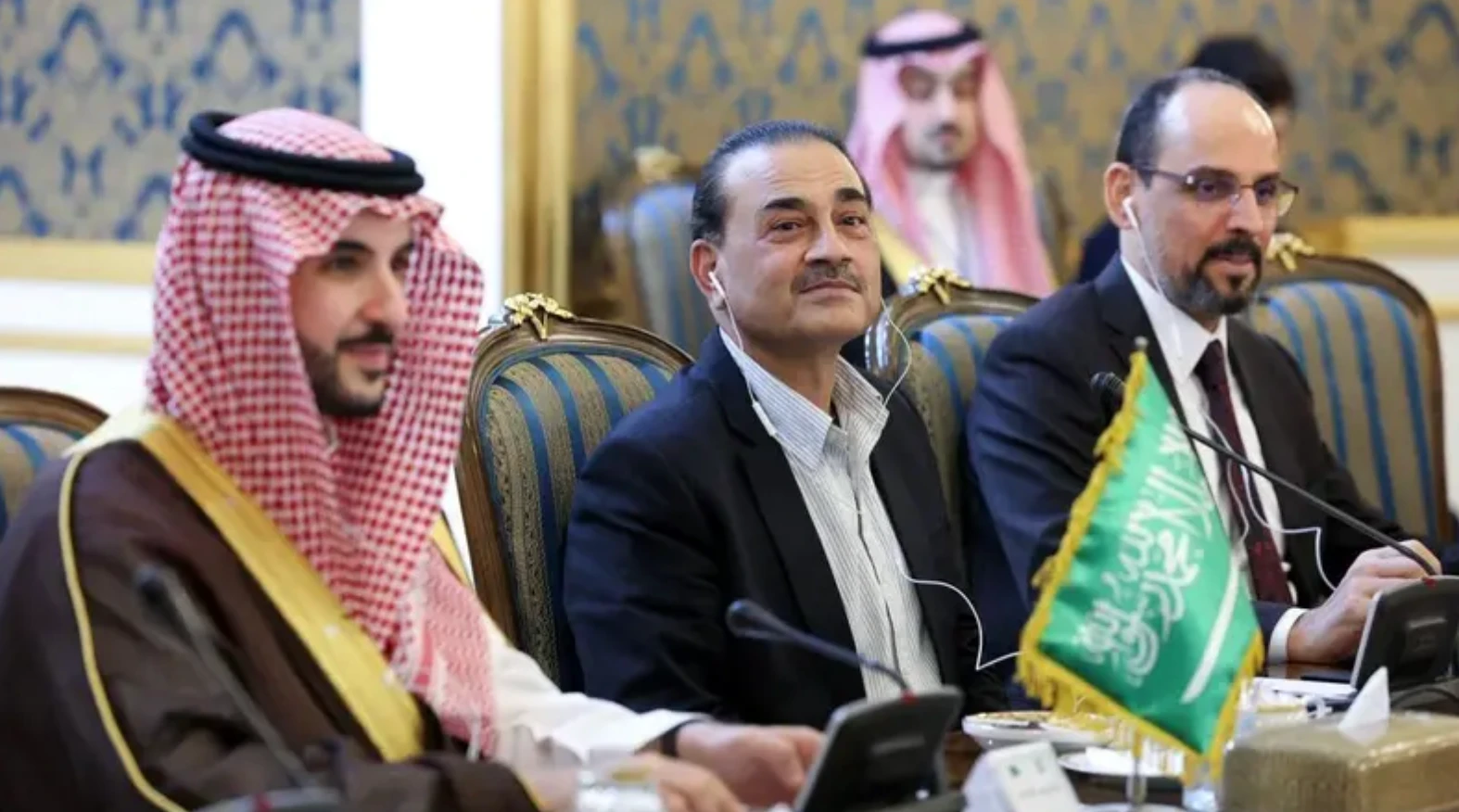

The surprise visit by the Makkah Pact senior officials — Saudi Arabia, Pakistan and Turkiye — to Tehran left many wondering: What can three capitals with different equities but a shared concern actually achieve in Tehran, and at this late hour?
The answer is both modest and crucial.
The visit represents an opportunity to apprise Iran of the facts and risks, and the need to act wisely and realistically, and to spare its people and the region the consequences of escalation. This is particularly true when a destructive US-Israeli campaign seems more imminent than ever.
This is not speculation. As CNN reported this week, US officials said American forces in the Middle East are prepared to launch new, potentially major, military operations against Iran “within 96 hours of receiving” an order from President Donald Trump. Sufficient forces are now deployed in the region to carry out the potential attacks, the sources said. And the scope, crucially, would likely go beyond efforts to simply “mow the lawn” — striking radars and launchers that can be quickly reconstituted — as has been the case since Trump halted full combat operations earlier this year.
In other words, this third round, if it happens, is not about managing the nuclear file. It is about ending it, and possibly many other things along the way.
So, who will compromise?
Well, both sides will have to give up something, as both sides have something to lose. The only difference is that Saudi Arabia takes losses, both its own and the region’s, into consideration — civilian, economic and strategic. I am not sure the same can be said for the ideologues in Tehran who consider enrichment a red line and refuse to send a gram of enriched uranium abroad.
The ball is now in Iran’s court. Will Tehran choose to come closer to Makkah — to realism, to the neighborhood, to international law — or will it risk chaos not just for itself but for the whole region?
Faisal J. Abbas | Editor-in-Chief
What was acceptable under Barack Obama in 2015 — 3.67 percent enrichment with a portion shipped to Russia — is now unacceptable to Trump. His position is zero enrichment, transfer of all stockpiles to America and the dismantling or severe restriction of facilities. Tehran, meanwhile, refuses both. Trump has also made it clear that if he does not get what he wants through negotiations, he will not hesitate to use brute force.
The distance between the two positions is vast. But that is exactly why the Makkah Pact matters.
Since its inception, the Kingdom has walked the fine line between diplomacy and deterrence. It has bravely and with high accuracy managed to protect itself, its holy sites and its people from missiles and drones, while keeping the door to de-escalation ajar. However, an unprecedented US-Israeli attack will have unprecedented consequences, whether or not it is militarily successful — for energy, for navigation, for the entire region.
This is why a last-ditch attempt to avert war is not weakness. It is wisdom.
Still, there are limits to what the Makkah Pact side will accept, and they must be stated clearly. Any discussion about regional security must be based on respect for the UN Charter, international law and the Charter of the Organization of Islamic Cooperation. That includes a concrete commitment: ceasing interference in Arab affairs, stopping support for militias and attacks, and ensuring freedom of navigation and its security.
This is the minimum for any regional order worth its name.
The ball is now in Tehran’s court. Eight days before the US midterms, the clock described by CNN is ticking. Will Tehran choose to come closer to Makkah — to realism, to the neighborhood, to international law — or will it risk chaos not just for itself but for the whole region?
Faisal J. Abbas is the Editor-in-Chief of Arab News. X: @FaisalJAbbas


