
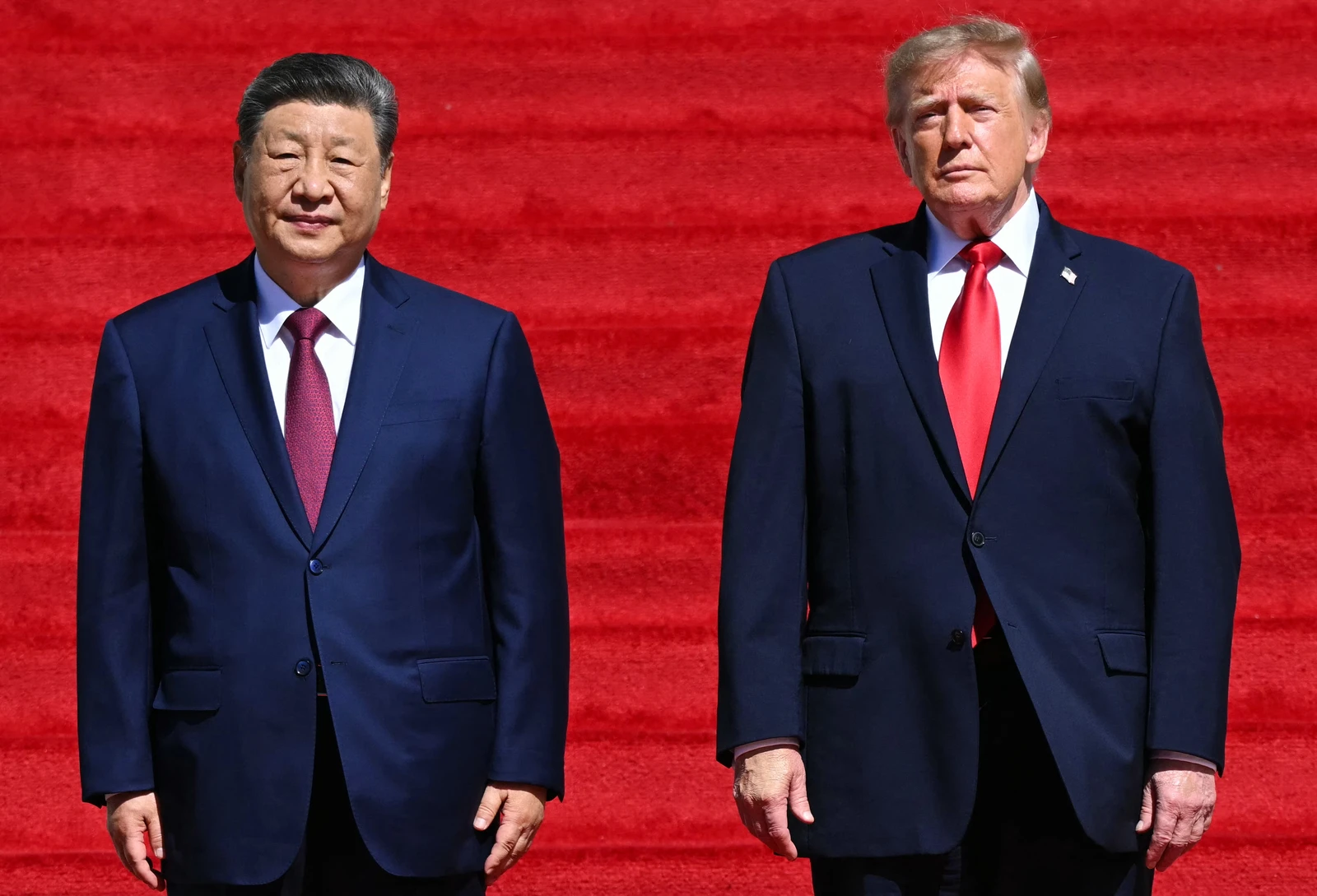

US President Donald Trump and his Chinese counterpart Xi Jinping may meet each other more times in 2026 than in most previous years. However, the bilateral relationship remains very fragile.
The pair met in China in May, in Washington in September and could meet at least twice more this year, in November and December. Yet, despite all the pomp and pageantry of their recent meetings, including Trump’s assertion that “tremendous strides” have been made and “we’ve never gotten along better,” comparatively little has been agreed, with much kicked into the long grass.
At best, the September session was a stability summit that left lots of key, unfinished business for the two leaders. Certainly, it was not the breakthrough event that the US president hinted at and competition between the two powers remains as intense as ever.
For instance, Beijing offered no big new help for Washington with resolving the Iran crisis. Moreover, on artificial intelligence, it is unclear how meaningful the new “US-China Super Intelligence Dialogue” will be in terms of exchanging views on risks and the benefits of AI, despite the opening of a bilateral “communication channel” to report AI incidents.
The wider lack of progress includes the very short extension, until January 2027, to the two countries’ trade truce, which was originally agreed in October 2025. That economic bargain saw Beijing pause its new rare-earth export restrictions for 12 months and agree to purchase more US agricultural products, while Washington agreed to reduce overall tariffs on Chinese goods by 10 percent.
At best, the September session was a stability summit that left lots of key, unfinished business for the two leaders
Andrew Hammond
US-China bilateral trade was already about 30 percent down to just under $415 billion last year. There seems little chance that trade flows will reach the 2022 peak of about $690 billion for at least the remainder of Trump’s presidency, which constitutionally ends in January 2029.
The short truce extension, which could presage significant market uncertainty later this year, has also disappointed many business groups that had hoped for more than a sticking plaster.
September’s trip underlined the changing balance of power between the US and China and how much Xi is now appearing to outsmart Trump. On the first issue, a defining moment of September’s visit was Trump’s decision to greet Xi on arrival at Joint Base Andrews with an approximately 30-meter red carpet, plus a 21-member honor guard and military flyover. This highly unusual, deferential greeting cemented the perception of Xi in China and much of the rest of the world as at least Trump’s equal.
On the second point, Xi appears to have found a formula to manage the mercurial nature of the US president. This includes the Chinese president’s apparent unwillingness to respond to his US counterpart’s flattery. Trump called Xi and his wife “outstanding” and the September trip “one of the biggest and most beautiful events to take place in many years.” This is the language most previous US presidents would have reserved for their most trusted partners.
Even before the visit began, the Chinese president took a leaf out of his counterpart’s playbook. He had threatened to pull out of the big event over potential major US arms sales to Taiwan, which he has long called a “red line” in bilateral relations.
Xi’s move blindsided the US president and piled the pressure on the White House, given that he badly needs diplomatic wins
Andrew Hammond
The backstory to the flare-up is that, last December, the Trump team announced an $11 billion arms package for Taipei. A separate one, worth a reported $14 billion, has been held up, with the US president asserting in the spring that it is a “bargaining chip” and his final call “depends on China.”
Xi’s move blindsided the US president and piled the pressure on the White House, given that he badly needs diplomatic wins. September’s summit had offered one of the last remaining chances for him to potentially show global statesmanship ahead of the US midterm elections.
Clearly, Xi is trying to master some of Trump’s own negotiating tactics and show “The Art of the Deal,” the title of Trump’s 1987 bestselling book, on the global political stage. This includes being unpredictable to keep counterparts guessing in a bid to gain the upper hand, plus using leverage to find and exploit pressure points, including on Iran.
This has made it even more difficult for any big bilateral breakthroughs, from trade to AI. This is despite onlookers like Sen. Bernie Sanders using Trump-type language to argue the US president should try to secure the “deal of the century” with Xi by agreeing a pause agreement on advanced AI.
Taken together, this year’s US-China diplomacy shows the changing bilateral balance of power, with Xi increasingly appearing to have the upper hand. Trump’s “The Art of the Deal” approach may have been a winning formula for him in the business world of 1980s New York, but it is proving much more difficult to translate into sustained success for the US in today’s increasingly complex global landscape.
Andrew Hammond is an associate at LSE IDEAS at the London School of Economics.


