Cornered against a wall and with a steel hook pushed around his neck, the dog emits a savage howl in a desperate attempt to fight free, but poison will soon be forced into his mouth as Kabul’s cull of strays claims another kill.
About 17,600 dogs were poisoned last year by municipal workers in the Afghan capital in an effort to protect residents from disease and to control the rocketing population of canines that roam the city’s streets and open ground.
The method of killing is brutally effective.
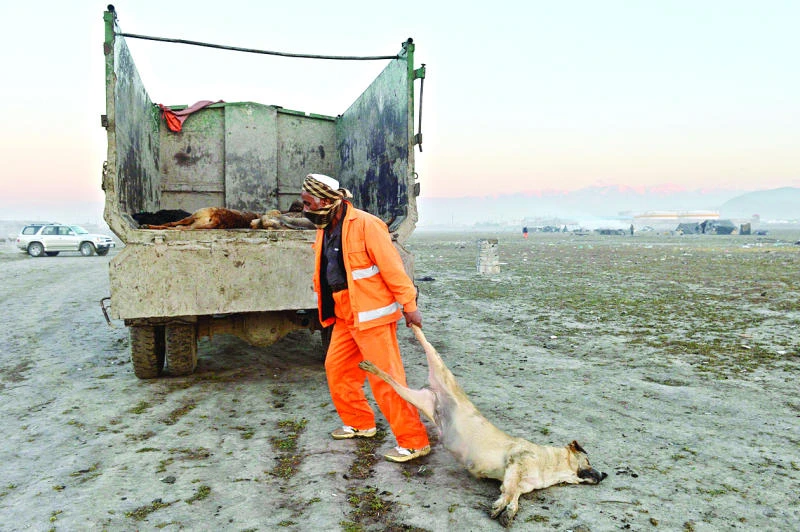
Teams of dog-catchers wearing orange suits use long steel hooks, wooden bars and large nets to ensnare their prey with practiced skill.
A heavy boot is put on the dog’s neck, and a spoon is used to press deadly strychnine into the mouth and gums.
Then the dogs are tied to ropes, and die within an hour in spasms of agony.
Alternatively, poisoned meat is left out at night and by morning the ground is littered with corpses.
The dogs, sometimes showing the final flickers of life, are thrown into the back of a truck and dumped on waste tips on the city outskirts.
“Every day, after evening prayers, we do this mass poisoning program, working until 10:00 pm, and we come back at 3:00 am,” said dog-catcher Islamuddin.
“We find these dogs, poison them and dump them where they will be buried.”
Like many residents in the Pul-e-Charkhi neighborhood where he works, Islamuddin has no qualms about killing dogs as part of a city policy that is widely seen as a necessary health precaution.
It is uncertain how many strays have rabies in Kabul, but the disease is much feared as it is often fatal to humans if they are bitten or scratched by an infected dog. Riaz Gul, from the nomadic Kuchi tribe that has a small camp in Pul-e-Charkhi, believes his 12-year-old son’s recent death was caused by a dog bite.
“He was bitten on his arm, and then after about 50 days he started to seem crazy and get ill,” he said.
“I took him to a doctor and mullah, but to no avail, and he died. “Of course, I am scared of the dogs. About 200 of them live in packs in this area.”
Wherever the dog-catching team works, locals gather to watch the animals be trapped, poisoned and then die a slow death. Dogs are regarded as unclean in Islam, and in Afghanistan they are generally only kept as guard dogs or for organized dog fights rather than as domestic pets.
“They attack people going to the mosque and children walking to school. They spread disease,” said Nasser Ahmad Ghori, director of the Kabul city sanitation department.
Afghanistan’s ruthless dog cull